July 9, 2020

All in the Family: Donald Trump

Trump’s worldview forged by neglect and trauma at home, his niece says in new book


WASHINGTON POST


A tell-all book by President Trump’s niece describes a family riven by a series of traumas, exacerbated by a daunting patriarch who “destroyed” Donald Trump by short-circuiting his “ability to develop and experience the entire spectrum of human emotion.”


President Trump’s view of the world was shaped by his desire during childhood to avoid his father’s disapproval, according to the niece, Mary L. Trump, whose book is by turns a family history and a psychological analysis of her uncle.

[When she writes in her prologue that “Donald has been institutionalized for most of his adult life,” she isn’t referring to mental health treatment. “Institutionalization” here refers to the gilded cosseting provided by the family name and fortune that ensured Donald would never have to survive by his own wits in the real world.--NY TIMES ]

[Mary describes how the five Trump children of her father’s generation all struggled to make do in a household where their mother’s chronic health problems left them at the mercy of a patriarch who was both uncaring and controlling. The oldest, Maryanne, was the uptight good girl; Freddy was the laid-back rebel; Elizabeth was the unassuming middle child; Rob was the baby, quiet and eager to please. And Donald, the second-youngest, was Donald: ingratiating to his father, disobedient to his mother and bullying to his younger brother, stealing little Rob’s favorite toy trucks and goading him into kicking a hole in the bathroom door--.NY TIMES  ]

[Mary writes of Donald's mother that “… she was the kind of mother who used her children to comfort herself rather than comforting them. She attended to them when it was convenient for her, not when they needed her to. Often unstable and needy, prone to self-pity and flights of martyrdom, she often put herself first.” She was “emotionally and physically absent,” she writes “The five kids,” she says, “were essentially motherless.”--POLITICO ]

[Mary sketches Fred Trump as a callous, sneering, domineering, lying, cheating, vindictive, workaholic bigot. (He didn’t rent apartments to die Schwarze, which is how he referred to Black people, employing his first language of German. He also frequently used the phrase “Jew me down,” a pejorative term for haggling for a lower price.) He was in the end, a “torturer,” “an iron-fisted autocrat,” “a high-functioning sociopath” who equated kindness with weakness and favored his second son at the disastrous expense of his four other children—particularly his namesake, Fred Jr., who “wasn’t who he wanted him to be” and was “dismantled” because of it.--POLITICO ]

She writes that as Donald matured, his father came to envy his son’s “confidence and brazenness,” as well as his seemingly insatiable desire to flout rules and conventions, traits that brought them closer together as Donald became the right-hand man in the family real estate business.


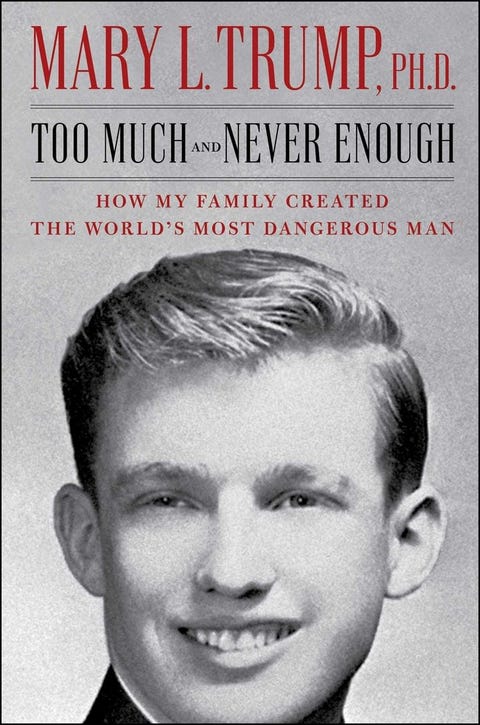
 Mary L. Trump, a niece of President Trump and the author of “Too Much and Never Enough: How My Family Created the World’s Most Dangerous Man,” published by Simon & Schuster. (Peter Serling/Simon & Schuster)
Mary Trump’s father, Fred Jr. — the president’s older brother — died of an alcohol-related illness in 1981, when she was 16 years old. President Trump told The Post last year that he and his father both pushed Fred Jr. to go into the family business, which Trump said he now regrets.

The book marks the first time that a member of Trump’s family has published such a memoir, providing an often bitter and blistering insider account of the forces that shaped Donald Trump, and so alarming the family that the president’s brother tried to block its publication in court. Mary Trump has long been estranged from the family after a dispute over her inheritance and other matters.

While the arc of Trump’s life has been well-chronicled, Mary Trump, 55, provides new details of family fights and recriminations, and she infuses the volume with her background as a clinical psychologist to analyze her uncle. Ahead of the July 14 publication date, the book became an instant bestseller based on advance orders, underscoring the intense interest among the public in the forces that shaped the man who became president. 


 Robert Trump, left, joins his brother Donald Trump at an event in New York on Nov. 3, 1999. (Diane Bondaress/AP)
The book, “Too Much and Never Enough: How My Family Created the World’s Most Dangerous Man,” chronicles the fruitless efforts by Mary’s father, Fred Jr., to earn his father’s respect as an employee. His younger brother Donald reliably ridiculed him as a failure who spent too much time following his passion, aviation. Fred Jr. subsequently left his job in real estate to become a pilot for Trans World Airlines.
Donald escaped his father’s contempt, Mary Trump writes, because “his personality served his father’s purpose. That’s what sociopaths do: they co-opt others and use them toward their own ends — ruthlessly and efficiently, with no tolerance for dissent or resistance.”
Too Much and Never Enough" Donald Trump Moments — Revelations From ...
[The sanitized version of the family myth is that Fred Trump valorized the importance of hard work, but Mary says this simply isn’t true. Fred’s real estate business depended on political connections and government largess; what he taught the Trump children to revere was not so much effort as dominance. “The person with the power (no matter how arbitrarily that power was conferred or attained) got to decide what was right and wrong,” Mary writes. The world was a zero-sum death match between winners and losers. Mary explains how a child would experience such life lessons as confusing, terrifying and stultifying. Her father, the eldest son, tried to resist, becoming a commercial pilot before despair and alcoholism crushed his career, his marriage and his health; he died of a heart attack at 42, when Mary was a teenager.--.NY TIMES ]

[Fred Trump Sr. could be brutal to his namesake, shouting at him once as a group of employees looked on, “Donald is worth ten of you,” Ms. Trump writes. Ms. Trump tells the story in her book about how his family sent him to the hospital alone on the night of his death. No one went with him, Ms. Trump writes. Donald Trump, she added, went to see a movie.--NY TIMES ]

The president, Mary Trump says, is a product of his domineering father and was acutely aware of avoiding the scorn that Fred Sr. heaped on the older brother, Freddy. “From an early age, Mary Trump writes, the future president demonstrated a willingness to cheat and a penchant for ridicule, once telling a neighborhood girl how “disappointed” he was by where she attended boarding school.
After graduating from military school, then living at home with his parents and commuting to Fordham University, Donald decided to apply to the University of Pennsylvania, which he perceived as a more prestigious school, but worried that his grades alone wouldn’t win him entry.
Mary Trump writes that Donald’s sister Maryanne “had been doing his homework for him” but that she couldn’t take standardized tests in his place. “To hedge his bets, he enlisted Joe Shapiro, a smart kid with a reputation for being a good test taker, to take his SATs for him. . . . Donald, who never lacked for funds, paid his buddy well.”

Trump was friends with a young man named Joe Shapiro when he attended the University of Pennsylvania. If Mary Trump is referring to that person, he is deceased, according to Shapiro’s sister, Beth Shapiro. She said in a telephone interview that her brother did not meet Trump until they both attended the Philadelphia school, and thus, she said, the timing the book describes does not make sense. “My brother never took a test for anybody else in his entire life,” she said.
Reached by phone, Shapiro’s wife, former tennis star Pam Shriver, said her late husband never said he had taken a test for Trump, nor did she believe he would. 
For years, Donald Trump said his admittance to what was then called the Wharton School of Finance at the University of Pennsylvania was proof that he was a “super genius.” The Post reported last year that the admissions officer who interviewed Trump was a close friend of Fred Jr., that many applicants to the school were admitted at that time and that the admissions officer did not see any evidence that Trump was a “super genius.”
Mary Trump writes that her grandfather’s children routinely lied to him, but for different reasons. For her father, “lying was defensive — not simply a way to circumvent his father’s disapproval or to avoid punishment, as it was for the others, but a way to survive.”
For her uncle Donald, however, “lying was primarily a mode of self-aggrandizement meant to convince other people he was better than he actually was,” Mary Trump writes.
She wrote that her father had a “natural sense of humor, sense of adventure, and sensitivity,” which he worked hard to hide from the family patriarch.
“Softness was unthinkable in his namesake,” she writes. Mary writes of the way her grandfather treated her father. Fred Sr. “would mock him. Fred wanted his oldest son to be a ‘killer.’ ”

Donald, 7½ years younger than his brother, “had plenty of time to learn from watching Fred humiliate” his eldest son, Mary Trump writes. “The lesson he learned, at its simplest, was that it was wrong to be like Freddy: Fred didn’t respect his oldest son, so neither would Donald.”

[She says her uncle has the emotional maturity of a 3-year-old and has “suffered mightily,” burdened by what she calls an insatiable “black hole of need.” He was trained to hunger endlessly for daddy’s approval; it’s just that now, as president of the United States, she says, the figures who remind him of home are Vladimir Putin and Kim Jong-un. She believes he has a substance-induced sleep disorder induced by the dozen daily Diet Cokes he drinks. --NY TIMES ]


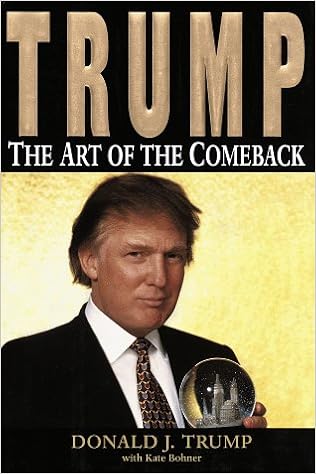
This was not Mary Trump’s first effort to write about her uncle. Decades ago, she writes, Donald Trump asked her to help write his book “The Art of the Comeback.” She says she did research and tried to interview her uncle, but he kept putting her off, and the publisher eventually sought someone with more experience as a co-author. The anecdote underscores that Mary Trump’s relationship with her uncle was, at times, a close one.
Trump: The Art of the Comeback: Donald J. Trump, Kate Bohner ...
But the relationship fell apart when she learned that Donald and his siblings were trying to prevent her and her brother, Fred III, from receiving most of what they believed they would inherit from Fred Sr. If her father had lived, he would have expected to get 20 percent of the estate, she writes. Instead, she says, the Trump family intended to give her “less than a tenth of one percent of what my aunts and uncles inherited.”
While Mary Trump says she and her brother challenged the will, she does not reveal how much she eventually received, which is covered by a confidentiality agreement. Robert Trump, the president’s younger brother, filed a petition seeking to stop publication of the book by citing that agreement, but the New York Supreme Court last week lifted a temporary restraining order against publisher Simon & Schuster.

[In the book, it turns out that Uncle Rob has only a bit part to play — the youngest child of five who took the path of least resistance, sliding into the executive chair of his father’s business, a mostly passive bystander to the central drama between Donald and Mary’s father, Freddy. Still, Mary doesn’t strip Rob of all personality. She remembers him as a teenager, not much older than she was, leaning against the refrigerator as he peeled back the foil on a block of Philadelphia cream cheese and ate it “as if it were a candy bar.”It’s the kind of detail — memorably specific, fundamentally human and decidedly weird — that gives this book an undeniable power. Mary, who was also a graduate student of comparative literature, knows how to tell a story and choose an anecdote.--NY TIMES]

Mary Trump writes that when her uncle announced his candidacy for president in 2015, “I didn’t take it seriously. I didn’t think Donald took it seriously.” The heir to the family business, she writes, “simply wanted free publicity for his brand.”
Trump's sister in spotlight after NY Times' investigation of ...
She says that Trump’s sister Maryanne, [above] who served until last year as a federal appeals court judge, shared her assessment and that both women were incensed to see prominent religious figures embrace Trump and hold him out as a religious man. “The only time Donald went to church was when the cameras were there. It’s mind boggling. He has no principles. None!” Maryanne Trump said, according to her niece. “He’s a clown — this will never happen,” she quotes her aunt as saying.


[ According to Too Much and Never Enough, Trump and [Roy] Cohn played a pivotal role in Maryanne’s elevation to the federal bench. At the time, she was only an assistant federal prosecutor, an unusual launchpad to a federal judgeship. Strings were pulled. When Maryanne had the temerity to tell Trump his presidency was failing, her niece now writes, he reminded her that he made her. Like Fred Sr, Trump brooks no hint of disloyalty.--GUARDIAN ]
During the fight over the inheritance, Mary Trump says, she was told that her grandfather’s estate was worth $30 million. But after being contacted by a reporter for the New York Times in 2017, she retrieved boxes of financial papers that she says showed the estate was actually worth $1 billion. 

[Maryanne was an executor of the estate. Ironically, she has emerged as her niece’s muse. The judge leaked like a sieve.  The author thanks her aunt in her acknowledgement “for all of the enlightening information”.As for Aunt Maryanne’s role in the mess, Mary Trump lumps her in with the rest of them: “They all knew where the bodies were buried because they buried them together.”--GUARDIAN]

Ms Trump writes that she became a key source for the newspaper’s 2018 investigation of the family finances, which won a Pulitzer Prize.
She describes how one of the Times’ reporters gave her a disposable cellphone to communicate securely. She says she loaded 19 boxes of Trump family financial material into a truck and shared the boxes with several Times reporters. She says she had a new mission: “I had to take down Donald Trump.” The Times did not respond to a request for comment and previously has declined to comment.

[A section on the gifts that her family received from Donald and his first wife, Ivana, suggests that their feints at generosity were bizarrely cheap and therefore rich with symbolism. Her brother received a handsome leather-bound journal that was two years out of date; Mary received a cellophane-wrapped food basket consisting of crackers and salami and an indentation on the tissue paper where a jar of caviar had been removed. Her mother got a fancy handbag that contained a used Kleenex.--NY TIMES]

At the end of the book, Mary Trump concludes that it was inevitable that her uncle would rely on division to govern the country, replicating the way she says Fred Sr. “turned his children against each other.” Donald Trump, she writes, “knows he has never been loved.”
NY TIMES

This is a book that’s been written from pain and is designed to hurt. Recalling her decision to share financial documents with New York Times reporters, Mary describes feeling so damaged by her grandfather’s cruelty “that only a grand gesture would set it right.” Forget the psychologist’s vocabulary of childhood attachment and personality disorders; it’s when Mary talks about her need “to take Donald down” that she starts speaking the only language her family truly understands.

N.Y.C. Schools, Nation’s Largest, Will Not Fully Reopen in Fall. Michael Cohen Back in Jail.Updates

Cherye Graves’s fourth-grade classroom at Eastside Elementary in Clinton, Miss., after students were forced to stay home in March during the coronavirus outbreak.

Classroom attendance in September will be limited to only one to three days a week in an effort to continue to curb the outbreak, the mayor said.


The decision to opt for only a partial reopening, which is most likely the only way to accommodate students in school buildings while maintaining social distancing, may hinder hundreds of thousands of parents from returning to their pre-pandemic work lives, undermining the recovery of the sputtering local economy.

Still, the staggered schedules in New York City schools for September reflect a growing trend among school systems, universities and colleges around the country, which are all trying to find ways of balancing the urgent need to bring students back to classrooms and campuses while also reducing density to prevent the spread of the virus.

Under the mayor’s plan, there will probably be no more than a dozen people in a classroom at a time, including teachers and aides, a stark change from typical class size in New York City schools, which can hover around 30 children.
Susannah Rosen, who has a neurodegenerative disease, worked with her occupational therapist, Debra Fisher, on a recent weekday.
Educators widely consider online learning to be a poor substitute for the classroom, especially for younger children and those with special needs. The shift has also created enormous challenges for parents who have struggled helping their children learn even as they have had to maintain jobs from home or, if they are essential workers, had to scramble for child care.
After Mayor Bill de Blasio said that the city’s public schools would stay closed through June, Gov. Andrew M. Cuomo questioned the mayor’s authority to make that decision.
In New York, Gov. Andrew M. Cuomo has authority over when schools across the state, including in New York City, can reopen. Mr. Cuomo and Mr. de Blasio have long feuded over schools, and Mr. Cuomo could still halt the mayor’s timeline for reopening. The governor did not contradict Mr. de Blasio on Wednesday.

The vast majority of the city’s public school students are low-income, and many of their parents and caretakers are essential workers who had little choice but to report to work even at the height of the pandemic. A Department of Education survey of about 400,000 parents found that about 75 percent of families are tentatively willing to send their children back to school.
Perhaps the biggest unanswered question of the reopening effort is how working families will find child care for the days when their children cannot be physically present in school.
Finding ways to plug the enormous gaps in child care is sure to be a citywide effort that does not rely solely on the Department of Education, since school buildings will be fully occupied by September.
The city will have to find other public and private space to accommodate thousands of children a day. The city Board of Health recently authorized the reopening of child care centers, but those centers have only a tiny fraction of the capacity the city will need come September.

Many of the city’s school buildings are over a century old, with poor air ventilation and cramped classrooms and hallways. Drastic budget cuts have left many schools with less money to hire teachers and staff — all while the city estimates that about one in five current teachers will receive medical exemptions to work remotely.

Schools Chancellor Richard A. Carranza said Wednesday that the city would try to bring as many Department of Education employees with teaching certificates into classrooms as possible.
Though union leaders have raised alarms about whether schools will have enough personal protective gear and nurses to safely reopen, the city has said it will deep clean schools each night and have sanitizer and disinfectant in all classrooms and common spaces. Some teachers have said they did not have enough resources to keep schools clean when the virus was spreading in March.

Michael Cohen, President Trump's former attorney

Michael Cohen arrested after refusing gov’t demand to not publish Trump book during sentence.


The fixer is back behind bars.


Michael Cohen was thrown back in prison on Thursday after refusing to sign a home confinement agreement requiring him to not publish a tell-all book about President Trump for the duration of his sentence, according to Lanny Davis, his friend and former attorney.
Cohen was presented with the hush contract while sitting down with a probation officer in downtown Manhattan for a meeting that he expected to be about fitting an electronic surveillance bracelet to his ankle, Davis told reporters on a conference call.
In addition to not publishing a book, the agreement stipulated that Cohen not use social media or talk to any journalists for the remainder of his three-year sentence, according to Davis, who wasn’t present but said he got the play-by-play recounted to him by Cohen attorney Jeffrey Levine
.
“That was a point that disturbed him because he pointed out that he was able to talk to the media while he was in Otisville,” Davis said, referring to the upstate New York prison where Cohen was doing hard time. “He said, ‘But the book is already done and I’m not giving up my First Amendment right to talk to the media, to use social media and, of course, to publish my book.’”
After Cohen made clear he wouldn’t sign, the probation officer left the room, Davis said.
“The next thing that they saw coming out of an elevator was three U.S. marshals holding shackles,” Davis continued.

The condition of his release was to serve out the rest of his sentence in home confinement. His sentence is up in January 2021 at the earliest — after November’s presidential election.
Michael Cohen dining at Le Bilboquet restaurant in Manhattan.During his furlough from prison, Mr. Cohen was photographed on July 2 having dinner at a sidewalk table outside Le Bilboquet, a French restaurant near his Park Avenue apartment, according to The New York Post, which published the photograph. The authorities did not contact Mr. Cohen after the episode and he did not believe it violated the terms of his release, Mr. Davis said.


Mayor Bill de Blasio on Thursday extended New York City’s prohibition on large public gatherings through Sept. 30, adding the West Indian American Day Parade, the Dominican Day Parade and the Feast of San Gennaro to the list of popular events to be scrapped this year as a result of the coronavirus pandemic.

Some neighborhoods, like Corona in Queens, were so hard hit during the peak of the coronavirus epidemic that they might now have herd immunity. 

Antibody results from walk-in medical offices in New York City appear to present the starkest picture yet of how infection rates have diverged across the city. In Corona, a working-class Latino neighborhood in Queens that was among those hit hardest, 68 percent of people tested at a CityMD clinic had antibodies. But in a wealthier, whiter neighborhood a short distance away, only 13 percent of people tested positive.

Mayor Bill de Blasio joined others on Thursday to fill in the letters “L” and “I” in the word “Lives” outside Trump Tower in Manhattan.

N.Y.C. Paints ‘Black Lives Matter’ in Front of Trump Tower

New York City painted “Black Lives Matter” in large yellow letters on the street outside Trump Tower on Thursday, the latest flare-up in a yearslong feud between President Trump, who rose to fame as a Manhattan real estate developer, and Mayor Bill de Blasio, who once sought to replace him.

Mr. de Blasio, who briefly joined activists and city workers to paint the block of Fifth Avenue between 56th and 57th Streets in Manhattan, made his intent clear before he grabbed a roller.
“Black lives matter in our city, and Black lives matter in the United States of America,” he said. “Let’s show Donald Trump what he does not understand. Let’s paint it right in front of his building for him.”

The mayor went on to help fill in the bottom of the “L” in “Lives,” as a number of people surrounded him chanting “Black lives matter” and “No justice, no peace” — though a few others nearby also shouted insults critical of him and his administration.

July 8, 2020

The Experiment Failed: Sweden Has Become the World’s Cautionary Tale

Its decision to carry on in the face of the pandemic has yielded a surge of deaths without sparing its economy from damage — a red flag as the United States and Britain move to lift lockdowns.

Sweden largely avoided imposing prohibitions. The government allowed restaurants, gyms, shops, playgrounds and most schools to remain open.

NY TIMES

Ever since the coronavirus emerged in Europe, Sweden has captured international attention by conducting an unorthodox, open-air experiment. It has allowed the world to examine what happens in a pandemic when a government allows life to carry on largely unhindered.

This is what has happened: Not only have thousands more people died than in neighboring countries that imposed lockdowns, but Sweden’s economy has fared little better.

“They literally gained nothing,” said Jacob F. Kirkegaard, a senior fellow at the Peterson Institute for International Economics in Washington. “It’s a self-inflicted wound, and they have no economic gains.”

The results of Sweden’s experience are relevant well beyond Scandinavian shores. In the United States, where the virus is spreading with alarming speed, many states have — at President Trump’s urging — avoided lockdowns or lifted them prematurely on the assumption that this would foster economic revival, allowing people to return to workplaces, shops and restaurants.

In Britain, Prime Minister Boris Johnson — previously hospitalized with Covid-19 — reopened pubs and restaurants last weekend in a bid to restore normal economic life.

Implicit in these approaches is the assumption that governments must balance saving lives against the imperative to spare jobs, with the extra health risks of rolling back social distancing potentially justified by a resulting boost to prosperity. But Sweden’s grim result — more death, and nearly equal economic damage — suggests that the supposed choice between lives and paychecks is a false one: A failure to impose social distancing can cost lives and jobs at the same time.

Sweden put stock in the sensibility of its people as it largely avoided imposing government prohibitions. The government allowed restaurants, gyms, shops, playgrounds and most schools to remain open. By contrast, Denmark and Norway opted for strict quarantines, banning large groups and locking down shops and restaurants.

More than three months later, the coronavirus is blamed for 5,420 deaths in Sweden, according to the World Health Organization. That might not sound especially horrendous compared with the more than 129,000 Americans who have died. But Sweden is a country of only 10 million people. Per million people, Sweden has suffered 40 percent more deaths than the United States, 12 times more than Norway, seven times more than Finland and six times more than Denmark.Per million people, Sweden has suffered 40 percent more coronavirus-related deaths than the United States.

Credit...Jonathan Nackstrand/Agence France-Presse — Getty Images
The elevated death toll resulting from Sweden’s approach has been clear for many weeks. What is only now emerging is how Sweden, despite letting its economy run unimpeded, has still suffered business-destroying, prosperity-diminishing damage, and at nearly the same magnitude of its neighbors.

Sweden’s central bank expects its economy to contract by 4.5 percent this year, a revision from a previously expected gain of 1.3 percent. The unemployment rate jumped to 9 percent in May from 7.1 percent in March. “The overall damage to the economy means the recovery will be protracted, with unemployment remaining elevated,” Oxford Economics concluded in a recent research note.
This is more or less how damage caused by the pandemic has played out in Denmark, where the central bank expects that the economy will shrink 4.1 percent this year, and where joblessness has edged up to 5.6 percent in May from 4.1 percent in March.

In short, Sweden suffered a vastly higher death rate while failing to collect on the expected economic gains.

The coronavirus does not stop at national borders. Despite the government’s decision to allow the domestic economy to roll on, Swedish businesses are stuck with the same conditions that produced recession everywhere else. And Swedish people responded to the fear of the virus by limiting their shopping — not enough to prevent elevated deaths, but enough to produce a decline in business activity.

Here is one takeaway with potentially universal import: It is simplistic to portray government actions such as quarantines as the cause of economic damage. The real culprit is the virus itself. From Asia to Europe to the Americas, the risks of the pandemic have disrupted businesses while prompting people to avoid shopping malls and restaurants, regardless of official policy.Sweden’s central bank expects its economy to contract by 4.5 percent this year, a revision from a previously expected gain of 1.3 percent.

Credit...Jonathan Nackstrand/Agence France-Presse — Getty Images 
Sweden is exposed to the vagaries of global trade. Once the pandemic was unleashed, it was certain to suffer the economic consequences, said Mr. Kirkegaard, the economist.

Collectively, Scandinavian consumers are expected to continue spending far more robustly than in the United States, said Thomas Harr, global head of research at Danske Bank, emphasizing those nations’ generous social safety nets, including national health care systems. Americans, by contrast, tend to rely on their jobs for health care, making them more cautious about their health and their spending during the pandemic, knowing that hospitalization can be a gateway to financial calamity.

“It’s very much about the welfare state,” Mr. Harr said of Scandinavian countries. “You’re not as concerned about catching the virus, because you know that, if you do, the state is paying for health care.”

July 7, 2020

Covid-19 Cases are Rising, But Deaths are Falling. What’s Going on?

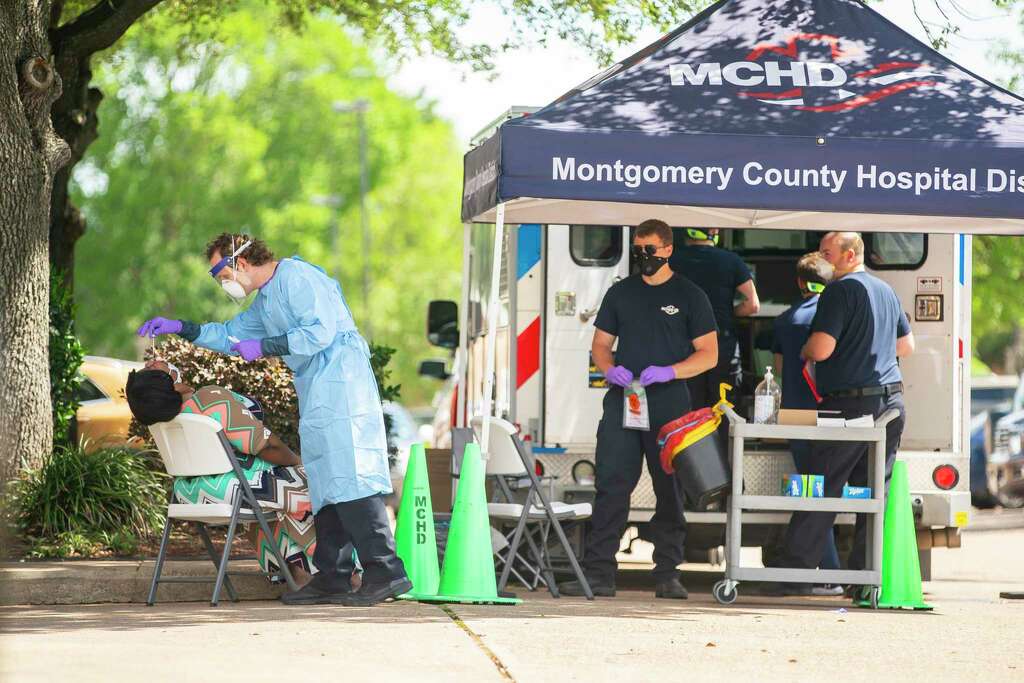
<p>Paramedics with the Montgomery County Hospital District administer tests for COVID-19 outside of an elderly care facility, Thursday, May 14, 2020, at Focused Care at Beechnut in Houston.</p>
VOX

There is something confounding about the US’s new coronavirus spikes: Cases are rising, but the country is seeing its lowest death counts since the pandemic first exploded.

The numbers are genuinely strange to the naked eye: On July 3, the US reported 56,567 new Covid-19 cases, a record high. On the same day, 589 new deaths were reported, continuing a long and gradual decline. We haven’t seen numbers that low since the end of March.

When laypeople observe those contradictory trends, they might naturally have a follow-up question: If deaths are not increasing along with cases, then why can’t we keep reopening? The lockdowns took an extraordinary toll of their own, after all, in money and mental health and some lives. If we could reopen the economy without the loss of life we saw in April and May, then why shouldn’t we?

I posed that very question to more than a dozen public health experts. All of them cautioned against complacency: This many cases mean many more deaths are probably in our future. And even if deaths don’t increase to the same levels seen in April and May, there are still some very serious possible health consequences if you contract Covid-19.

The novel coronavirus, SARS-Cov-2, is a maddeningly slow-moving pathogen — until it’s not. The sinking death rates reflect the state of the pandemic a month or more ago, experts say, when the original hot spots had been contained and other states had only just begun to open up restaurants and other businesses.

That means it could still be another few weeks before we really start to see the consequences, in lives lost, of the recent spikes in cases. And in the meantime, the virus is continuing to spread. By the time the death numbers show the crisis is here, it will already be too late. Difficult weeks will lie ahead.

Even if death rates stay low in the near term, that doesn’t mean the risk of Covid-19 has evaporated. Thousands of Americans being hospitalized in the past few weeks with a disease that makes it hard to breathe is not a time to declare victory. Young people, who account for a bigger share of the recent cases, aren’t at nearly as high a risk of dying from the virus, but some small number of them will still die and a larger number will end up in the hospital. Early research also suggests that people infected with the coronavirus experience lung damage and other long-term complications that could lead to health problems down the road, even if they don’t experience particularly bad symptoms during their illness.

And as long as the virus is spreading in the community, there is an increased risk that it will find its way to the more vulnerable populations.

“More infected people means faster spread throughout society,” Kumi Smith, who studies infectious diseases at the University of Minnesota, told me. “And the more this virus spreads the more likely it is to eventually reach and infect someone who may die or be severely harmed by it.”

This presents a communications challenge. Sadly, as Smith put it, “please abstain from things you like to benefit others in ways that you may not be able to see or feel” is not an easy message for people to accept after three-plus months in relative isolation.

But perhaps the bigger problem is the reluctance of our government to take the steps necessary to control the disease. Experts warned months ago that if states were too quick to relax their social distancing policies, without the necessary capacity for more testing or contact tracing, new outbreaks would flare up and be difficult to contain.

That’s exactly what happened — and now states are scrambling to reimpose some restrictions. Unless the US gets smarter about its coronavirus response, the country seems to doomed repeat this cycle over and over again.
Michelle Nguyen, a Kroger pharmacist, gives a driver a self testing kit at the COVID-19 testing site held at Montgomery County Precinct 2 Commissioner, 19110 Unity Park Drive, Tuesday, May 12, 2020, in

Why Covid-19 deaths aren’t rising along with cases — yet

The contradiction between these two curves — case numbers sloping upward, death counts downward — is the primary reason some people are agitating to accelerate, not slow down, reopening in the face of these new coronavirus spikes.

The most important thing to understand is that this is actually to be expected. There is a long lag — as long as six weeks, experts told me — between when a person gets infected and when their death would be reported in the official tally.

“Why aren’t today’s deaths trending in the same way today’s cases are trending? That’s completely not the way to think about it,” Eleanor Murray, an epidemiologist at Boston University, told me. “Today’s cases represent infections that probably happened a week or two ago. Today’s deaths represent cases that were diagnosed possibly up to a month ago, so infections that were up to six weeks ago or more.”

“Some people do get infected and die quickly, but the majority of people who die, it takes a while,” Murray continued. “It’s not a matter of a one-week lag between cases and deaths. We expect something more on the order of a four-, five-, six-week lag.”

As Whet Moser wrote for the Covid Tracking Project last week, the recent spikes in case counts really took off around June 18 and 19. So we would not expect them to show up in the death data yet.

The national numbers can also obscure local trends. According to the Covid Tracking Project, hospitalizations are spiking in the South and West, but, at the same time, they are dropping precipitously in the Northeast, the initial epicenter of the US outbreak.

Covid Tracking Project

And a similar regional shift in deaths may be underway, though it will take longer to reveal itself because the death numbers lag behind both cases and hospitalizations. But even now, Alabama, Arizona, Florida, Nevada, South Carolina, Tennessee, Texas, and Virginia have seen an uptick in their average daily deaths, according to Covid Exit Strategy, while Connecticut, Massachusetts, and New York have experienced a notable decline.

There are some reasons to be optimistic we will not see deaths accelerate to the same extent that cases are. For one, clinicians have identified treatments like remdesivir and dexamethasone that, respectively, appear to reduce people’s time in the hospital and their risk of dying if they are put on a ventilator.

The new infections are also for now skewing more toward younger people, who are at a much lower risk of dying of Covid-19 compared to older people. But that is not the case for complacency that it might superficially appear to be.

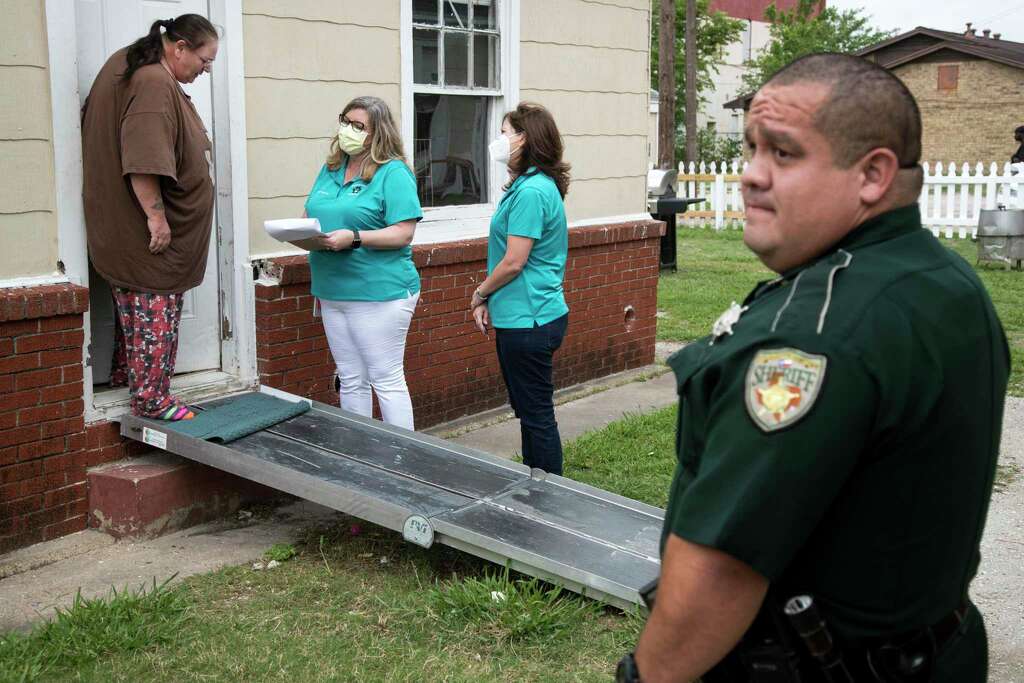
 <p>Principal Wendy Patterson and Angela Randall, assistant principal, of Roosevelt-Wilson Elementary in Texas City ISD, talk to the grandmother of one of their students while reaching out to some of their students</p>
Younger people are less at risk from Covid-19 — but their risk isn’t zero

For starters, younger people can die of Covid-19. About 3,000 people under the age of 45 have died from the coronavirus, according to the CDC’s statistics (which notably have a lower overall death count than other independent sources that rely on state data). That is a small percentage of the 130,000 and counting overall Covid-19 deaths in the US. But it does happen.

Moreover, younger people can also develop serious enough symptoms that they end up having to be hospitalized with the disease. Again, their risk is meaningfully lower than that of older people, but that doesn’t mean it’s zero.

CDC

There can also be adverse outcomes that are not hospitalization or death. Illness is not a zero-sum game. A recent study published in Nature found that even asymptomatic Covid-19 patients showed abnormal lung scans. As Lois Parshley has documented for Vox, some people who recover from Covid-19 still report health problems for weeks after their initial sickness. Potential long-term issues include lung scarring, blood clotting and stroke, heart damage, and cognitive challenges.

In short, surviving Covid-19, even with relatively mild symptoms, does not mean a person simply reverts to normal. This is a new disease, and we are still learning the full extent of its effects on the human body.

But even if we recognize that young people face less of a threat directly from the coronavirus, there is still a big reason to worry if the virus is spreading in that population: It could very easily make the leap from less vulnerable people to those who are much more at risk of serious complications or death.
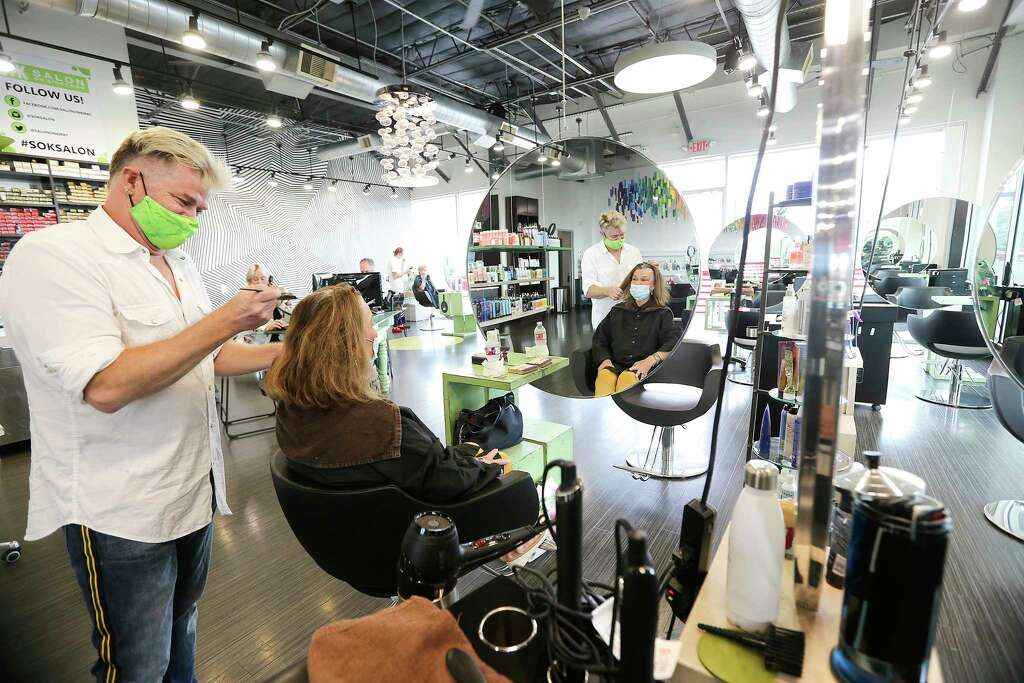
<p>Alden Clark, owner of Salon on Kirby works on Pat Gilmore-Maass' hair at the salon in Houston on Friday, May 8, 2020.</p>

The coronavirus could easily jump from younger people to the more vulnerable

One response to the above set of facts might be: “Well, we should just isolate the old and the sick, while the rest of us go on with our lives.” That might sound good in theory (if you’re not older or immunocompromised yourself), but it is much more difficult in practice.

“The fact is that we live in communities that are all mixed up with each other. That’s the concern,” Natalie Dean, a biostatistics professor at the University of Florida, says. “It’s not like there’s some nice neat demarcation: you’re at high risk, you’re at low risk.”

The numbers in Florida are telling. At first, in late May and into early June, new infections accelerated among the under-45 cohort. But after a lag of a week or so, new cases also started to pick up among the over-45 (i.e., more at-risk) population.

“The rise in older adults is trailing behind, but it is starting to go up,” Dean said.

Anecdotally, nursing homes in Arizona and Texas — the two states with the most worrisome coronavirus trends right now — have seen outbreaks in recent weeks as community spread increases. The people who work in nursing homes, after all, are living out in the community where Covid-19 is spreading. And, because they are younger, they may not show symptoms while they are going to work and potentially exposing those patients.

As one expert pointed out to me, both Massachusetts and Norway have seen about 60 percent of their deaths come in long-term care facilities, even though the former has a much higher total fatality count than the latter. That would suggest we have yet to find a good strategy for keeping the coronavirus away from those specific populations.

“There is so far not much evidence that we know how to shield the most vulnerable when there is widespread community transmission,” Marc Lipsitch, a Harvard epidemiologist, told me.

That means the best recourse is trying to contain community spread, which keeps the overall case and death counts lower (as in Norway) and prevents the health care system from being overwhelmed.

Health systems haven’t been overwhelmed — but some hospitals in new hot spots are getting close

Arizona, Florida, and Texas still have 20 to 30 percent of their ICU and hospital beds available statewide, according to Covid Exit Strategy, even as case counts continue to rise. While some people use those numbers to argue that the health systems can handle an influx of covid patients, the experts I spoke to warned that capacity can quickly evaporate.

“Let’s keep it that way, shall we?” William Hanage at Harvard said. “Hospitals are getting close to overwhelmed in some places, and that will be more places in future if action isn’t taken now. Also ‘not overwhelmed’ is a pretty low bar.”

Hospital capacity is another example of how the lags created by Covid-19 can lull us into a false sense of security until a crisis presents itself and suddenly it’s too late. Because it can take up to two weeks between infection and hospitalization, we are only now beginning to see the impact of these recent spikes.

And, to be clear, hospitalizations are on the rise across the new hot spots. The number of people currently hospitalized with Covid-19 in Texas is up from less than 1,800 on June 1 to nearly 8,000 on July 4. Hospitalizations in Arizona have nearly tripled since the beginning of June, up to more than 3,100 today.

And the state-level data doesn't show local trends, which are what really matter when it comes to hospital capacity. Some of the hardest-hit cities in these states are feeling the strain, as Hanage pointed out. Hospitals in Houston have started transferring their Covid-19 patients to other cities, and they are implementing their surge capacity plans, anticipating a growing need because of the trendlines in the state.

Once a hospital’s capacity is reached, it’s already too late. They will have to endure several rough weeks after that breach, because the virus has continued to infect more people in the interim, some of whom will get very sick and require hospitalization when there isn’t any room available for them.

“We’re seeing some drastic measures being implemented right now in Texas and Arizona along those lines: using children’s hospitals for adults, going into crisis mode, etc.,” Tara Smith, who studies infectious diseases at Kent State University, told me. “So it shows how quickly all of that can turn around.”

And, on top of Covid-19, these health systems will continue to have the usual flow of emergencies from heart attacks, strokes, accidents, etc. That’s when experts start to worry people will die who wouldn’t otherwise have. That is what social distancing, by slowing the spread of the coronavirus, is supposed to prevent.

 A map showing states’ progress on combating the coronavirus pandemic.
We don’t have to lock down forever — but we have to be smart and vigilant

Lockdowns are extraordinarily burdensome. Tens of millions of Americans have lost their jobs. Drug overdoses have spiked. There has been a worrying increase in heart-related deaths, which indicates people who otherwise would have sought medical treatment did not do so during the worst of the outbreak this spring.

But we cannot will the coronavirus out of existence. Experts warned months ago that if states reopened too early, cases would spike, which would strain health systems and put us at risk of losing more people to this virus. That appears to be what’s starting to happen. And it may get worse; if the summer heat has suppressed the virus to any degree, we could see another rebound in the fall and winter.

So we must strike a balance, between the needs of a human society and the reality that most of us are still susceptible to an entirely novel pathogen that is much deadlier and more contagious than the flu.

That means, for starters, being smarter about how we reopen than we have been so far. There is strong evidence that states were too cavalier about ending stay-at-home orders and reopening businesses, with just a handful meeting the metrics for reopening laid out by experts, as Vox’s German Lopez explained.
 A girl wears a face mask in a classroom in Dortmund, Germany.
“What I’ve seen is that reopening is getting interpreted by many as reverting back to a Covid-free time where we could attend larger group gatherings, socialize regularly with many different people, or congregate without masks,” Kumi Smith in Minnesota said. “The virus hasn’t changed since March, so there’s no reasons why our precautions should either.”

To date, most states have opened up bars again and kept schools closed. Lopez made a persuasive case last week that we’ve got that backward. One of the most thorough studies so far on how lockdowns affected Covid-19’s spread found that closing restaurants and bars had a meaningful effect on the virus but closing schools did not.

That study also found that shelter-in-place orders had a sizable impact. While those measures may not be politically feasible anymore, individuals can still be cautious about going out — and when they do, they can stick to outdoor activities with a small number of people.

Masks are not a panacea either, but the evidence is convincingly piling up that they also help reduce the coronavirus’s spread. Whether a given state has a mandate to wear one or not, that is one small inconvenience to accept in order to get this outbreak back under control.

And, really, that is the point. While the current divergence between case and death counts can be confusing, the experts agree that Covid-19 still poses a significant risk to Americans — and it is a risk that goes beyond literal life and death. We know some of the steps that we, as individuals, can take to help slow the spread. And we need our governments, from Washington to the state capitals, to get smarter about reopening.

It will require collective action to stave off the coronavirus for good. Other countries have done it. But we have to act now, before we find out it’s already too late.

Shootings overnight and Sunday in NYC kill at least 9, wound 41. NYPD Blames Reforms

A man was rushed to the hospital in critical condition with a gunshot wound to the head after he was shot outside of 549 Academy Street in Manhattan on Sunday, July 5.
DAILY NEWS

New York City turned into the Wild West as a series of shootings claiming at least 9 lives and wounding 41 others — including a Bronx teenager — erupted amid Fourth of July celebrations.
The shocking wave of violence came as the city was reeling from ongoing anti-police brutality protests, weeks of lockdown orders prompted by the coronavirus outbreak and soaring summer temperatures. Adding to the chaotic atmosphere, illegal fireworks exploded throughout the five boroughs all night long.
In Harlem, a 23-year-old was fatally shot on W. 116th St. near Morningside Park around 2:40 a.m.
This year’s spike in mayhem continued a worrisome surge in crime since coronavirus prompted authorities to shut down the city in mid-March.

June was especially violent, with 250 people shot in the first 28 days of the month, according to NYPD stats. That’s a massive spike compared to the 97 people shot in the same time period last year, and is the city’s most violent June on record since 1996, NYPD stats show.
So far, murders are up by 23% this year citywide, with 176 slayings as of June 28 compared to 143 during the same period last year. Even so, the city’s homicide rate remains far lower than the mid 1990s and even the mid-2000s. In 2006, the city saw 255 murders between Jan. 1 and June 28. 
A 20-year-old man was fatally shot on a Brooklyn street early Sunday, cops said. The victim was blasted in the chest in front of a house on Atkins Ave. near Pitkin Ave. in East New York about 12:40 a.m., police said.
Sunday’s shooters took advantage of an ongoing atmosphere of crisis, said Councilman Donovan Richards, who chairs the Council’s Public Safety Committee.
“The people exploiting this moment are sensing the division on the ground and they’re totally taking advantage of the streets, without a doubt,” the Queens Dem told The News.

“They sense division and therefore they understand they can take out their retribution on each other in ways they weren’t doing years ago because there was much more unity between the department and what was going on on the ground.”
In Harlem, a 23-year-old was fatally shot on W. 116th St. near Morningside Park around 2:40 a.m. A bullet hole is pictured in a vehicle nearby.

"Most Of Our Powers Were Taken Away": NYPD Blames Reforms For Increase In Violent Crime

GOTHAMIST

NYPD officials are largely blaming criminal justice reforms, coronavirus mitigation measures, and "anti-police rhetoric" for an increase in shootings, and a July 4th weekend that was marred by gun violence and 11 murders across the city.

"There is a multitude of reasons why shootings have increased in New York City," Chief of Crime Control Strategies Michael LiPetri told reporters at a press conference on Monday afternoon. "We have the knowledge to stop shootings; it’s unfortunate that most of our powers were taken away to stop the shootings. Knowledge is power? Well, we have the knowledge, we don’t have the power."
Yet the NYPD did not elaborate on what crime-fighting powers they have lost, nor did they say if record high unemploymentlost wages, or school cancellation due to the pandemic that has killed more than 24,000 New Yorkers and sickened countless more factored into their crime analysis.
According to the NYPD, there were 205 shootings in June of 2020, up from 89 in 2019, a 130 percent increase. Murders have also increased in New York by 23 percent for the first six months of 2020, from 147 to 181.
 
At a press conference on Monday afternoon, Chief LiPetri and Chief of Department Terence Monahan specifically singled out state bail reforms, a court system "shut down" by the pandemic, people released from Rikers Island due to COVID-19, City Council legislation that would ban chokeholds, the disbanding of the NYPD's anti-crime units that accounted for a disproportionate number of police shootings, and "the people who demoralized our men in blue, in so-called protest lines" for those increases.
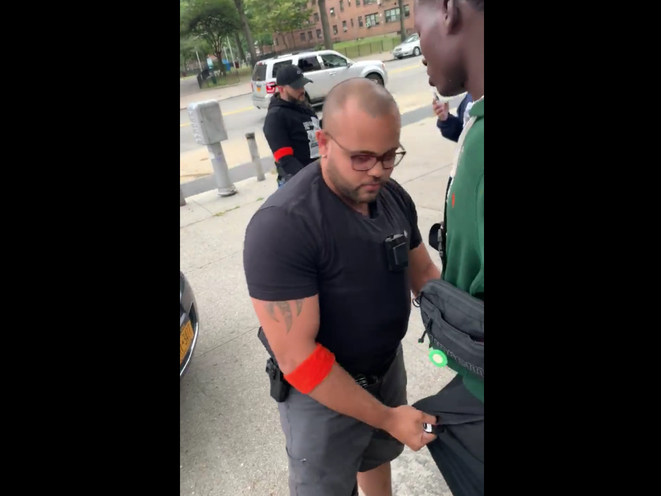
A plainclothes officer wordlessly searching a man in the Bronx this past November.
LiPetri said that because of the state bail reforms, 3,000 people have accounted for approximately 9,000 arrests since the pandemic began, but it's unclear if those arrests are for violent crimes or misdemeanors, or how many of those people might have been released on bail and arrested again under the old 2019 bail laws. (The "new" bail reform laws are now old: the state legislature's rollback of those reforms took effect on Friday.)

Of the 2,500 people released from Rikers due to COVID-19 concerns since the pandemic began, nine have been "tied to violent acts around the city," including two murders, though LiPetri conceded that one of those individuals would have served out their sentence before the murder was committed.
And 136 people released because of new bail reform laws this year were "involved in a shooting or a murder," the NYPD said. But did that mean they were a witness, a person of interest, a victim, or a suspect? The police department couldn't say.

Other metrics the police cited as affecting crime were even less quantifiable, like the protests that "crushed the morale of our cops," as Chief Monahan put it.
"If you walk across the street at City Hall Park over there and take a look on the street, you see the communist hammer and sickle that they painted out on the street," Monahan said. "Are these the loud voices that we should be following?"


There is also legislation that prohibits the police from using chokeholds in New York City that was passed last month by the City Council, that is awaiting Mayor Bill de Blasio's signature. The law prevents officers from "restrain[ing] an individual in a manner that restricts the flow of air or blood by compressing the windpipe or the carotid arteries on each side of the neck, or sitting, kneeling, or standing on the chest or back in a manner that compresses the diaphragm."

Chief Monahan claimed that this law would lead to prosecutions of the police because officers frequently need to kneel on unruly arrestees, and that one of the city's five DA's told him privately that it was "unconstitutional."

"There is a fear going through the police officers now from the diaphragm law—I call it the diaphragm law not the chokehold law," Monahan said, name-checking the bill's main sponsor, Queens Councilmember Rory Lancman.

"Rory Lancman, who is in one of the safest and affluent neighborhoods in the city, has signed a bill that is going to affect people in economically deprived areas of the city and have violence, because police officers may be hesitant to step forward and grab someone for a quality-of-life offense, if during the course of that the person resists and their knee should accidentally end up on a person's back," Monahan charged.

Reached by telephone on Monday, Lancman told Gothamist, "My district is nearly three quarters people of color, and if Chief Monahan wants to come and talk to my constituents about their urgent desire for police reform, I'd be happy to make that connection."

Lancman pointed out that the NYPD's own patrol guide contains a prohibition on any move that "may prevent or hinder breathing or reduce intake of air."
"So unless Chief Monahan is confessing to the NYPD never taking its own patrol guide seriously, there is nothing for a well-trained, well-disciplined, and well-intentioned officer to fear from this bill," Lancman said.

After a violent weekend, NYPD Commissioner Dermot Shea says this is "the storm" he said was coming. Blames bail reform and even the recent choke hold bill for "crippled police" Top Cop Points to Low Prisoner Numbers at Rikers Amid Spike in Shootings

The council member, who sits on the council's public safety committee, is also calling for the removal of NYPD Commissioner Dermot Shea for what he described as "an utter failure on the part of the police commissioner to follow the law, accept civilian authority over the police department."
Lancman said, "He's basically thrown up his hands and said all these new reforms are baloney, I can't run the police department with all of these new reforms, I give up."

recent Vera Institute study surveyed the policing budgets of cities across the country. Cities with more police officers did not necessarily have lower rates of crime.
"Baltimore has had extremely high crime rates compared to New York, but the difference isn't the number of cops, the difference is that New York City has funded violence interruption and violence prevention programs for decades while Baltimore has done far less of that," Rahman explained.

"The investment should not be more police flooding these high crime neighborhoods, but actually more resources that help with food stability and housing stability and keeping people fundamentally safe and healthy during this crisis."

All in the Family: Donald Trump’s Niece on the President’s Clan

A name you should know: Mary Trump

Trump at the 1990 opening of the Trump Taj Mahal in New Jersey with, from left, his brother Robert and wife Blaine Trump, parents Mary and Fred, and sister Maryanne Trump Barry. (Charles Rex Arbogast/AP)

Who she is: She is Trump’s niece, the daughter of his older brother, Fred Jr., who died of alcoholism in the 1980s.

Why you need to know about her: Because she’s writing a tell-all about the president. It sounds like fodder for Trump’s critics who want to try to get into his head to diagnose his behavior. Mary Trump is a psychologist, and in a teaser on Amazon posted Monday night, she said she will describe “a nightmare of traumas, destructive relationships, and a tragic combination of neglect and abuse” that made Trump into who he is today.

What else is interesting about this: We haven’t heard from Trump’s extended family much before this, and certainly not in a salacious, tell-all way. They seem to have an implicit pact to stay quiet — until now, five months before the election. The family history we already know sounds like a soap opera. As The Washington Post’s Michael Kranish reports: There’s also a battle over Fred Jr.’s fortune, and an allegation Trump and his siblings pulled funding for Mary Trump’s nephew who has cerebral palsy.