July 27, 2020

Fires and Pepper Spray in Seattle as Police Protests Widen Across U.S.

Protesters in Seattle faced a line of police officers after marching in support of demonstrators in Portland, Ore., on Saturday.

From Los Angeles to New York, protesters marched in a show of solidarity with demonstrations in Portland, Ore. In Seattle, they smashed windows and set fires. A shooting at a protest in Austin, Texas, left one man dead.

NY TIMES

A series of strident new protests over police misconduct rattled cities across the country over the weekend, creating a new dilemma for state and local leaders who had succeeded in easing some of the turbulence in their streets until a showdown over the use of federal agents in Oregon stirred fresh outrage.

With some demonstrators embracing destructive protest methods and police often using aggressive tactics to subdue both them and others who are demonstrating peacefully, the scenes on Saturday night in places like Seattle, Oakland, Calif., and Los Angeles recalled the volatile early days of the protests after the death of George Floyd at the end of May.

in Seattle, where a day of demonstrations focused on police violence left a trail of broken windows and people flushing pepper spray from their eyes. At least 45 protesters had been arrested as of early evening, and both protesters and police officers suffered injuries.

Carrying signs such as “Feds Go Home” and shouting chants of “No justice, no peace,” some among the crowd of about 5,000 protesters stopped at a youth detention center and lit several construction trailers there on fire. Some smashed windows of nearby businesses, ignited a fire in a coffee shop and blew an eight-inch hole through the wall of the Seattle Police Department’s East Precinct building, the police said.

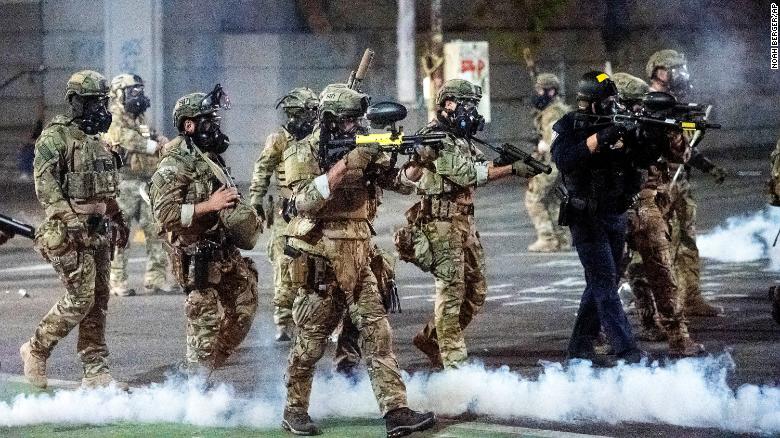
The police responded by firing flash grenades, showering protesters with pepper spray and abruptly rushing into crowds, knocking people to the ground. After a flash grenade left one woman with bloody injuries, police officers shoved people who had stopped to help her.
Gunshots can be heard in this video taken live from a protest in Austin, Texas, where one man was shot and killed.
In Austin, Texas, the police said one man was shot and killed just before 10 p.m. during a protest in the city’s downtown. In a live video from the scene, protesters are seen marching through an intersection when a car blares its horn. Seconds later, five shots ring out, followed shortly after by several more loud bangs.

The man who was killed may have approached a vehicle with a rifle before he was shot and killed, Officer Katrina Ratcliff said. Ms. Ratcliff said the person who shot and killed the man had fired from inside the vehicle. That person was detained and is cooperating with officers, she said. No one else was injured.

In Los Angeles, protesters clashed with officers in front of the federal courthouse downtown. Videos showed people smashing windows and lobbing water bottles at officers after protesters said the police fired projectiles at them.

The federal courthouse in Portland has been the scene of nightly, chaotic demonstrations for weeks, which continued again into Sunday morning, as thousands participated in marches around the city, the 59th consecutive day of protests there. Earlier, a group of nurses in scrubs had joined an organized group of mothers in helmets and fathers in hard hats, all assembled against the fence of a federal courthouse where federal agents — a deployment that has been a key focus of the recent demonstrations — have been assembled.
The “Wall of Moms” led a march to downtown Portland, Ore., on Saturday night.
Protesters in several cities said the smoke-filled videos of federal agents firing tear gas and shoving protesters in Portland had brought them to the streets on Saturday. In addition to marching in solidarity with the Portland protesters, the demonstration in Aurora, Colorado was also in response to the death of Elijah McClain, a 23-year-old massage therapist who died several days after officers put him in a chokehold last summer.

In Seattle, protesters in June laid claim to several city blocks, pressuring the police to temporarily abandon a police station in the city’s Capitol Hill neighborhood and establishing a free protest zone that endured for several weeks. When the city authorities finally reclaimed the zone, there was little resistance. And things remained calm. The Seattle City Council began embracing plans to make substantial cuts to the police department budget, restrict the use of tear gas and put the city on a path to reimagining policing.
Police and protesters Saturday met at the same intersection in Seattle where the protests stemming from George Floyd’s death took place.  
 Carmen Best, the Seattle police chief, stressed that a number of demonstrators also used violence. Some were tossing concrete blocks from a rooftop to the street below, she said. The coffee shop that was set afire had occupied apartments above it that had to be evacuated, she said.

Trump has seized on the scenes of national unrest — statues toppled and windows smashed — to build a law-and-order message for his re-election campaign, spending more than $26 million on television ads depicting a lawless dystopia of empty police stations and 911 answering services that he argues might be left in a nation headed by his Democratic rival, Joseph R. Biden Jr.

Mr. Biden insisted last week that the president’s pledge to inject a federal law-and-order presence into the already volatile issue of policing shows that he is “determined to sow chaos and division. To make matters worse instead of better.”

The situation has left city leaders, now watching the backlash unfold on their streets, outraged and caught in the middle. Mayor Jenny Durkan of Seattle said in an interview Sunday that the city is in the middle of a self-fulfilling prophecy, with protesters infuriated by the federal presence in Portland smashing windows and setting fires, the very images of “anarchy” that the president has warned about.
Thousands of people returned to the federal courthouse in Portland  on Friday. Some threw fireworks at the officers protecting the building, while others tried to break down the fence surrounding it.
Some cities had welcomed Mr. Trump’s offer to send additional law federal law enforcement agents in to help combat escalating gang violence and drug crime, but insisted they would brook no federal agents on their streets arresting and tear gassing protesters
.
Democratic city and state leaders pushed back against the new federal presence, but also expressed frustration that some on the streets were going too far and playing into the president’s gambit.

“No matter how many troops Donald Trump sends into American cities, it’s not going to distract them from their primary concern which is the coronavirus and their health,” said Jared Leopold, a Democratic strategist.

For city officials, the challenge is more immediate than the November election — it is bringing an end to nights of clashes on their streets.

July 26, 2020

Back to School? Maybe Not


“Is it better off returning to physical school? Yes,” said Harvard University education expert Robert Schwartz, “but this administration has made that extremely problematic.”

VOX
  • In a major shift, the Centers for Disease Control and Prevention on Thursday revised its position from just two weeks ago with a new set of guidelines that endorse reopening K-12 schools this fall despite the ongoing coronavirus pandemic. [New York Times]
  •  
  • President Donald Trump has in recent weeks seized on the issue of schools reopening and called for the CDC to modify its previous guidance to make those reopenings easier — which it now appears to have done. [CNN / Maggie Fox and Nick Valencia]
  • School buses in San Francisco. The Centers for Disease Control and Prevention has published new guidance two weeks after President Trump criticized its earlier recommendations on school reopenings.
  • Thursday’s recommendations stress the negative social, educational, and emotional impacts of not reopening on students, but ultimately leave the decision up to state and local officials. [NBC News / Shannon Pettypiece] Experts also are clear that returning to classroom instruction will be safe only if and when the US gets a handle on its coronavirus outbreak. “Is it better off returning to physical school? Yes,” said Harvard University education expert Robert Schwartz, “but this administration has made that extremely problematic.”
While children infected by the virus are at low risk of becoming severely ill or dying, how often they become infected and how efficiently they spread the virus to others is not definitively known. Children in middle and high schools may also be at much higher risk of both than those under 10, according to some recent studies.

 A large new study from South Korea found that children younger than 10 transmit the virus to others much less often than adults do, but that those between the ages of 10 and 19 can spread the virus at least as much as adults do.
P.S. 20 in Brooklyn. Across the country, educators have confronted a politically charged debate over reopening schools.The new guidelines may only do so much to encourage reopening: According to Education Week, at least 9 of the 15 largest school districts in the US have decided against returning to in-person classes in the fall. [Education Week]
  •  
  • Polling also suggests that most people aren’t comfortable with the idea of reopening schools unless major changes are made. According to an AP poll conducted earlier this month and released Thursday, only 8 percent of Americans support schools fully reopening as usual. [AP / Collin Binkley and Hannah Fingerhut]
  •  
  • The Trump administration has indicated that it hopes to use the next coronavirus aid package, which is still in the works, to incentivize schools to reopen by conditioning funding on their doing so. [Politico / Nicole Gaudiano, Michael Stratford, and Juan Perez Jr.]
  •  
  • Trump leaned into that idea at a press conference Thursday, telling reporters that “if the school is closed, the money” — the White House wants to include about $105 billion for schools in the next relief bill — “should follow the student.” [NPR / Anya Kamenetz]
  •  
  • That idea aligns with a bill introduced by Republican Sens. Tim Scott and Lamar Alexander earlier this week. The School Choice Now Act would clear the way for more students to be homeschooled or to attend private schools instead of public schools. [Twitter / Andrew Ujifusa]

WELCOME TO THE SUNSHINE STATE

As virus hit Florida, its governor sidelined scientists to follow Trump

The state’s crisis, experts and officials say, has revealed the shortcomings of a response built on shifting metrics, influenced by a few advisers and tethered to the Trump administration.

Essential work leads to a coronavirus outbreak for one group of immigrants in Florida

Guatemalan laborers, asked to work through the pandemic, are now among the hardest-hit communities in the hard-hit state.

July 25, 2020

More people in the US are hospitalized with Covid-19 than at almost any other time.


With daily cases, hospitalizations, and deaths still on the rise, the coronavirus pandemic keeps getting worse in the US.

VOX

More Americans are currently hospitalized with Covid-19 than at almost any other point in the pandemic, a grim indicator that the coronavirus pandemic is not slowing down in the US.
On July 23, 59,846 people across the United States were in the hospital after testing positive for the novel coronavirus, according to data reported by the Covid Tracking Project, just below the peak of 59,940 reached on April 15, when the New York City area was the epicenter of the US outbreak. (As the Covid Tracking Project notes, the national and state hospital data are erratic and incomplete at the moment, and reported totals may continue to shift.)

Christina Animashaun/Vox

What’s clear is that Covid-19 has migrated across the country to many more regions in the three months since. In the spring, hospitalizations were overwhelmingly concentrated in the Northeast, but now more than half of hospitalized Covid-19 patients are in the South. The West has also seen the number of hospitalized Covid-19 patients double since April, while the Northeast now accounts for fewer than 5,000 of the nearly 60,000 current hospitalizations.  


The current total is likely an undercount. Two states, Kansas and Hawaii, do not report current hospitalization data, and some states may temporarily not be reporting full hospitalization numbers because of a recent change in the reporting system ordered by the Trump administration.
“The hospitalization number is the best indicator of where we are,” Eric Topol, a professor of molecular medicine and director of the Scripps Research Translational Institute, told Vox. “We’re going to go to new heights in the pandemic that we haven’t seen before. Not that what we saw before wasn’t horrifying enough.”The growth has been driven by accelerating spread in ArizonaCaliforniaFlorida, Georgia, and Texas in particular. On April 15, when New York City hospitals were nearly being overrun with Covid-19 patients, Texas had about 1,500 patients hospitalized with the disease. Today, more than 10,000 Texans are hospitalized with Covid-19. 


Some areas are reaching a woeful tipping point of hospitals stretched to maximum capacity, scrambling to find beds in other facilities for Covid-19 patients. Miami-Dade County reported this week that the number of patients in need of ICU care had exceeded the number of available ICU beds. More than 50 hospitals across the state say they have no ICU beds available.


Texas Medical Center in Houston has already filled up its usual non-pandemic ICU unit and been forced to rely on its surge capacity plans to handle the patient load. Earlier this month, 10 out of the 12 hospitals in the Rio Grande Valley reported that they were completely full and needed to start transferring patients to hospitals elsewhere in the state.


This was, unfortunately, to be expected. Nearly all of the states currently experiencing an increase in new cases and hospitalizations started relaxing their social distancing restrictions in May and June before meeting the government’s reopening guidelines of having sufficiently reduced the virus’s spread and adequately ramped up their testing and tracing capabilities. New cases began rising and hospitalizations followed a few weeks after that. Now deaths are ticking up again, reversing a steady decline that had begun in early May.
Conservative radio talk show host Wayne Allyn Root hosts a protest in Las Vegas, Nevada, demanding the reopening of businesses on April 24.
 Ethan Miller/Getty Images[

Four million Americans have had confirmed cases of Covid-19. 


More than 143,000 of them have died. With hospitalizations surging and several states still reporting thousands of new cases a day, experts say we are in for a difficult August and fall.


We’ve still got 91 to 92 percent of people who are still vulnerable, who have not been infected,” said Topol. “And so that just shows how many more people can be hurt. Obviously many won’t get so sick, but many will.”


The new hospitalizations, and the untenable pressure they’re putting on the health care system, are also a reminder of how critical it is for states to implement and enforce measures like mandatory face masks, and for the federal government to solve testing and contact tracing problems. “It should be an all-points bulletin to really bear down on this because otherwise there’s no limit on where this might go,” said Topol.A digital sign on a street reads, “Covid-19 testing next right. Appointment required.”

Hospitals are running out of staff, supplies, and beds for Covid-19 patients


Hospitals in hot spots across the country are expanding and even maxing out their staff, equipment, and beds, with doctors warning that the worst-case scenario of hospital resources being overwhelmed is on the horizon if their states don’t get better control of the coronavirus.

“With Covid, a lot of times people who aren’t sick enough yet get pushed to the back, and then they can become really, really sick unfortunately because we were focusing our efforts on the people who are on the brink of death,” an emergency room doctor at the Banner Health system in the Phoenix metro area, who asked to go unnamed fearing retaliation from his employer, told Vox recently.

Other doctors in Arizona, where 85 percent of hospital beds statewide were in use as of Thursday, have said the scarcity of resources means they’ll soon be rationing medical care, as doctors in Italy were forced to do.“The fear is we are going to have to start sharing ventilators, or we’re gonna have to start saying, ‘You get a vent, you don’t.’ I’d be really surprised if in a couple weeks we didn’t have to do that,” says Murtaza Akhter, an emergency medicine physician at Valleywise Health Medical Center in Phoenix.

The rampant transmission of the virus in Arizona and resulting pressure on hospitals are particularly infuriating to some emergency room and ICU staff, who say they’re having to make decisions on the fly that they’re uncomfortable making.


“Sending people with Covid home with oxygen tanks because we don’t have the resources for them? This is something I’ve never done in my life before,” says Akhter. “This is crazy. And this is gonna be even worse in a couple of weeks. So far we’re trying to hold steady, but how long will that last?”
The psychological toll, he says, is serious too.


“To come off a shift and be like, ‘I’m losing hope’ — that’s a dangerous place to be in,” he says. “I don’t want to feel that way. And that’s because despite the horrible numbers, despite the fact I’m still getting the Covid cases [in the ER], despite what we’ve been saying to the media from the front line, I drive home from work and I literally see lots of people congregating together closely and in the grocery store not wearing masks.”

Texas hospitals say they are in better shape now with personal protective equipment than they were in March and April, but that could change as the crisis gets worse. 


Staffing is a universal problem in hot spots. Houston Methodist has already brought in out-of-state nurses and asked its administrative staff with nursing certifications to start doing medical work again. Nurses are also being asked to work longer and overnight shifts.


Rural hospitals in Texas aren’t running out of beds yet, but they are running into a staffing shortage. These facilities might typically have five patients in a given unit, and the hospitals have staffed them accordingly. But now there might be as many as 20 patients.

“You’re working every nurse as much as you can work them and still not meeting the need,” Henderson says.

It’s not clear where more staff could come from. The state has already sent about 2,300 volunteers to the Rio Grande Valley, one of the hardest-hit areas in the state.
“Other areas are requesting that workforce support,” Henderson says. “But there’s not much more in terms of resources to be sent.”

Another concern is ventilators. Rural hospitals in Texas would ordinarily transfer their patients in serious condition, the kind who might be on a ventilator for days, to a larger hospital in the city. But because urban hospitals are already overrun with Covid-19 patients, there is nowhere for the rural hospitals to send their patients. Instead, they are forced to keep those patients, causing their beds to fill up even more quickly.


And while the current coronavirus patients are younger than those seen in the spring, Henderson says his hospitals don’t have enough of the nasal oxygen hookups that are used to help those patients breathe on their own and prevent them from being put on a ventilator.


“They’ve shown to be effective, but everybody’s trying to get them,” he says.
El Centro Regional Medical Center in Imperial County, one of California’s biggest Covid-19 hot spots right now, has already brushed up against its worst-case scenario. The hospital recently saw its available ventilators dwindle to one.

Adolphe Edward, the hospital’s CEO, convened an impromptu committee to evaluate the patients currently on ventilators so they could prioritize if another patient who needed one came through their door. They checked the patients’ lung capacity and considered whether they could risk taking one or two of them off the ventilator if the need arose.

Luckily, Edward figured out a workaround. He called another nearby hospital and asked if they had any ventilators available. They had two, which they shipped over to El Centro. For now, the machines are still there, though Edward says he and the other hospital have stayed in constant contact in case the ventilators need to be transferred again.

Daily deaths are creeping up again but are still far below the earlier peak


While daily Covid-19 hospitalizations are surging, another key metric, daily deaths, was 1,039 on July 23, still less than half of its May 7 peak of 2,742, according to the Covid Tracking Project. Yet the trend is ominous, since daily deaths were dropping steadily by mid-June and then began rising again in early July.


On Thursday, Florida reported a new record single-day death toll of 173. Texas hit its own respective record on Wednesday, with 193 deaths.


Yet it’s possible, they say, that fewer people who are hospitalized will end up dying in this summer stage of the pandemic as compared to the spring.


“Hospitalizations undoubtedly are going to be associated with more deaths or chronic illnesses, but I’m hoping that the deaths are not as steep as they were back in March and April,” said Topol. “And maybe that’s because they are more young people that are sick and they will pull through. Maybe it’s also because the treatments are getting better, not just the drugs but just the whole approach.”
Overall, he says, “The hope is that the relationship between hospitalizations and fatalities won’t be as tight as it was, but we have to watch this closely because that’s the optimistic view.”


Update, July 24: This article and its headline previously stated that hospitalizations had surpassed a peak reached in April. They have been updated to reflect irregularity in the hospitalization data.

July 24, 2020

Trump Makes Some Policy Reversals as Polls Dip & Coronavirus Spreads. He Also Announces Plans to Increase Federal Officers in More U.S. Cities


Fact check: Trump has OK'd 36 clemency requests, far fewer than others
WASHINGTON POST

Trump on Thursday abruptly canceled the Republican National Convention celebrations scheduled for next month in Jacksonville, Fla., making the latest in a series of head-snapping reversals in the face of a nationwide pandemic that continues to spread out of control.

Trump has for months instructed his advisers to find a way to stage a loud, boisterous and packed convention celebration, after North Carolina officials said they could not guarantee such an event in Charlotte. Advisers scoured the country for a new location to host a multi-night televised spectacle, settling on Jacksonville, where the mayor and Florida’s governor are Trump’s allies.


The president’s ambition, however, ran headlong into a massive spike in coronavirus cases in Florida, growing local opposition and enormous logistical hurdles. At one point, convention planners announced they would administer daily coronavirus tests to thousands of delegates, donors and members of the media to help reduce the viral risk. That plan was later scrapped to move large portions of the celebrations to an outdoor venue.

The convention retreat came as polls continue to show public disapproval of Trump’s handling of the pandemic, with presumptive Democratic nominee Joe Biden expanding leads in key battleground states and advisers pressing Trump to try to shift gears.

In the past week, Trump has abandoned his longtime refusal to wear a mask or enthusiastically promote their use, stopped pushing for public mass campaign gatherings and acknowledged for the first time in months that the pandemic is likely to get worse before it gets better. Trump also acknowledged Thursday that some schools might have to delay reopening.

Democrats are planning a four-day convention in August that will be anchored in Milwaukee, with simulcasts from satellite locations across the country and prerecorded video. Delegates and party officials have been told to stay home, and the in-person crowd for major speeches, including Biden’s acceptance of the nomination, is expected to be small.

Trump advisers have repeatedly argued to him in recent days that a more cautious approach is likely to boost his popularity. Canceling the convention, they said, would also show he is taking the virus seriously.

Republican planners had already concluded that a packed, indoor arena would not be possible over several consecutive nights, given the high caseload in northern Florida. Some White House and campaign officials were fearful of the negative press if delegates and others were infected with the virus at the convention, two officials said.

They also came to the conclusion that they would probably have to use the National Guard to protect the convention from protests and allow for distancing in the crowd. The president, advisers said, was less than enthusiastic about an arena or stadium that appeared less than full.

Federal agents use crowd control munitions to disperse Black Lives Matter protesters in the US city of Portland, Oregon, on July 20, 2020.

Trump Announces Plans to Increase Federal Officers in More U.S. Cities


Trump announced that he is sending more federal law enforcement agents into Chicago and Albuquerque, casting the effort as one meant to help fight crime while delivering a speech that appeared designed to score political points against Democratic leaders and burnish his law-and-order image.

Appearing at an event with top federal law enforcement officials and the family members of crime victims, Trump delivered fiery talking points that took direct aim at those who have advocated redirecting funding from law enforcement to other endeavors. He blamed the recent increases in violence in some cities on leaders who have endorsed such steps and said he planned to increase federal law enforcement’s presence to reduce crime.


The remarks seemed likely to exacerbate tensions between his administration and local officials and residents already wary of militarized U.S. officers roving their streets. Soon after he finished speaking, Chicago’s mayor accused Trump of seeking to distract from his handling of the coronavirus pandemic.
Mr. Biden sought to dismiss any concerns at a news conference three weeks ago, telling reporters that he was up to the rigors of the campaign trail and the presidency when asked if he had taken a cognitive test. “I’ve been tested, and I’m constantly tested,” he said. “Look, all you’ve got to do is watch me, and I can hardly wait to compare my cognitive capability to the cognitive capability of the man I’m running against.”

Mr. Trump recently suggested injecting disinfectant to counter the coronavirus and he has been reported to once ask aides about using nuclear weapons to disrupt hurricanes.

Mr. Biden has the edge upstairs in the view of the public. In a poll by The Hill newspaper with the HarrisX research firm released this week, 56 percent of voters said the former vice president was mentally fit to lead the nation, while just 45 percent said that of Mr. Trump.

Other American presidents have struggled with cognitive or psychological issues but rarely addressed them publicly the way Mr. Trump has. A Duke University study in 2006 found that nearly half of presidents suffered from mental illness at some point in their lives. Nearly 25 percent of presidents met the criteria for depression, according to the study, including James Madison, Abraham Lincoln and Calvin Coolidge. Ronald Reagan’s aides were concerned enough that he was slipping late in his presidency that they secretly considered whether to invoke the 25th Amendment to remove him for incapacity before deciding he was still fit enough to finish his tenure.

In unscripted moments before the camera, the president sometimes wanders from topic to topic without completing a train of thought, repeats himself or falls back on the same familiar phrases when questioned. He makes statements that defy common sense, like insisting that if there were not so many coronavirus tests conducted, there would not be so many cases of the virus, which as skeptics have pointed out is roughly equivalent to saying that there would not be as many pregnancies if there were not as many pregnancy tests administered.

Testing Bottlenecks Threaten N.Y.C.’s Ability to Contain Virus. California Overtakes NY For Most Cases in U.S

New York City public health officials have grown increasingly alarmed by delays in coronavirus test results. 

“Honestly, I don’t even really see the point in getting tested,” said one New Yorker who has waited nearly two weeks, with still no results.


Despite pledges from Gov. Andrew M. Cuomo and Mayor Bill de Blasio to make testing widely accessible and effective, many people in the city who have gotten tested have waited more than a week to learn whether they had the coronavirus. Delays in test results could hinder New York’s ability to control the spread of the disease,

In early July, a quarter of coronavirus test results were returned within 24 hours, but another quarter of tests took more than six days, Avery Cohen, a spokeswoman for the mayor, said.Now, the median wait time at some clinics in New York City is nine days.

Although the mayor and governor have urged New Yorkers to get tested regularly, some public health officials and laboratory executives worry that strategy isn’t sustainable. That’s partly because in New York officials haven’t been able to significantly expand state and city laboratories’ capacity for testing — meaning the delays could get worse before they get better. So far, the backlog does not seem to have contributed to an uptick in transmission. 

The demand for tests is growing faster than laboratories can handle it. That demand is likely to increase as schools begin to reopen — especially because some universities will require that students test negative for the virus before they can attend in-person classes. Mr. Cuomo defended the state’s testing performance on Thursday, noting that the national labs, like Quest Diagnostics, were “getting overwhelmed” by tests from other states.

There are dozens of CityMD walk-in clinics in New York, and thousands of people get tested at them each day. Many of those tests are sent to a lab in New Jersey run by Quest Diagnostics. Quest Diagnostics has provided several reasons that wait times are long, including the high level of demand from employees getting tested before returning to their workplaces.
Test result delays may undermine contact tracing, which alerts people who may have been exposed to the coronavirus so they can avoid spreading it to others. The combination of testing and tracing could be an important factor in warding off a second wave of the outbreak. As of late June, the city had hired 3,000 disease detectives and case monitors.
People visited Venice Beach in Los Angeles on Wednesday. The city has seen the most cases in California, and while parts of it feel under siege, in other areas there is little palpable sense of the severity of the situation.

California Is Once Again at the Center of the Virus Crisis


The state was the first to issue a stay-at-home order, helping to control an early outbreak. It has now surpassed New York for the most known cases of the virus.


NY TIMES

When everything shut down in March as the coronavirus took off in California, Canter’s Deli, a mainstay in the Fairfax District of Los Angeles, laid off dozens of employees. A few months later, it called them back to work. By then, the state appeared to have emerged from the initial virus crisis in much better shape than other parts of the country.

But now California’s caseload is exploding, with rising deaths and hospitalizations. As quickly as things had opened up, they have shut down again. California is now in the unwelcome position of having found itself at the center of the pandemic twice over.

 After a reopening that some health officials warned was too fast, cases surged, leading to a new statewide mask mandate and the closure of bars and indoor dining again. With more than 420,000 known cases, California has surpassed New York to have the most recorded cases of any state, and it set a single-day record on Wednesday with more than 12,100 new cases and 155 new deaths.

And as California struggles once again to contain the virus, the multitude of challenges playing out across America have collided in every corner of the state, as if it were a microcosm of the country itself. Some localities have resisted both new shutdowns and enforcing a mandatory mask order. Some rural areas of the state remain relatively unscathed with low case counts, while cases in Los Angeles are skyrocketing. The city’s mayor, Eric M. Garcetti, has warned that a new stay-at-home order could come down in the coming days.

In many parts of San Francisco, Silicon Valley and Los Angeles, people do not leave home without a mask. In Huntington Beach, and across Orange County, residents have openly defied mask orders and protested against them.
Protesters demonstrated against the state’s stay-at-home order at the entrance to the Huntington Beach Pier in May.
In Los Angeles and San Diego, classrooms will be empty this fall, after public school officials decided they were unwilling to risk in-person instruction. But in Orange County, a recommendation by the Board of Education that children return to school without masks became political fodder for debate, even as the governor announced that most California schools would not be able to teach in person.
A long line of cars near a testing site at Dodger Stadium in Los Angeles last week. Credit...Robyn Beck/Agence France-Presse — Getty Images[/caption]
 
The contradictions span the state, creating a sense of regional dissonance. In Imperial County, on the southern border with Mexico, hospitals have been so overwhelmed with virus cases that patients have had to be airlifted elsewhere. But in the northernmost tip, the virus has yet to hit Modoc County, an agricultural community of around 9,000, where there were zero known cases as of Thursday.

It is in some ways California’s sprawling nature, with 40 million residents spread across urban downtowns and rural areas, liberal strongholds and conservative alcoves, that has aggravated the feeling of back-and-forth. What applies in one area may not feel necessary in another, even as residents live under statewide orders. And the sense of confusion is often made worse by conflicting political messages from local leaders, the governor and the White House.

July 23, 2020

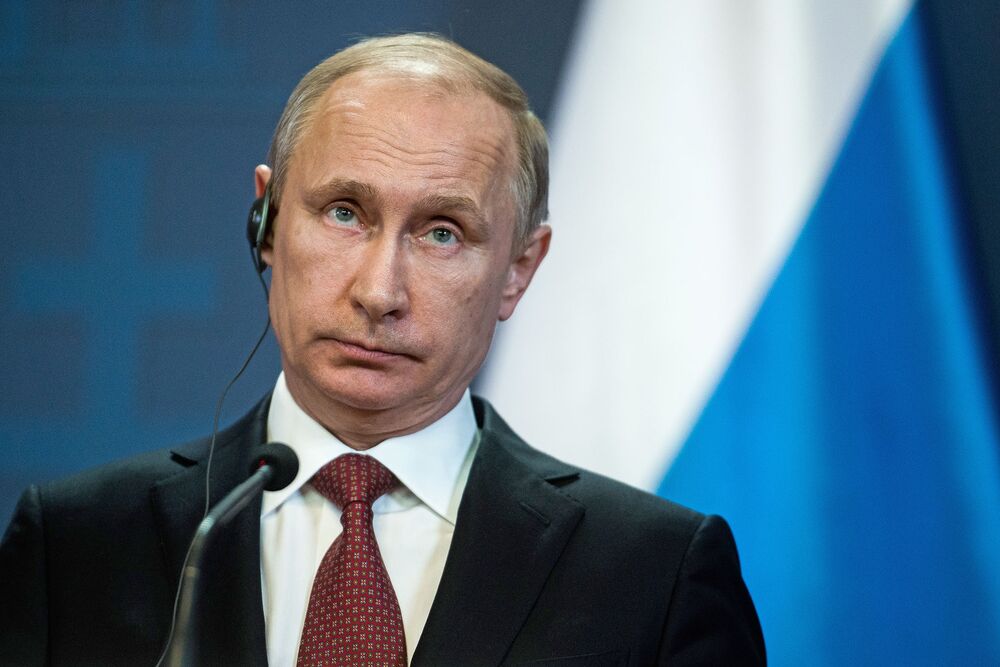
First We Take Russia and Then We Take The West. Putin Ruthlessly Rules KGB Capitalist Russia.

Putin, Like a Czar, Controls a Greedy, Corrupt Oligarchy


NY TIMES

In the years that it took the journalist Catherine Belton to research and write “Putin’s People,” her voluminous yet elegant account of money and power in the Kremlin, a number of her interview subjects tried various tactics to undermine her work. One of them, “a close Putin ally” apparently alarmed by her questions about Russian President Vladimir Putin’s activities as a K.G.B. agent in Dresden in the 1980s, emphatically insisted that any rumored links between the K.G.B. and terrorist organizations had never been proved: “And you should not try to do so!” he warned.
Another source, defending Putin’s tenure as the deputy mayor of St. Petersburg, took a cooler approach. Asked about a local politician named Marina Salye who found evidence of corruption in the so-called oil-for-food scheme that Putin oversaw in the early ’90s, he didn’t bother to deny her findings; he just rejected the very idea that her findings mattered. “This all happened,” he smugly acknowledged. “But this is absolutely normal trading operations. How can you explain this to a menopausal woman like that?”

Belton suggests that this is the kind of two-pronged strategy the Kremlin has used to pursue its interests at home and abroad: Deploy threats, disinformation and violence to prevent damaging secrets from getting out, or resort to a chilling cynicism that derides everything as meaningless anyway.

The dauntless Belton, currently an investigative reporter for Reuters who previously served as the Moscow correspondent for the Financial Times, allowed neither approach to deter her, talking to figures with disparate interests on all sides, tracking down documents, following the money. The result is a meticulously assembled portrait of Putin’s circle, and of the emergence of what she calls “K.G.B. capitalism” — a form of ruthless wealth accumulation designed to serve the interests of a Russian state that she calls “relentless in its reach.”

As central as Putin is to the narrative, he mostly appears as a shadowy figure — not particularly creative or charismatic, but cannily able, like the K.G.B. agent he once was, to mirror people’s expectations back to them. The people who facilitated Putin’s rise didn’t do so for particularly idealistic reasons. An ailing Boris Yeltsin and the oligarchs who thrived in the chaos after the collapse of the Soviet Union were looking for someone who would preserve their wealth and protect them from corruption charges. Putin presented himself as someone who would honor the bargain, but then replaced any Yeltsin-era players who dared to challenge his tightening grip on power with loyalists he could call his own.
Putin Quietly Drops Goal to Make Russia an Economic Powerhouse ...
“Putin’s People” tells the story of a number of figures who eventually ran afoul of the president’s regime. Media moguls like Boris Berezovsky and Vladimir Gusinsky were stripped of their empires and fled the country. Belton says the real turning point was the 2004 trial that sent Mikhail Khodorkovsky — at one point Russia’s richest man, with a controlling stake in the oil producer Yukos — to a Siberian prison camp for 10 years. Putin has since presided over the country and its resources like a czar, Belton writes, bolstered by a cadre of friendly oligarchs and secret service agents. Russia’s legal system was turned into a weapon and a fig leaf.

Putin allowed and even encouraged the oligarchs to accrue vast personal fortunes, but they were also expected to siphon some money from their business ventures into the obschak, a collective kitty whose slush funds, Belton says, have been useful in projecting the image of a powerful Russia on the world stage.

The Kremlin’s abiding definition of power was cramped and zero-sum; the resources were plowed into undermining other countries on the relative cheap, by funding troll farms, election meddling and extremist movements.

It was an old K.G.B. model adapted for the new era, with Putin pursuing a nationalist agenda that embraced the country’s pre-revolutionary imperial past. Putin’s people had even figured out a way to turn London’s High Court into a tool for their own interests, freezing the assets of rival oligarchs while British lawyers took fat fees from both sides.

As much as the West has been a target for the Kremlin’s “active measures,” Belton argues that the West has also been complacent and even complicit. The complacency has taken the form of a blithe belief in the power of globalization and liberal democracy, a persistent faith that once Russia opened itself up to international capital and ideas, it would never look back.

But more mercenary motives were at play, too. Western business interests recognized how much profit could be made off of Russian oil behemoths and the giant sums of money sloshing around. (Unsurprisingly, Deutsche Bank — an institution at the center of many scandals — has occupied a crucial role.) Even when Putin was the beneficiary of such arrangements, he was contemptuous of them; his ability to use Western companies to Russia’s advantage only confirmed his long-held view “that anyone in the West could be bought.”

“Putin’s People” ends with a chapter on Donald Trump, and what Belton calls the “network of Russian intelligence operatives, tycoons and organized-crime associates” that has encircled him since the early ’90s. The fact that Trump was frequently overwhelmed by debt provided an opportunity to those who had the cash he desperately needed. Belton documents how the network used high-end real estate deals to launder money while evading stricter banking regulations after 9/11. She’s agnostic on whether Trump was a witting accomplice who was aware of how he was being used. As one former executive from the Trump Organization put it, “Donald doesn’t do due diligence.”

But Belton does. And while the president may not read much — neglecting even those intelligence briefings about Russian bounty payments to Taliban militants — there are presumably any number of people in the White House and his party who do.

Still, to read this book is to wonder whether a cynicism has embedded itself so deeply into the Anglo-American political classes that even the incriminating information it documents won’t make an actionable difference. A person familiar with Russia’s billionaires told Belton that once corrosion sets in, it’s devilishly hard to reverse: “They always have three or four different stories, and then it all just gets lost in the noise.”

July 22, 2020

U.S. reports more than 1,000 deaths in a day for the first time in July. UPDATES

A testing site in Miami Beach on Tuesday. Miami-Dade County plans to start fining people who violate its mask requirement.

C.D.C. says the number of people infected ‘far exceeds the number of reported cases’ in parts of the U.S.


NY TIMES

The number of people infected with the coronavirus in different parts of the United States has been anywhere from two to 13 times higher than the reported rates for those regions, according to data released Tuesday by the Centers for Disease Control and Prevention.
The findings suggest that large numbers of people who did not have symptoms or did not seek medical care may have kept the virus circulating in their communities. The study is the largest of its kind to date, although some early data was released last month.
 
“These data continue to show that the number of people who have been infected with the virus that causes Covid-19 far exceeds the number of reported cases,” Dr. Fiona Havers, the C.D.C. researcher who led the study, said in an email. “Many of these people likely had no symptoms or mild illness and may have had no idea that they were infected.”

The researchers analyzed samples from people who had routine clinical tests, or were inpatients at hospitals, in 10 cities and states for evidence of prior virus infection. About 40 percent of infected people do not develop symptoms, but they may still pass the virus on to others. The United States now tests roughly 700,000 people a day. The new results highlight the need for much more testing to detect infection levels and contain the viral spread in parts of the country.

For example, in Missouri, the prevalence of infections as of May 30 was 2.8 percent or 171,000, 13 times the reported rate of 12,956 cases, suggesting that the state missed most people with the virus who might have contributed to its outsized outbreak.

Only a tiny percentage of Americans — including those in hard-hit areas — possess the necessary antibodies for immunity to covid-19, according to new CDC data. T
Medical workers at United Memorial Medical Center trying to save the life of a patient inside the facility’s coronavirus unit, without success, this month in Houston.

At least 1,120 coronavirus deaths were reported across the United States on Tuesday, the first time in July the single-day total had exceeded 1,000. 


Officials in Nevada, Oregon and Tennessee reported their highest single-day death figures yet. Public health experts have warned for weeks that deaths would trail new cases by about a month and case counts have risen substantially since mid-June, when states began lifting stay-at-home orders and reopening businesses.
The United States Marine Corps Air Station, Futenma, in 2018. The airbase, in Okinawa, Japan, is among the American military’s hardest hit by a new outbreak.

The U.S. military’s infection rate has tripled over the past six weeks.


Over 20,000 members have contracted the virus, and the infection rate in the armed services has tripled over the past six weeks. Cases are rising the most on military bases in Arizona, California, Florida, Georgia and Texas, all states that have seen surges in infections,

The rise of cases among a largely young population that lives in dense quarters near cities where bars and other crowded places that have been opened is unsurprising. But the increase raises questions about the military’s safety precautions as the Pentagon wrestles with both containing the virus within the ranks while also addressing logistical problems it has created, like relieving units that had been stuck overseas for longer than expected.
Trump says virus in US will get worse before it gets better - ABC News

Trump says the virus will probably ‘get worse before it gets better.’


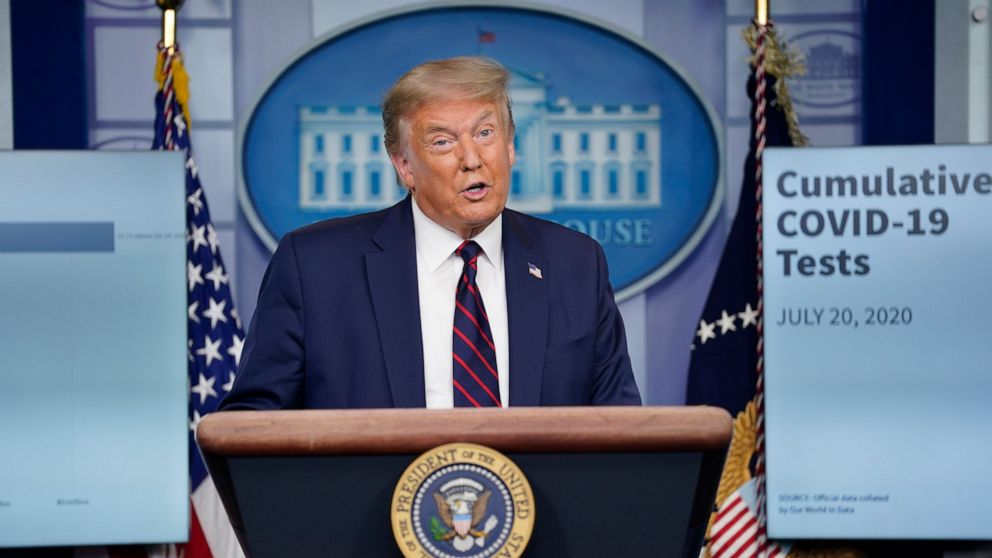
Trump abruptly departed on Tuesday from his rosy projections about the coronavirus, warning Americans from the White House briefing lectern that the illness would get worse before widespread recovery.

In his first virus-focused televised news conference since late April,Mr. Trump appeared before reporters to defend his track record, which has been widely criticized for his tendency to downplay the severity of the pandemic. Appearing without Vice President Mike Pence, Dr. Deborah Birx or Dr. Anthony S. Fauci, key members of his White House coronavirus task force, Mr. Trump also implored citizens — especially young people — to wear masks.

“Get a mask,” said Mr. Trump, who has been reluctant to wear them in public himself. “Whether you like the mask or not, they have an impact. They will have an effect and we need everything we can get.” Trump’s comment urging Americans to wear masks was a stunning departure from his past comments on wearing them. In recent weeks, he has disparaged masks as unsanitary and suggested that people who wore them were making a political statement against him.
Mr. Trump’s less dismissive comments about the pandemic reflected a dawning realization within his team that the virus not only is not going away but has badly damaged his standing with the public heading into the election in November. Approval of his handling of the pandemic has fallen from 51 percent in late March to 38 percent last week in polling by The Washington Post and ABC News.
Former Vice President Joseph R. Biden Jr., the presumptive Democratic nominee who now leads Mr. Trump by double digits, has assailed him in recent days for ignoring a devastating threat to the United States.

A study of patients in New York published in the journal JAMA reports that blood clotting problems may be significantly more common among Covid-19 patients than among those with other infectious diseases. And patients with blood-clotting problems were twice as likely to die, the study found.

The dubious deployment of armed enforcers within the U.S. is central to Trump’s politics


Trump is leveraging a manufactured excuse to use military and quasi-military forces for his political benefit 

WASHINGTON POST

The White House has argued that New York City is in the grip of a ferocious crime wave.
“Misguided movements, such as ‘Defund the Police,’ seek to leave our communities more vulnerable than ever,” White House press secretary Kayleigh McEnany said during a briefing earlier this month. “Case in point: This weekend alone, in New York, there were 44 shootings with 11 killed.”
“We can’t let this happen to the cities,” President Trump said on Monday. “New York was up 348 percent — the crime rate.” He claimed that the police “are afraid to do anything.

“If the governor is not going to do something about it,” Trump said, “we’ll do something about it.”
 
Asked what he would do, Trump pointed to the recent deployment of federal law enforcement to Portland, Ore.
“In Portland, they’ve done a fantastic job,” Trump said. “They’ve been there three days, and they really have done a fantastic job in [a] very short period of time. No problem. They grab them; a lot of people in jail. They’re leaders. These are anarchists. These are not protesters.” 
That statement alone is hard to defend, given documented instances in which people say they have been snatched off the street by unidentified people in military gear.
Those armed enforcers apparently worked for the Department of Homeland Security — thought it’s hard to say with certainty. DHS is leading the effort in Portland and has argued that its deployment is in response to a “siege” of federal buildings in the city. It produced a list of a number of actions taken by “violent anarchists,” most of which identified incidents of graffiti.
 
DHS derives its authority to deploy in Portland — and presumably New York — from an executive order Trump signed last month. That order, offered in response to incidents in which protests led to vandalism of government buildings or the toppling of public monuments, claimed that “Anarchists and left-wing extremists have sought to advance a fringe ideology that paints the United States of America as fundamentally unjust and have sought to impose that ideology on Americans through violence and mob intimidation.”
 
“They have led riots in the streets, burned police vehicles, killed and assaulted government officers as well as business owners defending their property, and even seized an area within one city where law and order gave way to anarchy,” the order read.

In response, DHS and other federal officials were ordered to leverage a patchwork of laws aimed at protecting government buildings, churches and memorials to establish a parallel police presence in targeted cities.

While incidents of violence and vandalism occur nightly in replayed footage that airs on Fox News, it is not the case that there is an ongoing series of violent protests in most American cities. The White House’s claims about the need for intervention in New York don’t even pretend to be about the protests that are the focus of Trump’s executive order, except by association: The protests are calling for changes in how police do their jobs, leading to changes at the NYPD, which the NYPD argues is enabling violent criminal activity.
 
There has been an increase in shooting incidents in the city, with shootings more than doubling over the past month. But those incidents have primarily taken place across an expansive area, from Brooklyn to northern Manhattan and into the Bronx. Deploying federal officers near federal buildings — clustered in southern Manhattan — wouldn’t do much. Deploying them in the city broadly wouldn’t either, unless the intent is to send thousands of DHS enforcers into the streets.
There are constant protests in New York City. It’s thoroughly dishonest to argue that those protests are connected directly to the violent incidents Trump is targeting. 
But that’s not what Trump is doing. What he’s doing instead is leveraging a manufactured excuse to use military and quasi-military forces for his political benefit — just as the White House ordered a group of peaceful protesters to be cleared from a plaza in Washington so Trump could visit a church for a photo opp.
 
We saw this same instinct well before the recent protests. In the weeks leading up to the 2018 midterm elections, Trump ordered the deployment of troops to the border with Mexico, arguing that a caravan of migrants traveling up from Central America demanded a federal armed response. The soldiers mostly stayed at the border putting up concertina wire until the election was over.

A few months later, Trump engineered a government shutdown to strong-arm Congress into funding a wall on that same border. When Congress declined to do so, Trump declared a national emergency predicated on a surge in families arriving and seeking asylum. That emergency allowed him to divert funding from across the Defense Department to the construction effort. While House Democrats tried to force an end to the emergency declaration, the Republican Senate has allowed it to continue.
 
National emergencies must be renewed annually. The White House did so in February despite a sharp drop in the number of migrants arriving at the border, the ostensible predicate for the emergency in the first place.
 
Trump has recently been taking victory laps on the issue. “You don’t hear about the wall. They don’t want to talk about the wall anymore. Do you notice?” Trump said at an event last month. “Never has the Democrat Party fought so hard against something. And do you notice? They never talk about the wall. Because, in the end, they gave it up. They gave up. We won.”

A victory on the wall was, of course, critical to Trump’s argument that he has delivered for his base since his 2016 election. It’s just as important as his warnings about frightening migrants were to his pitch in late 2018 and just as central as “law and order” has been to his reelection bid this year.
To fight for “law and order,” you need lawlessness and a mechanism to hold that lawlessness in check. Trump has managed to establish the mechanism — the law — and is now in the process of identifying the disorder.

Polling suggests his reelection message isn’t resonating. But that hasn’t stopped him before.