August 19, 2020

Why The Majority Of NYPD Misconduct Complaints End Up “Unsubstantiated”


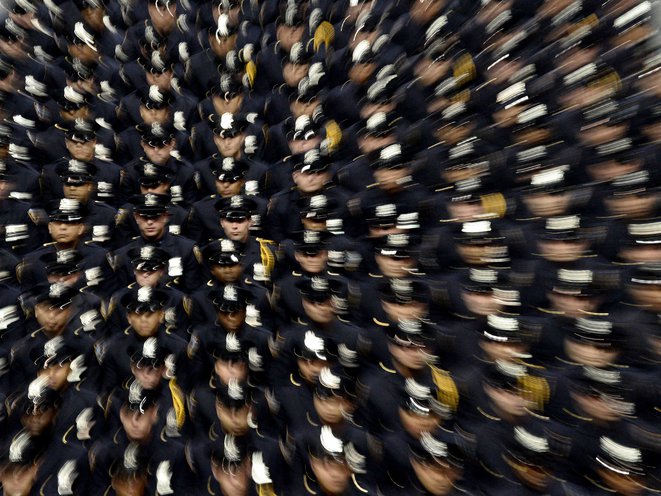
A zoom effect shows an aerial shot of officers in their dress uniforms.
Police officers graduating at a ceremony at the Barclays Center in 2013. ANDREW GOMBERT/EPA/SHUTTERSTOCK

Randell Simon had just returned home after dropping his son off at school on January 9th, 2019, when he saw three plainclothes NYPD officers blocking the way to his building’s front door.

The officers were there to serve a warrant in a neighboring building. Simon, 34, said one of them, Captain William Diab, quickly became discourteous and told him, “I’ll smack the ‘F’ out of you.”

Simon said Diab, then a lieutenant, issued a threat that’s burned into his memory. “This is his exact word: ‘I'm not from this district. I don't police in this district. You'll never see me again. I'll kill you.’”


Video recovered from a security camera shows Diab, in a backwards Yankees hat, using his entire body to back Simon into a corner. Moments later, Diab grabs Simon by his coat and slams him against a stone wall, as Simon puts his hands up. Simon was arrested and charged with assaulting an officer and resisting arrest.


Five months later, Simon filed a complaint against Captain Diab with the Civilian Complaint Review Board, the body that investigates police misconduct.


Simon’s case languished for a year and a half, as investigators tracked down the other two officers involved in the scuffle. He took personal days off from his job as an employee with the city’s Department of Youth & Community Development so he could provide information to the CCRB.


Despite the security camera video, sworn testimony from Simon, and the fact that Simon’s charges were ultimately dismissed, the CCRB deemed Simon’s complaint “unsubstantiated” in an official determination in June. The ruling means that investigators could not produce sufficient evidence to recommend disciplinary charges against an officer to the NYPD commissioner.


The CCRB did not give Simon a reason explaining their decision.

“My heart felt broke,” said Simon. “I just feel everything was clear cut from the video, from the affidavit, from the officer, and you could see the wrongdoings, and I don't understand. What is the CCRB looking for?"


The case, one of thousands investigated by the CCRB every year, underscores the difficulty in substantiating police misconduct.


The CCRB has a relatively small staff and budget—$19 million compared to the police department’s $5 billion budget—which was recently cut even further. Some CCRB investigators are left with handling upwards of 30 cases simultaneously. Delivering the burden of proof is arduous for the complainant, who must testify in person; if no video evidence exists, their word is pitted against that of an NYPD officer.


And the NYPD has routinely stonewalled CCRB investigations, often withholding critical evidence that can advance a case, according to an investigation by ProPublica. In some instances, the NYPD redacts or withholds names of potential witnesses on records found on warrants, arrests records, documents listing who was in station house calls, and injury officer reports, said the report. More recently, the NYPD has not complied with requests to obtain body-worn cameras from uniformed officers, with hundreds of requests to obtain videos for investigations still pending.


From 2010 through 2019, the CCRB reached conclusions in 17,325 complaints, with 8,775 of those complaints deemed unsubstantiated, according to figures provided by the agency, making it the most common determination. This contrasts with 2,933 cases deemed substantiated over that same time period.


Also within that same period, there were also 1,525 cases listed as unfounded, meaning there was enough evidence to show the allegation made against an officer didn’t happen, and 2,939 cases where the officer was exonerated, where the actions committed by the officer were lawful. The remainder of the cases, 1,153, were deemed “MOS Unidentified,” in which an officer alleged to have committed misconduct was not properly identified to proceed with a disciplinary action.
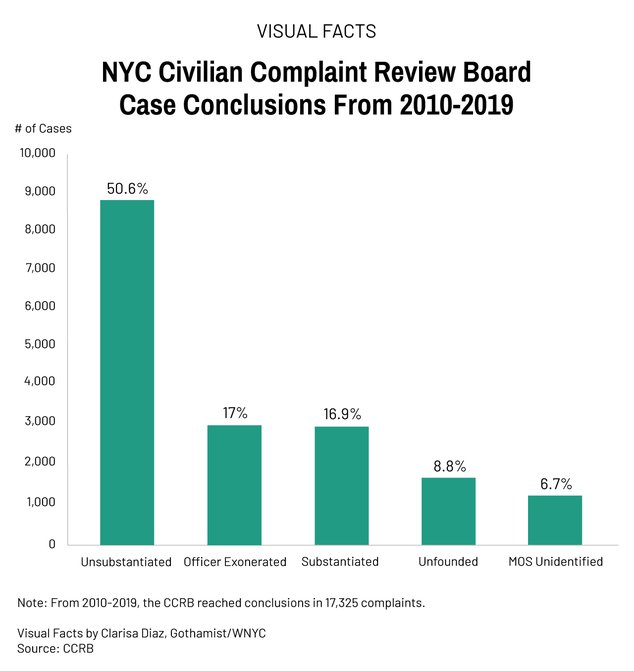
A graph breaking down the number of CCRB complaints filed from 2010 to 2019, showing the rate of "unsubstantiated" cases vs. "substantiated" cases.

The time and effort required to pursue a case often cause complainants to just give up. In the latest CCRB annual report, 49 percent of all cases filed in the first half of 2019 were “truncated,” meaning someone does not follow through on their complaint, decides to withdraw their case, or cannot be tracked down by investigators.


Public Advocate Jumaane Williams, who has pushed for increasing the CCRB’s powers, filed a CCRB complaint in 2011 after he and activist Kirsten John Foy were arrested at the West Indian Day Parade.


Williams, who at the time was a Councilmember representing East Flatbush, Marine Park, and Midwood, was detained and held by police after he and Foy were crossing through a barricaded sidewalk. Williams and Foy—both Black—were soon met by police officers who pushed them to the ground. They were both detained but not charged with a crime. Williams and Foy still pursued a complaint with the CCRB, claiming the officers had used excessive force.


Even with video capturing a portion of Foy’s arrest, the CCRB exonerated the officers in Williams’ case and unsubstantiated the claims in Foy’s case.

"It showed the strength of the officer's word,” said Williams of the experience. “I was a City Councilmember and my word didn't mean anything.”


In cases without any video evidence, the unsubstantiation rate was 51 percent, while in cases where there was video, it was 44 percent, according to a recent CCRB study.


But even if there is video, an officer can dispute what’s on screen, which could then trigger an unsubstantiated complaint, according to Jenzo DuQue, a former CCRB investigator who serves as an investigator for Neighborhood Defender Service in Harlem.

DuQue recalled that the police would argue that the video was inconclusive or that it “doesn’t feel like a representation” of what actually happened, which would then increase the chance that a complaint would be unsubstantiated.


“Part of the circumstances are just officer perception,” said DuQue. “And so they're going to make decisions or justifications, based on that additional information that isn't readily available [to investigators].”


Body-worn cameras, which all uniformed NYPD patrol officers were equipped with in the beginning of 2019, appear to help the CCRB reach determinations in cases. Between May 2017 and June 2019, the CCRB reached determinations in 76 percent of complaints with body-worn camera evidence, compared to 39 percent when no video was available, according to a recent survey.


But the CCRB does not have direct access to body camera footage—they must request it from the NYPD. Currently there is a backlog of roughly 700 requests for this footage.

Adding to the bureaucracy is the fact that the CCRB—composed of mayoral, New York City Council, and NYPD appointees—does not have final say over whether officers should face discipline. That powers lies with the NYPD Commissioner.


“Investigators have no real control over the outcome of a case,” said DuQue. “The board decides whether misconduct occurred and whether to recommend discipline, but ultimate authority falls to the commissioner, who can similarly flip allegations and disagree with the board's findings, so there are many layers between investigation and determination/outcome.”

An unsubstantiated complaint can also happen when an officer fails to appear at their CCRB interview, a requirement by the New York City Charter that hasn’t been enforced by the NYPD, according to Maryanne Kaishian, a defense attorney with Brooklyn Defender services, who is familiar with Simon’s case.


“If the police fail to show up, fail to explain the actions that they were taking, fail to explain what it is that they were doing in the neighborhood or why it was they approached somebody, the CCRB may be unable to determine whether NYPD rules were broken. Since an unsubstantiated claim means that the CCRB cannot reach a determination, this may be the result of police refusing to cooperate,” said Kaishian.


Ethan Teicher, a spokesperson for the CCRB, said that the board’s mandate is that a “preponderance of the evidence” must be collected to prove a substantiated or exonerated case, adhering to the rules presented in the NYPD patrol guidebook. In a statement, Teicher acknowledged that “current unsubstantiation rates are a problem for New York City that the CCRB is committed to solving.”


“In fact, reducing the unsubstantiation rate is a significant reason why the Agency continues to push the NYPD to address the backlog of body-worn camera requests,” said Teicher. “New Yorkers need the CCRB to be able to make fact-based investigative findings. It is crucial that the CCRB have access to as much evidence as possible in order to carry out its investigative mandate.”


Unsubstantiated complaints—which remain on an officer’s record—hold some usefulness when establishing a pattern of alleged misconduct, according to Molly Griffard, an attorney with the Legal Aid Society.


"It can be telling when there's a pattern of complaints against an individual officer or a precinct,” said Griffard. “It doesn't tell you for sure that [an unsubstantiated case] happened, but it does tell you that a number of people have complained about a similar type of misconduct that this officer or precinct are engaging in, which I think can then tell the public here are some of the problems with policing and also should be tell our lawmakers about what's going on with policing and what and public perceptions of policing as well."


A trove of CCRB data recently published by ProPublica reveals a portion of Captain Diab’s record, showing 44 complaints filed against him, in which 22 were unsubstantiated, 12 exonerated, two unfounded, and seven substantiated, requiring retraining. The dataset does include the five unsubstantiated complaints and one exoneration involving Simon’s case against Diab. Those include discourtesy, abuse of authority, and force allegations. (You can read more about those newly released police disciplinary records here).


"He has a very long record of complaints and it’s baffling that the city has him still being a police officer," said Simon. "How can we get the bad apples out if the CCRB finds every officer is cleared of doing their wrongdoing? What other way do we get the bad apples out?”

Gothamist asked the NYPD if they or Captain Diab wanted to comment for this story. They have not responded to Gothamist's request. A request for comment to the Captains Endowment Association was not returned.


A year and a half since his incident, Simon continues to deal with the aftermath of the confrontation that’s left him wary of the police and a system he thought would help him.

"This affected not only my life, it affected my kid's life. Every time I go out of the house, my son says, 'Daddy, oh, you see police, run,'" said Simon.

His recommendation when filing a complaint? “Don’t bother.”
Surge in Covid cases among children fuels fears over US school reopenings


Experts challenge ‘myth’ that kids are not at risk as new study adds to worrying reports from schools and camps


An exponential rise in Covid-19 cases among children in the US has raised the alarm among experts as the new school year begins.

recently released study from the American Academy of Pediatrics and the Children’s Hospital Association found that nearly 339,000 coronavirus cases among children have been reported across the nation since the start of the pandemic, with 97,000 cases reported just in the last two weeks of July.

The findings add concern to troubling reports emerging from places that moved early to reopen schools. The day after classes resumed for one Georgia school district, a second-grade student tested positive for coronavirus, sending his teacher and classmates home for a two-week quarantine. The same week, Georgia’s department of health confirmed the death of a seven-year-old boy, the state’s youngest to die from the virus. He had no underlying health conditions.

Linda Rosenstock, a professor of health policy and dean emeritus of UCLA’s Fielding School of Public Health, said the surge in cases among young people was a reflection of the widespread toll the virus has taken across the country.

“A fair interpretation of this data is that as cases rise, more children are infected. In the same way the lockdown helped slow the rise, when restrictions were loosened, we saw more cases overall,” said Rosenstock.

“It reflects the state of the pandemic that is running unabated in the US at the moment,” she added. “If you try to reopen in places where the disease is raging, we’d see a rise of cases among children.”

Rosenstock said the fact that fewer children were tested earlier in the pandemic may have fueled a “myth” that children were not at risk of infection. While research suggests that children tend to have milder symptoms than adults, she said the new data attests to the fact children can still infect adults, whose symptoms can be more severe.

The findings undercut assumptions that children are unlikely to catch and spread coronavirus to adults and other children – a claim Donald Trump seized on to make a case that schools should reopen for in-person instruction this fall.

What we know about kids and coronavirus in the US


The nation’s understanding of how coronavirus affects kids has evolved during the pandemic. Experts say the new study further confirms that children can play a significant role in spreading the virus and that, in rare cases, infections can lead to severe illness or death among youth.

Nationally, children represent 8.8% of all Covid infections, according to the report from the American Academy of Pediatrics. About 70% of the new cases reported among children in July came from states in the south and west, where coronavirus has ripped through the population.

California, which late last month saw its first death of a child due to Covid, has reported more cases than other state. But its share of infected children relative to the overall population puts in the middle of the pack, just above the national average. Wyoming, Tennessee and New Mexico top the per-capita infection rates for children; in all three states, children account for more than 15% of all cases.

Children represent fewer than 4% of hospitalizations from the virus and account for fewer than 1% of Covid-related deaths in states that reported results. Twenty states reported zero child deaths.

Katherine Williamson, a pediatrician in southern California’s Orange county and a spokeswoman for the American Academy of Pediatrics, said the findings also indicated that the virus impacts children differently across age groups.

Children younger than five tend to be least symptomatic, Williamson said, and outbreaks among children and teachers at care centers and preschools remain low. The risk goes up for children aged five to 10, and children over 12 appear to have more adult-like symptoms, she said.

“The hard part is that because young children are less symptomatic, we may miss the symptoms and neglect to test them,” Williamson said.

What it means for reopening schools


The report comes as states and regions across the country wrestle with how to safely reopen schools for in-person instruction this fall, a decision with both academic implications for children and economic consequences for parents hoping to find childcare and return to work.

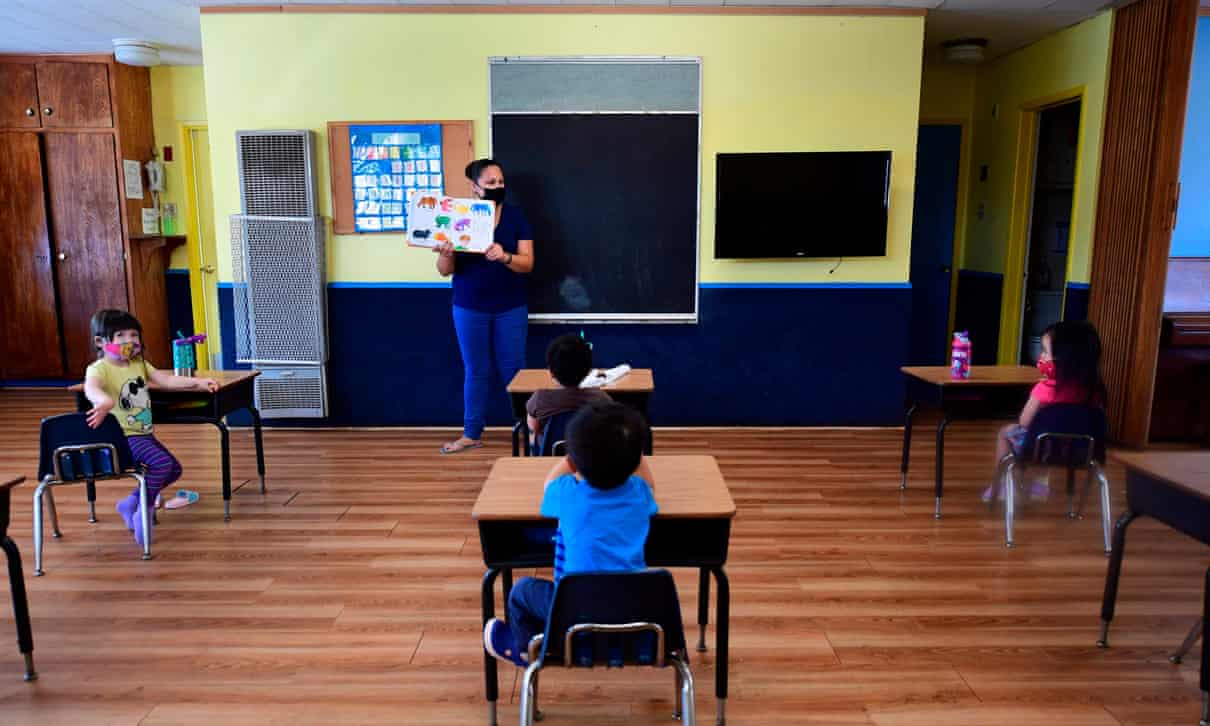
“We have a fairly good idea of how to decrease the risk of spreading the virus in schools through social distancing, masking, hand-washing, and screening for systems before students enter school,” Williamson said. Just as important, she added, was consistent enforcement of the safety measures.

“That last piece is where places got in trouble. They started getting lax about the rules and then cases went up,” said Williamson.

John Swartzberg, a clinical professor emeritus of infectious diseases and vaccinology at UC Berkeley’s school of public health, said the timing of the case surge highlighted by the report did not bode well for a return to in-person instruction in the near future.

“The very significant increase in cases occurred when children were out of school, which suggests that if we put children back in school, it will exacerbate the problem,” Swartzberg said.

Mitigation efforts, however, will cost extra money: additional classrooms would have to be used to put distance between students, which would require more teachers.

“For the bulk of public schools in the US, which have been horrifically underfunded for so long, where are those resources going to come from? At schools I know in the Bay Area, teachers buy paper and colored pencils for the kids because the school district can’t do it. And that was before the pandemic,” Swartzberg said.

“Putting children back in school, sending students back in universities, is a great experiment,” he said. “We have no idea what’s going to happen.”


Calif Wildfires/Postmaster Gen/NYC Gyms/UPDATES

In California, record heat, rolling blackouts and now wildfires test a state already besieged.

Gov. Gavin Newsom of California warned that power outages were likely to continue in coming days and urged Californians to reduce their energy usage.

On Monday, Gov. Gavin Newsom of California called for an investigation into what he described as a major utility failure that was even more alarming set against the backdrop of the pandemic, when people, many largely confined inside, may be more dependent than ever on electricity: rolling blackouts over the weekend, caused by a record-shattering heat wave.

And a wave of wildfires are also posing particular challenges in the pandemic, Mr. Newsom said, as officials struggle to shelter residents forced to flee, and the state’s firefighting force has been depleted thanks to outbreaks in the state’s prisons.

The power issues and wildfires could also have impact on education. A reporter asked, for instance, about how the state would address the loss of remote learning time, if students lose power. “In extenuating circumstances, we have to be flexible,” he said.

The blackouts came not long after California leaders scrambled to address problems with the state’s virus data reporting system, which clouded case counts and threw into question the list of counties where virus transmission is particularly troubling.

Mr. Newsom said on Monday that the backlog of cases arising from the data glitch had been cleared, and that the state’s seven-day average reflected that.

The state’s positivity rate and other measures, such as hospitalizations, he said, were moving in the right direction.
The sun set last week on a lonely cactus in Death Valley in Southern California.
 

Death Valley Just Recorded the Hottest Temperature on Earth

In the popular imagination, Death Valley in Southern California is the hottest place on earth. At 3:41 p.m. on Sunday, it lived up to that reputation when the temperature at the aptly named Furnace Creek reached 130 degrees Fahrenheit, according to the NOAA Weather Prediction center.

If that reading — the equivalent of 54 degrees Celsius — is verified by climate scientists, a process that could take months, it would be the highest temperature ever reliably recorded on earth.

Death Valley is no stranger to heat. Sitting 282 feet below sea level in the Mojave Desert in southeastern California near the Nevada border, it is the lowest, driest and hottest location in the United States. It is sparsely populated, with just 576 residents, according to the most recent census.

Brandi Stewart, the spokeswoman for Death Valley National Park, said that the valley is so hot because of the configuration of its lower-than-sea-level basin and surrounding mountains. The superheated air gets trapped in a pocket and just circulates. “It’s like stepping into a convection oven every day in July and August,” she said. So how does 130 degrees, which she walked out into on Sunday, feel? “It doesn’t feel that different from 125 degrees,” she said. “The feeling of that heat on my face, it can almost take your breath away.”

She added that “People say, ‘Oh, but it’s a dry heat!’ I want to do a little bit of an eye roll there,” she said. “Humidity has its downsides too, but dry heat is also not fun.”

The heat rises through the afternoon, generally reaching the peak from 4 p.m. to 5:30 p.m. The high on Monday was 127.

The previous record for highest temperature was also observed in Death Valley on June 30, 2013, at 129 degrees. The same temperature was also recorded in Kuwait and Pakistan several years later.

And that is also important to understand: There may be hotter places than Death Valley, such as parts of the Sahara, but they are too remote for reliable monitoring, said Daniel Swain, a climate scientist at the University of California, Los Angeles and the National Center for Atmospheric Research.

As the greenhouse gases that humans generate continue heating the planet, more records are expected, and not just in Death Valley.

In a letter to the F.B.I. director on Monday, two Democratic congressman said the postmaster general had “hindered the passage of mail.”

The postmaster general received millions in income from a company that works with U.S.P.S., documents show.

Postmaster General Louis DeJoy, who has come under fire for financial ties to a company that does business with the United States Postal Service, received between $1.2 million and $7 million in income last year from that firm, according to financial disclosure forms reviewed by The New York Times.

Mr. DeJoy continues to hold between $25 million and $50 million in that company, XPO Logistics, where he was chief executive until 2015 and a board member until 2018. Those stock holdings were first reported last week by CNN.

But documents filed with the Office of Government Ethics show that Mr. DeJoy also receives millions of dollars in rental payments from XPO through leasing agreements at buildings that he owns. The revelations are likely to fuel further scrutiny of Mr. DeJoy, a major donor to President Trump who has made cost-cutting moves and other changes at the Postal Service that Democrats warn are aimed at undermining the 2020 election.

Mr. DeJoy agreed on Monday to testify next week before the House Oversight Committee, where Democrats are expected to press him on the justification for his policies and question his potential conflicts of interest.

Mr. DeJoy has maintained that he has fully complied with federal ethics rules and that the measures he has implemented are necessary to modernize the Postal Service. “I take my ethical obligations seriously, and I have done what is necessary to ensure that I am and will remain in compliance with those obligations,” Mr. DeJoy said in a statement.

Elsewhere on the postal front:

  • Two Democrats on the House Judiciary Committee urged the F.B.I. to open a criminal investigation into actions by Mr. DeJoy and the Postal Service’s Board of Governors that may have caused mail delays. “Multiple media investigations show that Postmaster DeJoy and the Board of Governors have retarded the passage of mail,” Representatives Ted W. Lieu of California and Hakeem Jeffries of New York wrote in a letter to the F.B.I. director. “If their intent in doing so was to affect mail-in balloting or was motivated by personal financial reasons, then they likely committed crimes.”

  • Mail-in voters from six states filed a lawsuit against Mr. Trump and Mr. DeJoy, seeking to block cuts to the Postal Service ahead of the election.

  • Senator Mitch McConnell, pushed back on Monday on concerns that the Postal Service would not be able to handle as many as 80 million ballots come November, telling reporters in his home state that “the Postal Service is going to be just fine” and that Treasury Secretary Steven Mnuchin had already signaled a willingness to spend more on it.

  • The House Speaker, Nancy Pelosi, Democrat of California, said Sunday that she would call the House back from its annual summer recess almost a month early to vote this week on legislation to block changes at the Postal Service.

  • Postal slowdowns and warnings of delayed mail-in ballots are causing election officials to rethink vote-by-mail strategies, with some states seeking to bypass the post office with ballot drop boxes, drive-through drop-offs or expanded in-person voting options, despite the coronavirus pandemic.

    The 2020 election was supposed to be the largest-ever experiment in voting by mail, but the Trump administration’s late cost-cutting push at the Postal Service has shaken the confidence of voters and Democratic officials alike. The images of sorting machines being removed from postal facilities, mailboxes uprooted or bolted shut on city streets, and packages piling up at mail facilities have sparked anger and deep worry.

    Even if, as the Postal Service says, it has plenty of capacity to process mail-in ballots, the fear is that the psychological damage is already done. So as Democrats in Washington fight to restore Postal Service funding, election officials around the country are looking for a Plan B.

  • The newest front in the battle over voting in 2020 is the drop box, where ballots mailed out to voters can be returned without fear of Postal Service backlogs or coronavirus infection. Once voters deposit their ballots in such boxes, they are collected by election officials and brought to polling places for tabulation.

    Election officials in Connecticut, Virginia, Pennsylvania and elsewhere are seeking to expand drop-off locations for absentee and mail-in ballots, but they have met vehement opposition from President Trump and his campaign.

    • Ahead of a pair of congressional hearings, the US postmaster general is “suspending” new Postal Service initiatives that drew widespread criticism. [Washington Post / Jacob Bogage]
    • P>S>: There’s no meaningful distinction between voting by mail and absentee voting. [Vox / Dylan Matthews]
  • Students waiting outside Woollen Gym on the University of North Carolina at Chapel Hill campus on Monday. The school announced it would shift to remote learning for all undergraduate classes starting Wednesday.
  • U.S. college campuses grapple with coronavirus fears, outbreaks and protests.

  • The University of North Carolina at Chapel Hill announced it would shift to remote learning for all undergraduate classes starting Wednesday.

    The university, with 30,000 students, was one of the largest in the country to open its campus during the pandemic. Officials said 177 students had been isolated after testing as of Monday, and another 349 students were in quarantine because of possible exposure.

  • The university said it would help students leave campus housing without financial penalty. It was not immediately clear how the university’s decision would affect its athletic programs, though North Carolina said that student-athletes could remain in their dormitories.

    The university’s athletic department said in a statement that it still expected its students would be able to play fall sports, but that it would “continue to evaluate the situation.” 

  • Earlier this month, dozens of students protested plans to reopen by staging a “die-in” on campus. A similar protest erupted on Monday at the Georgia Institute of Technology in Atlanta, the first day of fall classes. The school had said that majority of courses would have some in-person attendance this fall, but dozens of students and faculty members staged a “die-in” on campus to push for more options for staff and students to teach or learn remotely.

  • Some of the concerns about reopening college campuses have been directed at students who have gathered at bars or house parties. Video footage appearing to show University of North Georgia students attending a crowded off-campus party garnered online attention over the weekend
  • Gyms and fitness centers have been closed in New York City since March 16, and statewide since March 22.
  • N.Y. Gyms and Fitness Studios Can Reopen as Soon as Aug. 24, Cuomo Says.

  • Health clubs will be limited to a third of their total capacity and must meet state requirements before reopening.
  • Mr. Cuomo’s announcement came with several caveats: Gyms would be limited to a third of their total capacity, and people would be required to wear masks at all times. The state would also require air filters that help prevent airborne transmission of viral particles and sign-in forms to assist with contact-tracing efforts.

    Local governments will also need to inspect gyms to make sure they meet the state’s requirements before they open or within two weeks of their opening.

    Local elected officials can stop gyms from holding indoor classes, Mr. Cuomo said. New York City has decided not to initially allow indoor fitness classes or indoor pools to operate when gyms reopen, a spokesman for the mayor said.

    Mr. Cuomo’s announcement came with several caveats: Gyms would be limited to a third of their total capacity, and people would be required to wear masks at all times. The state would also require air filters that help prevent airborne transmission of viral particles and sign-in forms to assist with contact-tracing efforts.

    Local governments will also need to inspect gyms to make sure they meet the state’s requirements before they open or within two weeks of their opening. Local elected officials can stop gyms from holding indoor classes, Mr. Cuomo said. New York City has decided not to initially allow indoor fitness classes or indoor pools to operate when gyms reopen, a spokesman for the mayor said.

    Mr. Cuomo said on Monday that gyms would be allowed to reopen because New York has successfully kept its rate of positive coronavirus test rates hovering around 1 percent since June.

    Still, Mr. Cuomo said that he remained worried that reopening gyms might accelerate the virus’s spread. He said his main concern was that local governments would not adequately enforce the state’s restrictions, noting, as he has before, how many cities and towns have not aggressively cracked down on bars and restaurants ignoring social distancing measures.

    It was not clear on what day New York City would clear gyms for reopening, or which agency would be responsible for conducting the necessary inspections or enforcing regulations.

    Last week, Mr. Cuomo announced that museums and other cultural institutions in New York City, which stayed closed even as their counterparts reopened in the rest of state, would be allowed to reopen on Aug. 24, at 25 percent capacity and with timed ticketing.

    Also last week, Mr. Cuomo gave bowling alleys statewide the green light to reopen with strict protocols in place: Every other lane is supposed to be blocked off because of social distancing, and bowling equipment must be properly sanitized.

In 'Rigged,' A Comprehensive Account Of Decades Of Election Interference


Rigged
Rigged
America, Russia, and One Hundred Years of Covert Electoral Interference
Hardcover, 384 pages
NPR
In the bleak midwinter of a political year in Washington, a top out-of-power partisan contacts a Russian diplomat at the embassy in Washington.
The topic of discussion: What their governments might do for each other in the coming administration.
This scene may sound familiar, only it wasn't former national security adviser Mike Flynn. The American political figure was former Illinois Gov. Adlai Stevenson, who went up to the Soviet embassy in January of 1960 to see Ambassador Mikhail Menshikov.
After "caviar, fruits and drinks," his excellency the ambassador produced a message from Soviet premier Nikita Khrushchev. "We are concerned with the future, and that America has the right president," the Soviet leader wrote, per Stevenson's later recollection. Moscow wanted to get behind him against what it considered a distasteful hardliner: Vice President Richard Nixon. "Because we know the ideas of Mr. Stevenson, we in our hearts all favor him," Khrushchev wrote. Continued the letter:
"Could the Soviet press assist Mr. Stevenson's personal success? How? Should the press praise him, and if so, for what? We can always find many things to criticize Mr. Stevenson for because he has said many harsh and critical things about the Soviet Union and communism! Mr. Stevenson will know best what would help him." 
This overture — which Stevenson rebuffed — is one of many gems unearthed by David Shimer in his important new history, Rigged: America, Russia, and One Hundred Years of Covert Electoral Interference.
Stevenson's encounter encapsulates the essence of a very old game.
If Russia's attack on the 2016 election and other elections in Great Britain and Western Europe seemed like bolts from the blue, they shouldn't. Shimer's authoritative book places them in their proper context as only the latest installments in the long-running and sometimes grim practice of statecraft.
To be clear, the experiences of 2016 and since were novel in key ways, of which more below, but the premise of the work — the goal of a nation to bring about a desired outcome within the politics of another — was not.
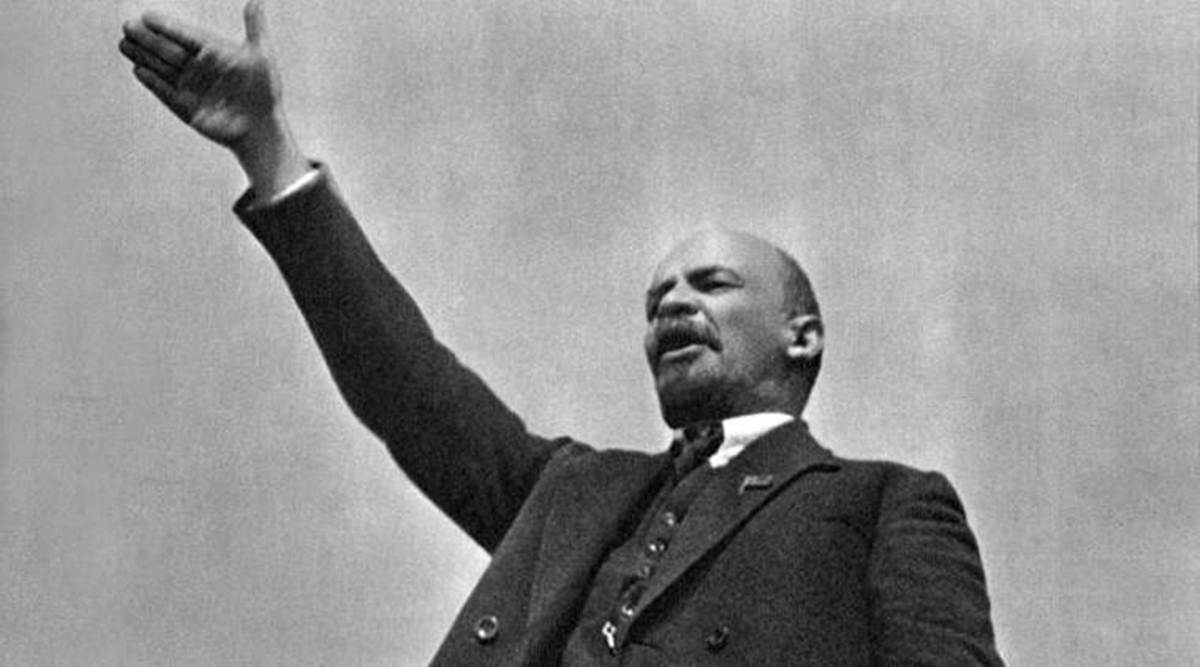
Lenin is not a figure to look up to at a time when we want more democracy,  not less | The Indian Express
Comrade Lenin
The Russians, Shimer argues, had a head start, one that derives from the ambitious and paranoid aspects of early Communism in the Soviet Union and its progenitor, Vladimir Lenin.
They also had a standing, peacetime secret intelligence service, which the United States, in the 19-teens, did not. Lenin and his successors made foundation stones of the agencies that became — and then evolved from — the KGB and the army's GRU.
Washington tried to catch up.
After World War II, it and the then-new CIA also got into the business of trying to change the course of events within nations around the world.
This work made the CIA infamous in many places, but Shimer focuses his attention in Rigged specifically on the influence of democratic elections, not on coups or armed operations.
The American stories haven't been excavated as often and make for fascinating reading, as when President Harry Truman ordered the CIA to help defeat communists in Italy's 1948 election. It did many things, including infuse a lot of cash.
"We had bags of money that we delivered to selected politicians to defray their political expenses, their campaign expenses, for posters, for pamphlets," as Shimer quotes one CIA officer.
But election influence also wasn't that simple: Much of the American suasion in the Italian election was as plain as day and wielded in the open.

3 Times the United States Intervened in Foreign Elections

1) Italy – 1948

Election Rally
In the 1964 Chilean presidential election, the Soviets were known to be supporting well-known Marxist candidate Salvador Allende, who had unsuccessfully run for the presidency in 1952, 1958, and 1964. In response, the U.S. government gave Allende’s Christian Democratic Party opponent, Eduardo Frei over $2.5 million.Allende, running as the Popular Action Front candidate, lost the 1964 election, polling only 38.6% of the votes compared to 55.6% for Frei.
In the 1970 Chilean election, Allende won the presidency in a close three-way race. According to report from the Church Committee, a special U.S. Senate committee assembled in 1975 to investigate reports of unethical activities by the U.S. intelligence agencies, the U.S. Central Intelligence Agency (CIA) had orchestrated the kidnapping of Chilean Army Commander-in-Chief General René Schneider in an unsuccessful attempt to prevent the Chilean Congress from confirming Allende as president. 
The inside game vs. the outside game
Washington threatened to withhold post-WWII aid if Rome went communist; Italian-Americans wrote letters to relatives in the old country urging them to spurn the communists; Frank Sinatra and Joe DiMaggio contributed radio broadcasts.
History records that Italians elected the Christian democrats who were Washington's preferred interlocutors and kept the communists out of power.
So how much of that was thanks to the public messaging from the United States — and how much because of the CIA's hidden hand? This question about causality and efficacy will linger.
Inside the Agency and around Washington, however, the answer was obvious. Shimer's research and reporting shine in sections like this one, in which he characterizes the sentiment about how much the CIA believed its own work: He quotes one official saying it, then a second, and then a third.
Although the efficacy of covert action might never be provable definitively, leaders in Washington and Moscow continued to believe in the value of this kind of work through the Cold War and beyond. Then-deputy CIA Director Robert Gates was reporting to Congress in secret about Soviet election interference in the 1980s.

3) Yugoslavia — 2000

Serbia - Belgrade - Student demonstration against Milosevic
Since incumbent Yugoslav President Slobodan Milosevic had come to power in 1991, the United States and NATO had been using economic sanctions and military action in failed attempts to oust him. In 1999, Milosevic had been charged by an international criminal tribunal for war crimes including genocide in connection with the wars in Bosnia, Croatia, and Kosovo.
In 2000, when Yugoslavia held its first free direct elections since 1927, the U.S. saw a chance to remove Milosevic and his Socialist Party from power through the electoral process. In the months before the election, the U.S. government funneled millions of dollars into the campaign funds of anti- Milosevic Democratic Opposition Party candidates.
The U.S. contribution to the campaigns of Kostunica and other Democratic Opposition candidates galvanized the Yugoslavian public and proved to be the decisive factor in the election. “If it wouldn’t have been for overt intervention,” he said, “Milosevic would have been very likely to have won another term.”
And President Bill Clinton — whom Shimer interviewed for this book — described his desire to put Uncle Sam's thumb on the scales in the 2000 election in Serbia that ousted its infamous president Slobodan MiloÅ¡ević. The State Department helped opponents and civic organizations and trained activists to monitor polling places.
"For Washington, overt democracy promotion, rather than covert electoral interference, had become the rule," Shimer writes.

Comrade Putin
Russian President Vladimir Putin was watching. He complained to Clinton about the American military operations in the former Yugoslavia and appears never to have dropped his belief that the United States was worming into elections around the world — and especially in his front yard.
Meanwhile, the world moved online. That not only made individual American political targets vulnerable to foreign cyberattackers but also millions of people available, in a new, "neutral" medium, to the very old arts of persuasion or agitation.
In the old days, a group with a name such as "the World Peace Council" might have circulated pamphlets. Or an explicitly communist group might have made a straight-ahead case for world revolution, as Shimer writes.
By 2016, an influence specialist in Saint Petersburg, posing as a fellow citizen, could metaphorically tap an individual American on the shoulder. They formed groups. They shared memes. They organized rallies that took place in the real world.

And in key cases, as, for example, with black voters, they hammered a message: "We" — Russians pretending to be black American citizens — can't win with either of these candidates, so "we" — real black voters — must stay home.
And so on.
Disinformation is consequential. Based on nothing more than the apparently comforting or affirming nonsense they've been told by a stranger, people will take action. Some even will take actions that endanger their own children, and others, by keeping them from being vaccinated.
Many people, even most people, may not respond to these kinds of suggestions in this way. But in an American election that can be decided by small margins — fewer people than fit into Michigan Stadium on a typical autumn Saturday to see the Wolverines — reaching and changing individual minds isn't nothing.
If you could get a message to 100 million people and affect the behavior of 1 percent of them, that could do the trick.
What difference does it make
Does that mean that Russia elected Trump in 2016?
Shimer recounts the story in ample detail and includes the views of both those who think it was determinative and those who believe it wasn't. His section about the torturous deliberations within President Obama's administration about how to respond to Russia's active measures is comprehensive to the point of encyclopedic.
Shimer's purpose is less to answer the question — after all, the spies and diplomats still don't all agree about the U.S. efforts in Italy in 1948 — than to establish that after roughly a century of dirty tricks and active measures, the reach afforded by Facebook and Twitter changed the old game for malefactors such as Russia's "Internet Research Agency."
"The CIA focused on manipulating the psyches of Italian voters," Shimer writes. "Today, billions of people have uploaded their psyches to the Internet, exposing them to targeted manipulation. The platform is new, but the goal of shaping people's views is not."
Later, in assessing 2016, he writes: "What must be beyond debate is that the IRA influenced the minds of unsuspecting voters. Its divisive content spread far and wide, reaching more than 100 million Americans," he writes.
That also has brought a new default kind of practice in statecraft and politics.
Political campaigns must be on guard for attacks, as must elections officials across America's thousands of individual voting jurisdictions, as must spies and security officials and Washington. Political cyberattacks continue apace.

The United States has spent hundreds of millions of dollars to buy new machines, upgrade IT systems and change its practices to try to protect ballots from interception, sabotage or other mischief.
But as Shimer writes in his painstaking book, this game has seldom been about changing ballots as much as it has been about changing minds.

Trump dramatically accelerates the pace of his efforts to weaponize the federal government to his advantage.

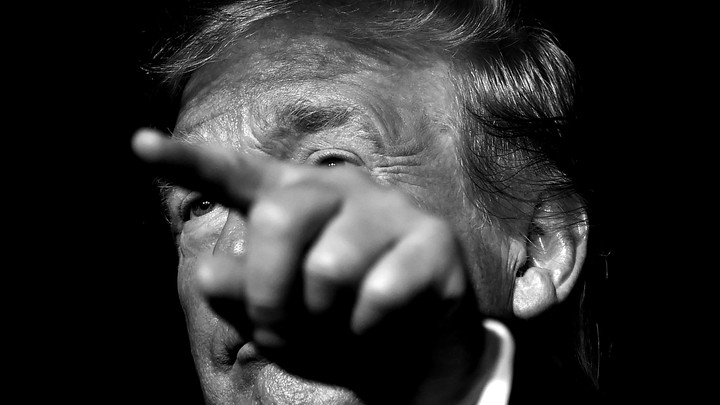
 Donald Trump points a finger into the distance.


RONALD BROWNSTEIN, ATLANTIC

Trump’s open admission yesterday that he’s sabotaging the Postal Service to improve his election prospects crystallizes a much larger dynamic: He’s waging an unprecedented campaign to weaponize virtually every component of the federal government to partisan advantage.

Trump is systematically enlisting agencies, including the Postal Service, Census Bureau, Department of Justice, and Department of Homeland Security, that traditionally have been considered at least somewhat insulated from political machinations to reward his allies and punish those he considers his enemies. He is razing barriers between his personal and political interests and the core operations of the federal government to an extent that no president has previously attempted.

Presidents have always put their stamp on the federal government. It’s common for regulatory agencies, for instance, to dramatically shift direction in their attitude toward Big Business when partisan control of the White House changes. And presidents have always rewarded their political supporters, at times causing scandals because of questionable Cabinet appointments or procurement decisions.

But no matter which individuals were appointed to lead them, some agencies have always been considered more protected from politics. It’s those barriers that Trump, with the tacit support of congressional Republicans, is steadily dismantling. Presidents have used the Postal Service to reward loyalists with jobs since the country’s earliest history. But they didn’t expect what Trump does from the agency. “The whole spoils system goes back to having supporters who were appointed as postmasters,” says Kedric Payne, the general counsel of the nonpartisan Campaign Legal Center and a former top official at the Office of Congressional Ethics. “But it wasn’t to disrupt the election.”

Trump has dramatically accelerated the pace of his efforts to weaponize federal actions since his Senate acquittal. Beyond his recent efforts to impede mail delivery, Trump has:

  • rapidly purged inspectors general across the federal government, replacing five of them within a short period, including the intelligence-community IG who forwarded to Congress the whistleblower complaint that triggered Trump’s impeachment.
  • openly pressured the Justice Department to back off the prosecution of his former National Security Adviser Michael Flynn, and to request more lenient sentencing for his ally Roger Stone. Trump later commuted Stone’s sentence outright.
  • deployed federal law-enforcement officials from the Department of Homeland Security to confront protesters in Portland, Oregon, and other cities over the explicit objection of governors and mayors.
  • enlisted the military into his campaign against protesters, drafting Defense Secretary Mark Esper and Joint Chiefs of Staff Chairman Mark Milley to accompany him during his walk to St. John’s Church in Washington, D.C., after armed personnel forcibly cleared out peaceful protesters. The decision prompted so much concern in the military that Milley later apologized.
  • taken repeated steps to manipulate the results of the decennial census in a manner that could undercount people of color and benefit the Republican Party. The Supreme Court stopped Trump from adding a citizenship question to the census, but the administration now says it intends to exclude undocumented immigrants from the population counts used to apportion congressional seats and Electoral College votes among the states. It also announced it will cut off efforts to contact households that haven’t responded to the census on September 30, despite the disruption caused by the coronavirus outbreak. Census experts and former Census Bureau directors have said that such a truncated schedule is guaranteed to undercount minorities.
  • Miles Taylor: Trump Wanted to Maim Migrants at Border Wall
  • Miles Taylor, who served as DHS chief of staff under Trump, says the president is dangerous. 

    In an op-ed for today’s newspaper, the Trump appointee says the president “has tried to turn DHS, the nation’s largest law enforcement agency, into a tool used for his political benefit. He insisted on a near-total focus on issues that he said were central to his reelection — in particular building a wall on the U.S. border with Mexico. … Top DHS officials were regularly diverted from dealing with genuine security threats by the chore of responding to these inappropriate and often absurd executive requests, at all hours of the day and night. … Trump has also damaged the country in countless ways that don’t directly involve national security but, by stoking hatred and division, make Americans profoundly less safe. … It is more than a little ironic that Trump is campaigning for a second term as a law-and-order president. His first term has been dangerously chaotic. Four more years of this are unthinkable.” (Taylor also recorded a video testimonial for Republican Voters Against Trump.)