September 28, 2020

There Should Be No Doubt Why Trump Would Nominate Amy Coney Barrett

 JEFFREY TOOBIN SEPTEMBER 26, 2020

Judge Amy Coney Barrett speaking at a podium at a Federalist Society event with other speakers sitting on both sides of her

Amy Coney Barrett, whom President Trump will reportedly nominate to replace Ruth Bader Ginsburg on the Supreme Court, was born in 1972, so she can expect to spend several decades shaping both American law and American life. As it happens, a year before Barrett’s birth, Lewis F. Powell, Jr., then a prominent lawyer in Richmond, Virginia, and later a Supreme Court Justice himself, wrote a now famous memorandum to the United States Chamber of Commerce, arguing that businesses needed to take a more aggressive hand in shaping public policy. “The American economic system is under broad attack,” he wrote, from, specifically, the consumer, environmental, and labor movements. He added that “the campus is the single most dynamic source” of that attack. To counter it, Powell suggested that business interests should make a major financial commitment to shaping universities, so that the “bright young men” of tomorrow would hear messages of support for the free-enterprise system. A little less than a decade later, a pair of law professors named Robert Bork and Antonin Scalia signed on as the first faculty advisers to a fledgling organization for conservative law students called the Federalist Society for Law and Public Policy Studies. The efforts of the Federalist Society were lavishly funded by the business interests invoked by Powell, and it has trained a generation or two of future leaders. Not all of them have been “bright young men.” Some are women, including Barrett, and her nomination would vindicate Powell’s plan and transform the Supreme Court.

Barrett made an appealing first impression in 2017, during her confirmation hearings to the federal bench. She and her husband are the parents of seven children. For many years, she was a popular professor at Notre Dame Law School, which she also attended and from which she graduated summa cum laude. She clerked on the Supreme Court for Justice Scalia. As a judge on the Seventh Circuit, she has been a reliable conservative voice. Even liberal peers in the academy find her personable. She would probably do well in providing the artful non-answers that are the currency of Supreme Court confirmation hearings before the Senate Judiciary Committee, just as she did in 2017.

But there should be no doubt about why Barrett, barring any late-breaking surprises, would be chosen. Much of the commentary about her selection would focus on the issue of abortion, and her likely role in overturning Roe v. Wade. During the 2016 campaign, Trump repeatedly promised to appoint Justices who would vote to overrule that landmark, and with his three selections, including Neil Gorsuch and Brett Kavanaugh, he appears to have delivered. Barrett is not only a member of a conservative organization within the Catholic Church; her legal writings, and the views of some who know her, suggest that she would overturn Roe.

Still, it’s worth remembering the real priorities of Trump and Mitch McConnell, the Senate Majority Leader, in this nomination. They’re happy to accommodate the anti-abortion base of the Republican Party, but an animating passion of McConnell’s career has been the deregulation of political campaigns. The Supreme Court’s Citizens United decision brought the issue to wide public attention, but McConnell has been crusading about it for decades. He wants the money spigot kept open, so that he can protect his Senate majority and the causes for which it stands. This, too, is why the Federalist Society has been so lavishly funded over the years, and why it has expanded from a mere campus organization into a national behemoth for lawyers and students. Under Republican Presidents, Federalist Society events have come to operate as auditions for judicial appointments. The corporate interests funding the growth of the Federalist Society probably weren’t especially interested in abortion, but they were almost certainly committed to crippling the regulatory state.

Barrett is a product of this movement, and not just because she clerked for Scalia. Her writings and early rulings reflect it. Her financial-disclosure form shows that, in recent years, she has received about seven thousand dollars in honoraria from the Federalist Society and went on ten trips funded by it. But it’s not as if Barrett was bought; she was already sold. The judge has described herself as a “textualist” and an “originalist”—the same words of legal jargon that were associated with Scalia. (She believes in relying on the specific meaning of the words in statutes, not on legislators’ intent. She interprets the Constitution according to her belief in what the words meant when the document was ratified, not what the words mean now.) But these words are abstractions. In the real world, they operate as an agenda to crush labor unions, curtail environmental regulation, constrain the voting rights of minorities, limit government support for health care, and free the wealthy to buy political influence.

It should go without saying that the nomination and the expected confirmation of Barrett in the final days before a Presidential election would represent a paramount act of hypocrisy for McConnell and the other Republicans who denied even a hearing to Merrick Garland, President Barack Obama’s choice for the Supreme Court, in 2016. But the fact that these Republicans are willing to risk that charge shows how important the Supreme Court is to them. Far more than a senator, a Supreme Court Justice can deliver on the agenda. 

September 27, 2020

Positive COVID-19 test rates top 25% in some U.S. Midwest states


YAHOO/REUTERS

By Lisa Shumaker

(Reuters) - The number of tests coming back positive for COVID-19 is topping 25% in several states in the U.S. Midwest as cases and hospitalizations also surge in the region, according to a Reuters analysis.

North Dakota's positive test rate has averaged 30% over the past seven days compared with 6% the prior week. The positivity rate has risen to 26% in South Dakota, up from 17% the previous week, according to the analysis using testing data from The COVID Tracking Project.

Minnesota and Montana are averaging 7% of tests coming back positive, but Montana's positivity rate rose on Sunday to 20%, according to the analysis.

The World Health Organization considers rates above 5% concerning because it suggests there are more cases in the community that have not yet been uncovered.

Several states such as New York, Massachusetts, Vermont and Maine have positive test rates of less than 1%.

At the same time that positive test rates are climbing in the Midwest, cases and hospitalizations are setting records in those states.

In the past week, seven states in the Midwest and western region have reported record one-day rises in new infections - Minnesota, Montana, Oregon, South Dakota, Utah, Wisconsin and Wyoming.

Wisconsin set records for new cases twice last week and is now reporting more new infections each day than Florida. South Dakota set records for new cases three times last week.

While a recent increase in testing might explain some of the increase in cases, hospitalizations have also surged in the Midwest and are not influenced by the number of tests performed.

Wisconsin's hospitalizations set new records seven days in a row last week, rising to 574 on Saturday from 362 a week ago. South Dakota's hospitalizations have set records six of the last seven days, rising to 216 on Sunday from 170 seven days earlier. Wyoming and North Dakota also had record numbers of COVID-19 patients in their hospitals last week.

All Midwest states except Ohio reported more cases in the past four weeks as compared with the prior four weeks, according to the Reuters analysis.

The United States is reporting 46,000 new infections on average each day, compared with 40,000 a week ago and 35,000 two weeks ago. (Graphic: https://graphics.reuters.com/world-coronavirus-tracker-and-maps/countries-and-territories/united-states/)

Deaths have generally been trending downward in the United States for about six weeks. Deaths are a lagging indicator and can take several weeks to rise after an increase in cases.


September 26, 2020

‘I Feel Sorry for Americans’: A Baffled World Watches the U.S.


From Myanmar to Canada, people are asking: How did a superpower allow itself to be felled by a virus? And why won’t the president commit to a peaceful transition of power?


Although Myanmar is beset with its own coronavirus outbreak, there is a sense of sympathy for the United States.Credit...Minzayar Oo for The New York Times


By Hannah Beech
Sept. 25, 2020


740


BANGKOK — Myanmar is a poor country struggling with open ethnic warfare and a coronavirus outbreak that could overload its broken hospitals. That hasn’t stopped its politicians from commiserating with a country they think has lost its way.

“I feel sorry for Americans,” said U Myint Oo, a member of parliament in Myanmar. “But we can’t help the U.S. because we are a very small country.”

The same sentiment prevails in Canada, one of the most developed countries. Two out of three Canadians live within about 60 miles of the American border.

“Personally, it’s like watching the decline of the Roman Empire,” said Mike Bradley, the mayor of Sarnia, an industrial city on the border with Michigan, where locals used to venture for lunch.

Amid the pandemic and in the run-up to the presidential election, much of the world is watching the United States with a mix of shock, chagrin and, most of all, bafflement.

ImageThe bridge between Sarnia, Ontario, and Port Huron, Mich. The border between the United States and Canada is largely closed, and many Canadians want it to stay that way until at least until the New Year. Credit...Paul Sancya/Associated Press


How did a superpower allow itself to be felled by a virus? And after nearly four years during which President Trump has praised authoritarian leaders and obscenely dismissed some other countries as insignificant and crime-ridden, is the United States in danger of exhibiting some of the same traits he has disparaged?

“The U.S.A. is a first-world country but it is acting like a third-world country,” said U Aung Thu Nyein, a political analyst in Myanmar.

Adding to the sense of bewilderment, Mr. Trump has refused to embrace an indispensable principle of democracy, dodging questions about whether he will commit to a peaceful transition of power after the November election should he lose.

His demurral, combined with his frequent attacks on the balloting process, earned a rebuke from Republicans, including Senator Mitt Romney of Utah. “Fundamental to democracy is the peaceful transition of power,” Mr. Romney wrote on Twitter. “Without that, there is Belarus.”

In Belarus, where tens of thousands of people have faced down the police after the widely disputed re-election last month of President Aleksandr G. Lukashenko, Mr. Trump’s remarks sounded familiar.

“It reminds me of Belarus, when a person cannot admit defeat and looks for any means to prove that he couldn’t lose,” said Kiryl Kalbasnikau, a 29-year-old opposition activist and actor. “This would be a warning sign for any democracy.”

“We used to look to the U.S. for democratic governance inspiration,” said Eduardo Bohórquez, the director of Transparency International Mexico. “Sadly, this is not the case anymore.”

“‘Being great’ is simply not enough,” he added.

In Indonesia, the most populous Muslim-majority democracy, there is a sense that the United States has left the world adrift, even if its application overseas of democratic ideals was imperfect. For decades, Washington supported some of Asia’s most ruthless dictators because they were considered vital to halting communism in the region.

“The world sees the dismantling of social cohesion within American society and the mess in managing Covid,” said Yenny Wahid, an Indonesian politician and activist. “There is a vacuum of leadership that needs to be filled, but America is not fulfilling that leadership role.”

Ms. Wahid, whose father was president of Indonesia after the country emerged from decades of strongman rule, said she worried that Mr. Trump’s dismissive attitude toward democratic principles could legitimize authoritarians.

“Trump inspired many dictators, many leaders who are interested in dictatorship, to copy his style, and he emboldened them,” she said.
Image
In Indonesia, there is a sense that the United States has left the world adrift.Credit...Ulet Ifansasti for The New York Times


In places like the Philippines, Mexico and others, elected leaders have been compared to Mr. Trump when they have turned to divisive rhetoric, disregard of institutions, intolerance of dissent and antipathy toward the media.

But there is also a sense that Americans are now getting a glimpse of the troubles people living in fragile democracies must endure.

“They now know what it’s like in other countries: violating norms, international trade and its own institutions,” said Eunice Rendon, an expert on migration and security and the director of Migrant Agenda, a nonprofit organization in Mexico. “The most powerful country in the world all of a sudden looks vulnerable.”

Already, an American passport, which once allowed easy access to almost every country in the world, is no longer a valuable travel pass. Because of the coronavirus, American tourists are banned from most of Europe, Asia, Africa, Oceania and Latin America.

Albania, Brazil and Belarus are among a small group of countries welcoming Americans with no restrictions, however.

The State Department has tried to play up its role in battling the coronavirus overseas, even as the United States struggled to supply its own doctors and nurses with adequate equipment early in the pandemic. In March, the United States provided 10,000 gloves and 5,000 surgical masks, among other medical supplies, to Thailand, which today has recorded fewer than 3,520 coronavirus cases and 59 deaths. Despite the low caseload, most Thais continue to wear face masks in public and the country never suffered a mask shortage.

“Through the American people’s generosity and the U.S. government’s action, the United States continues to demonstrate global leadership in the face of the Covid-19 pandemic,” a State Department statement said.

Image
A pro-democracy rally in Bangkok. Thailand has recorded fewer than 3,520 coronavirus cases and 59 deaths.Credit...Adam Dean for The New York Times


In Cambodia, which reports being largely spared by the virus so far, there is a measure of schadenfreude toward the United States. Prime Minister Hun Sen has survived as Asia’s longest serving leader by cracking down on dissent and cozying up to China. He has turned his back on American aid because it often came with conditions to improve human rights. Now, he and his administration are ridiculing the United States and its handling of the pandemic.

“He has many nuclear weapons,” Sok Eysan, a spokesman for Mr. Hun Sen’s Cambodian People’s Party, said of Mr. Trump. “But he is careless with a disease that can’t be seen.”
Image
Belarus soldiers in Minsk last month.Credit...Sergey Ponomarev for The New York Times


Some others in Europe are confident that American institutions are strong enough to withstand assault.

“I have no doubt in the ability of the constitutional structures of the United States with their system of checks and balances to function,” said Johann Wadephul of Germany, a senior lawmaker from Chancellor Angela Merkel’s conservatives.

Still, that the president of the United States, the very country that shepherded the birth of Germany’s own peaceful democracy after the defeat of the Third Reich, was wavering on the sanctity of the electoral process has been met with disbelief and dismay.

The diminution of the United States’ global image began before the pandemic, as Trump administration officials snubbed international accords and embraced an America First policy. Now, though, its reputation seems to be in free-fall.

A Pew Research Center poll of 13 countries found that over the past year, nations including Canada, Japan, Australia and Germany have been viewing the United States in its most negative light in years. In every country surveyed, the vast majority of respondents thought the United States was doing a bad job with the pandemic.

Such global disapproval historically has applied to countries with less open political systems and strongmen in charge. But people from just the kind of developing countries that Mr. Trump has mocked say the signs coming from the United States are ominous: a disease unchecked, mass protests over racial and social inequality, and a president who seems unwilling to pledge support for the tenets of electoral democracy.

Image
Mr. Trump has refused to guarantee a peaceful transition of power, an unprecedented move by an American president.Credit...Anna Moneymaker for The New York Times
Mexico, perhaps more than any other country, has been the target of Mr. Trump’s ire, with the president using it as a campaign punching bag and vowing to make Mexicans pay for a border wall. Now they are feeling a new emotion that has overtaken their anger and bewilderment at Trumpian insults: sympathy.

September 20, 2020

The de Blasio reopening debacle: How NYC’s mayor and chancellor botched their biggest challenge

 HARRY SIEGEL, DAILY NEWS

Clueless mayor, leaderless schools.
Clueless mayor, leaderless schools. (John Minchillo/AP)

With infection and death rates soaring, bodies stacking up faster than they could be buried and public hospitals overflowing even as armories, gyms and Manhattan’s first homeless shelter were converted into sick bays, the city’s health commissioner made a bold decision: Schools would stay open.

So as Los Angeles closed its system for an “enforced vacation” and attendance in Chicago plummeted, students in New York went to school as usual, with classes kept separate from each other.

They are “better off in school, under supervision, than playing about in the streets,” the commissioner explained, while his 8-year-old son was stricken with the virus.

Adults need to feed their families and their kids need to be in the modern and sanitary conditions the city can provide, he said, “under the constant guardianship of the medical inspectors” with school physicians checking students each morning and sending sick ones home where school nurses and Health Department inspectors visited them.

The nation’s biggest, densest city — which also kept businesses including movie theaters open on staggered schedules — stayed the course and saw its way through a plague that killed 675,000 Americans with a much lower death rate than other big cities. It was perhaps the culminating triumph of the progressive era that saw education regimented, systematized and prioritized, with vast resources poured into modern new buildings with good ventilation as urban enrollment soared.

That’s no fairy tale of New York, but what happened when the “Spanish flu” hit in 1918 and Health Commissioner Royal S. Copeland, backed by Mayor John Hyland, rose to the occasion — two Tammany Hall regulars stepping up to see the city through one of the city’s darkest hours.

That’s a stark contrast to Bill de Blasio’s debacle in 2020, with an overwhelmed and unimaginative mayor wresting control from his Health Department while prioritizing message control over mission control. Friday, de Blasio insisted that reopening schools was a “greater challenge than anyone foresaw,” which any principal could tell you is a flat-out lie.

The truth is that the mayor and his second-choice, second-rate schools chancellor — who’s shown more public passion for challenging the admissions standards at a handful of elite public high schools than he has for reopening the full system — failed to meet the moment, shaking the confidence of parents, principals and teachers in Tweed’s ability to fulfill the basic mission of the public schools.

Our “leaders” have passively overseen this self-inflicted disaster, after de Blasio vowed to make New York the only big city school system in America to physically reopen for the start of the school year.

September 19, 2020

Ruth Bader Ginsburg, Supreme Court justice and legal pioneer for gender equality, dies at 87


Ruth Bader Ginsburg's Death Is One More Terrible Blow in a Year of Loss -  Scientific American


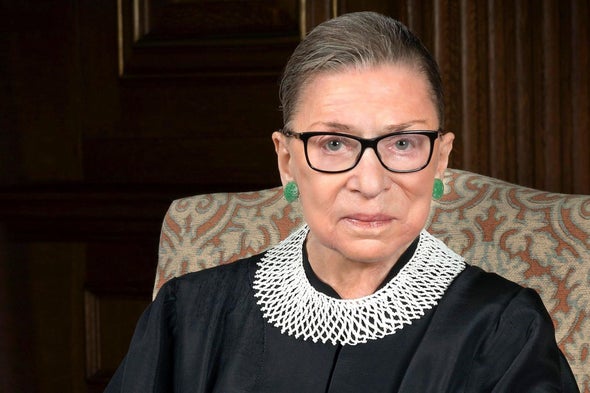
Supreme Court Justice Ruth Bader Ginsburg, the second woman to serve on the high court and a legal pioneer for gender equality whose fierce opinions as a justice made her a hero to the left, died Sept. 18 at her home in Washington. She was 87.

The death was announced in a statement by the U.S. Supreme Court. She had recently been treated for pancreatic cancer.

Born in Depression-era Brooklyn, Justice Ginsburg excelled academically and went to the top of her law school class at a time when women were still called upon to justify taking a man’s place. She earned a reputation as the legal embodiment of the women’s liberation movement and as a widely admired role model for generations of female lawyers.

Working in the 1970s with the American Civil Liberties Union, Justice Ginsburg successfully argued a series of cases before the high court that strategically chipped away at the legal wall of gender discrimination, eventually causing it to topple. Later, as a member of the court’s liberal bloc, she was a reliable vote to enhance the rights of women, protect affirmative action and minority voting rights and defend a woman’s right to choose an abortion.

Ruth Bader Ginsburg takes the oath of office from Chief Justice William H. Rehnquist, right, at the White House on Aug. 10, 1993. President Bill Clinton, left, nominated her to the high court. Ginsburg’s husband, Martin, holds the Bible.

On the court, she became an iconic figure to a new wave of young feminists, and her regal image as the “Notorious RBG” graced T-shirts and coffee mugs. She was delighted by the attention, although she said her law clerks had to explain that the moniker referred to a deceased rapper, the Notorious B.I.G. She also was the subject of a popular film documentary, “RBG” (2018).

When she was named one of Time magazine’s 100 most influential people in 2015, her colleague and improbable close friend, conservative Justice Antonin Scalia, wrote about her dual roles as crusader and judge. “Ruth Bader Ginsburg has had two distinguished legal careers, either one of which would alone entitle her to be one of Time’s 100,” wrote Scalia, who died in 2016.

After Scalia’s death, the Senate took no action to confirm President Barack Obama’s nominee to the court, U.S. Appeals Court Judge Merrick Garland. President Trump, who took office in 2017, has nominated two new justices to the court, Neil M. Gorsuch and Brett M. Kavanaugh, the latter succeeding Justice Anthony M. Kennedy.

NPR reported that Justice Ginsburg, in a statement dictated to her granddaughter in recent days, said, “My most fervent wish is that I will not be replaced until a new president is installed.”

A landmark moment for Justice Ginsburg came in 2011, when the court for the first time opened its term with three female justices. Justice Ginsburg said in an interview with The Washington Post that it would “change the public perception of where women are in the justice system. When the schoolchildren file in and out of the court and they look up and they see three women, then that will seem natural and proper — just how it is.”

Her outspoken feminism played a role in Justice Ginsburg’s success. President Bill Clinton acknowledged that in 1993 when he nominated her to replace retiring Justice Byron White. At the time, she was a judge on the U.S. Court of Appeals for the D.C. Circuit.

“Many admirers of her work say that she is to the women’s movement what former Supreme Court justice Thurgood Marshall was to the movement for the rights of African Americans,” Clinton said in Rose Garden ceremony. “I can think of no greater compliment to bestow on an American lawyer.”

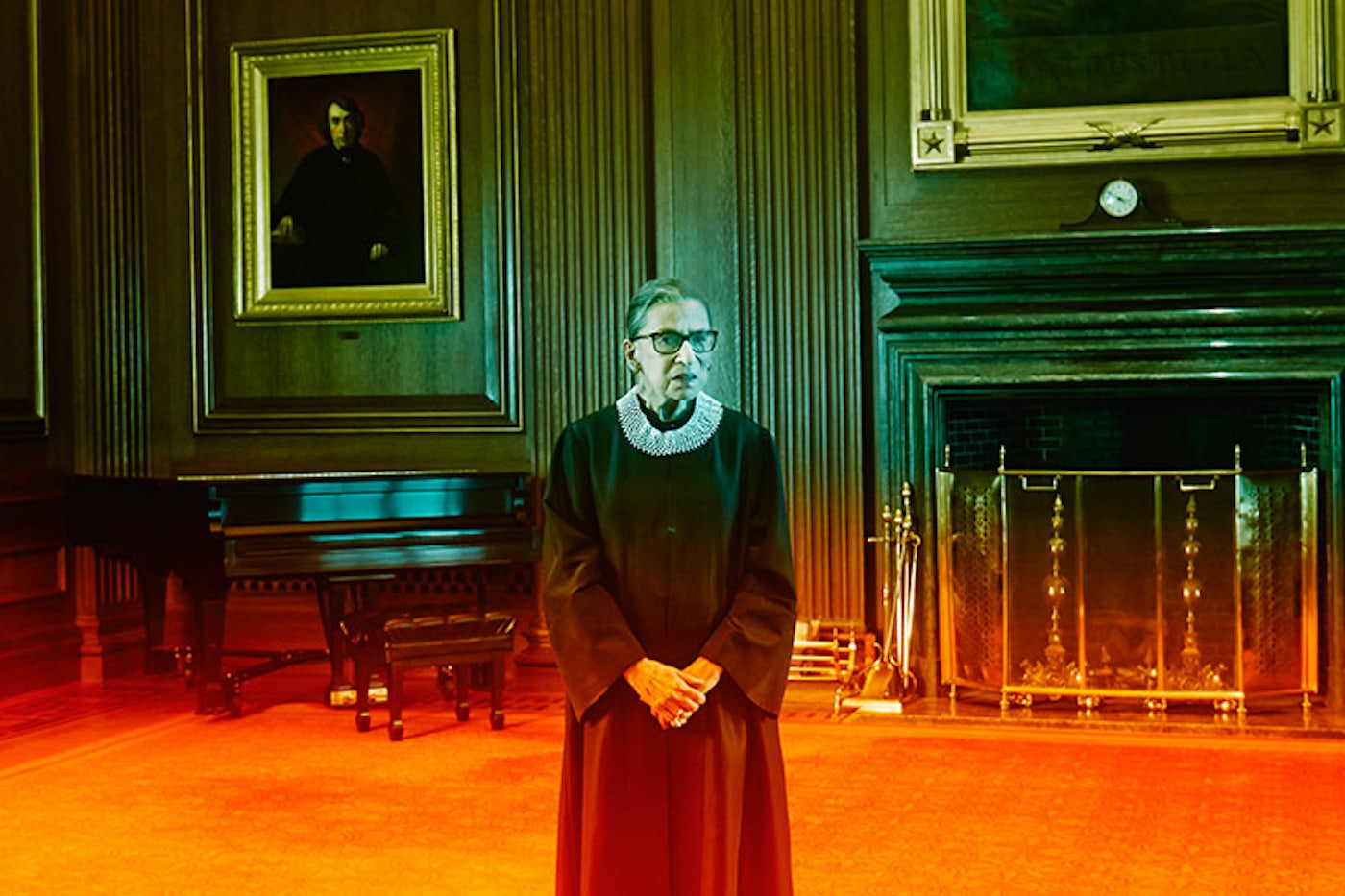
Justice Ruth Bader Ginsburg Celebrates 27 Years on Supreme Court | Chicago  News | WTTW

(Justice Ginsburg herself usually demurred when the comparison was made, saying that Marshall literally risked his life defending Black clients in the segregated South and that her legal work required no such sacrifice.)

On the court, Justice Ginsburg’s most notable rulings and dissents advanced feminist causes.

In 1996, she authored a groundbreaking decision ordering the Virginia Military Institute to admit women, ending a 157-year tradition of all-male education at the state-funded school.

While Virginia “serves the state’s sons, it makes no provision whatever for her daughters. That is not equal protection,” Justice Ginsburg wrote in United States v. Virginia. The 7-to-1 decision — her friend, Scalia, was the dissenter — was the capstone of the legal battle for gender equality, she said later.

“I regard the VMI case as the culmination of the 1970s endeavor to open doors so that women could aspire and achieve without artificial constraints,” Justice Ginsburg said after the decision.

Supreme Court Justice Ruth Bader Ginsburg dies of metastatic pancreatic  cancer at 87 - The Boston GlobeLater in her career, discrimination against women was the theme of several forceful dissents Justice Ginsburg read from the bench, a sparingly used bit of theater that justices employ to emphasize deeply held disagreements with a majority opinion.

Among them was a protest of the court’s decision to uphold a federal ban on so-called partial-birth abortions. “The court deprives women of the right to make an autonomous choice, even at the expense of their safety,” Justice Ginsburg wrote. “This way of thinking reflects ancient notions about women’s place in the family and under the Constitution — ideas that have long since been discredited.”

In another, she objected to a ruling that said workers may not sue their employers over unequal pay caused by discrimination alleged to have begun years earlier. That case had been filed by Lilly Ledbetter, the lone female supervisor at a tire plant in Gadsden, Ala., who sued after determining she was paid less than male co-workers.

In an interview with The Post in 2010, Justice Ginsburg said the Ledbetter case struck a personal chord.

“Every woman of my age had a Lilly Ledbetter story,” she said. “And so we knew that the notion that a woman who is in a nontraditional job is going to complain the first time she thinks she is being discriminated against — the one thing she doesn’t want to do is rock the boat, to become known as a complainer.”

She called upon Congress to take action, and once Democrats were in control, it did. Obama signed the law relaxing the deadlines for filing suits.

If the law is often complex, her view of equality was simple, she once said.

“It has always been that girls should have the same opportunity to dream, to aspire and achieve — to do whatever their God-given talents enable them to do — as boys,” Justice Ginsburg said in a 2015 conversation at the American Constitution Society. “There should be no place where there isn’t a welcome mat for women. . . . That’s what it’s all about: Women and men, working together, should help make the society a better place than it is now.”

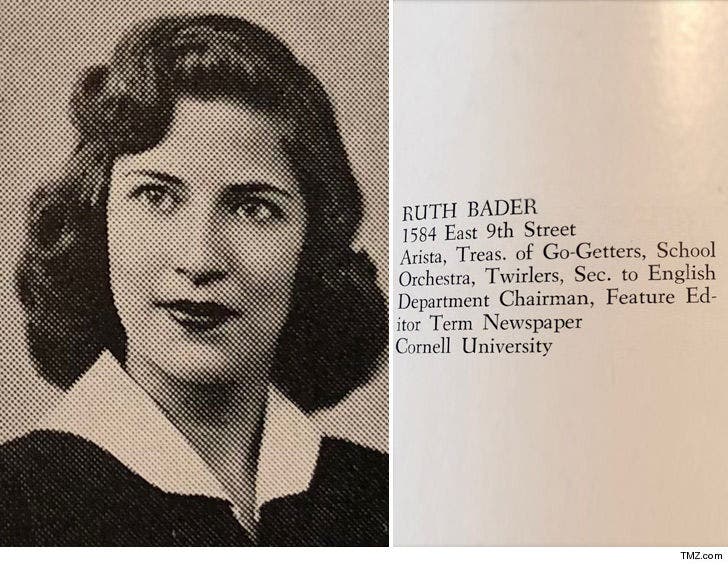
Ruth Bader Ginsburg Was a High School 'Twirler'Baton twirler and bookworm

Joan Ruth Bader — her mother suggested using her middle name in kindergarten to avoid confusion with other Joans in the class — was born on March 15, 1933. She was the second daughter of Nathan Bader, a Jewish immigrant from Russia who became a furrier and haberdasher, and the former Celia Amster.

As a schoolgirl, Justice Ginsburg — known to friends as “Kiki” — was smart, popular and competitive, both a bookworm and a baton twirler. But her early life was also shadowed by tragedy. Her older sister, Marilyn, died of meningitis at age 8, leaving Justice Ginsburg to be raised as an only child. She later said she grew up “with the smell of death.”

Raised in Flatbush, then a striving working-class neighborhood of Jewish, Italian and Irish immigrants in Brooklyn, Justice Ginsburg was molded largely by her mother, who had graduated from high school at 15. Her mother never went to college, instead taking a job to help her oldest brother through Cornell University.

Celia Bader was determined that her daughter would have a different path. She stored away money given by her husband for personal expenses to establish a college tuition fund.

But tragedy struck again. By the time Justice Ginsburg was a teenager, her mother was battling cervical cancer. She died in 1950, on the day before Justice Ginsburg graduated near the top of her class from Brooklyn’s James Madison High School.

By the time Celia Bader died, the college fund was $8,000. But her daughter did not need it; she had won enough scholarships to cover her expenses. She ended up giving most of the money to her dad.

Justice Ginsburg, like her uncle, attended Cornell, where on a blind date she met her future husband, Martin Ginsburg, a confident, fun-loving fraternity member and a standout on the university’s golf team. She later said he was the first boy she ever dated who cared about what was in her head.

30 Legendary Photos Of The Notorious Ruth Bader Ginsburg

After graduation, Martin Ginsburg enrolled at Harvard Law School while Ruth completed her senior year, graduating first in her class in 1954.

Shortly after, they married. He was drafted into the Army, and the couple moved to Lawton, Okla., where Martin was stationed at Fort Sill. While Martin served his two-year hitch, Ruth took a civil service exam and came close to landing a good job at Lawton’s Social Security office.

A problem emerged when she mentioned that she was pregnant. She was told that she would not be allowed to go Baltimore for training, forcing her to settle for a lower-paying job as a typist.

After Martin’s Army discharge in 1956, the couple went to Cambridge, where Ruth also enrolled in Harvard Law, one of nine women in a class of more than 500.

Those were the days of relentless grillings by professors using the Socratic method, a high-pressure situation made even more intense for female students by the prevailing view that they were operating in a realm where they did not belong.

At one point, Dean Erwin Griswold asked the women of the class what it felt like to occupy seats that could have gone to deserving men. (In 1993, on the eve of her Supreme Court confirmation, Griswold told the Harvard Crimson he long favored admitting women but that he had been overruled by the university’s governing board. He added that in asking women such a provocative question, he was playing devil’s advocate. “I think she completely misunderstood it and should have known better,” he said.)

Further complicating matters for Justice Ginsburg as a Harvard student was the responsibility of being a new mother after the birth of her daughter, Jane. (Jane eventually attended Harvard Law as well, one year behind future Chief Justice John G. Roberts Jr.)

Through it all, Justice Ginsburg was an academic star at Harvard. She earned top grades and a spot on the law review. But crisis soon invaded her life once again when her husband was diagnosed with testicular cancer. The prognosis was dire. “At the time, there were no known survivors,” Justice Ginsburg said.

Doctors treated the ailment with both radiation and surgery. Justice Ginsburg collected carbon copies of class notes from Martin’s classmates, and she typed his papers as he dictated before turning to her own studies. Martin eventually recovered and after graduation snagged a job at a New York firm.

In 1958, Ruth transferred from Harvard to Columbia Law School to complete her legal training. There, she continued to thrive, again making the law review and tying for first in her class at graduation in 1959.

Ruth Bader Ginsburg Supreme Court Justice: Young Photos | Time.com

Once she started looking for work, she could not find a job at New York’s top firms.

“I struck out on three grounds — I was Jewish, a woman and a mother,” Justice Ginsburg reflected later. “The first raised one eyebrow; the second, two; the third made me indubitably inadmissible.”

Nor could she land an interview for a clerkship with Supreme Court Justice Felix Frankfurter, despite a recommendation from a dean of Harvard Law School. Frankfurter made it clear that he simply wasn’t ready to hire a woman.

Eventually, she landed a position as a clerk for a federal district court judge, after a Columbia law professor lined up a man as a replacement in the event Justice Ginsburg faltered.

After her clerkship, Justice Ginsburg signed on for a summer fellowship to study the legal system in Sweden. The six weeks in Stockholm proved to be an awakening, as she was thrust into the midst of that country’s burgeoning debate about gender roles in raising families.

The question was easily settled in Justice Ginsburg’s personal life, even as it roiled around her. She and Martin shared child rearing and household duties. She liked to tell the story of her response to receiving repeated calls from school administrators about discipline problems with her son, James.

On one “particularly weary” day, she told the school, “This child has two parents. I suggest you alternate calls, and it’s his father’s turn.”

During her tenure on the court, Martin, a tax expert and later a Georgetown University Law School instructor who died in 2010, often baked cakes for justices’ birthday celebrations. He also was a reliable contributor to the spouse lunches and dinners held by the justices at the court.

Martin Ginsburg once proposed this response to public requests for Justice Ginsburg’s “favorite recipe”: “The Justice was expelled from the kitchen nearly three decades ago by her food-loving children. She no longer cooks and the one recipe from her youth, tuna fish casserole, is nobody’s favorite.”

Opinion | My Memories of Ruth Bader Ginsburg - The New York Times

A 'sparrow,' not a robin

In 1963, Justice Ginsburg became the second woman to join the faculty at New Jersey’s Rutgers Law School. There, her feminist awakening continued, even if she probably would not have described it that way.

When Justice Ginsburg learned that her salary was lower than that of male colleagues, she joined an equal pay campaign with other female teachers, which resulted in raises for the women.

While teaching at Rutgers, she also began taking on cases on behalf of the New Jersey branch of the ACLU. She battled successfully for maternity leave rights for teachers in New Jersey, who previously faced the threat of dismissal when they became pregnant.

In 1972, Justice Ginsburg became the first woman hired with tenure at Columbia Law School. Around that time, she also became the first director of the ACLU’s Women’s Rights Project.

At the ACLU, Justice Ginsburg led a team of lawyers that brought six cases before the Supreme Court between 1973 and 1979. They won five, victories that eventually altered the nation’s legal terrain by establishing that the constitutional guarantee of equal protection applied not only to racial minorities but to women as well.

In many ways, she was an unlikely revolutionary. Friends called her shy, and detractors and even her family said she could be humorless. But at times, she could be whimsical and was known to have a wry wit. Opera was her passion, and she said she would have been a diva instead of a justice if she’d had the voice of a robin instead “of a sparrow.”

In 1994, she and Scalia appeared in 18th-century costumes as extras in the Washington National Opera’s production of Richard Strauss’s “Ariadne auf Naxos.” Later, composer-librettist Derrick Wang took words from their opinions and put them to music in an opera called “Scalia/Ginsburg.” She often was asked why that order, instead of alphabetical?

Seniority reigns at the Supreme Court, Ginsburg answered, and Scalia got there first.

Ruth Bader Ginsburg and Antonin Scalia: An unlikely friendship and an  elephant ride in India

Roe and Clinton

Her early victories at the Supreme Court prompted President Jimmy Carter to appoint her to the U.S. Court of Appeals for the D.C. Circuit in 1980.

On an appeals court that often divided along ideological lines, Justice Ginsburg frequently straddled the middle. She dissented from the majority’s refusal to hear the case of an Air Force officer who wanted to wear a yarmulke while on duty, saying the prohibition reflected “callous indifference” to his religious faith.

On the other hand, Justice Ginsburg voted to dismiss a case brought by a gay sailor discharged from the Navy, and she voted against a minority set-aside program in O’Donnell Construction Co. v. District of Columbia. She developed enduring friendships with conservative jurists Scalia and Robert H. Bork while all three served on the appeals court.

A strong supporter of abortion rights, Justice Ginsburg nonetheless alienated some of her erstwhile allies with a 1984 speech at the University of North Carolina, where she criticized the Supreme Court’s landmark ruling in Roe v. Wade that guaranteed abortion rights.

The court’s 1973 ruling was too sweeping, she said, contributing to the divisive rancor that has accompanied the abortion issue ever since. She suggested that the court and the cause of abortion rights would have been better served had the court simply overturned the Texas law outlawing almost all abortions, which was at issue in the case.

She clarified her position in a 1993 lecture in which she argued that the justices should have grounded the right to abortion not in the concepts of “personal liberty” and “privacy” that spring from the 14th Amendment, but in the amendment’s equal protection clause.

Her novel views on Roe created a significant hurdle for her ascension to the high court. After White announced his resignation in 1993, Justice Ginsburg, then 60, was among a large group of potential nominees placed before Clinton.

Justice Ginsburg faced opposition from a new generation of women’s activists who, citing her abortion rights speeches and record as a moderate on the appeals court, argued that her views were too narrow and that time had passed her by.

Oscars 2019: Ruth Bader Ginsburg doc depicts an exceptional marriage —  Quartz at Work

Justice Ginsburg also had her supporters, including her husband, who helped organize an effort that resulted in a torrent of letters and telephone calls to the White House that prompted Clinton to give her a second look. Clinton was also spurred on by Senate conservatives who pointed to Justice Ginsburg as a moderate that they could support, which appealed to Clinton’s New Democrat leanings. Clinton announced her nomination on June 14, 1993. She was confirmed just over two months later by a 96-to-3 vote.

Ruth Bader Ginsburg on Her Beloved Husband Marty | PEOPLE.com

After the president announced her nomination, the normally reserved Ginsburg took time to thank a list of people and causes, including the civil rights and women’s movements, her husband and two children, her mother-in-law and first lady Hillary Clinton. Then, she offered one final tribute.

“It is to my mother, Celia Amster Bader, the bravest and strongest person I have known, who was taken from me much too soon,” Justice Ginsburg said. “I pray that I may be all that she would have been had she lived in an age when women could aspire and achieve, and daughters are cherished as much as sons.”

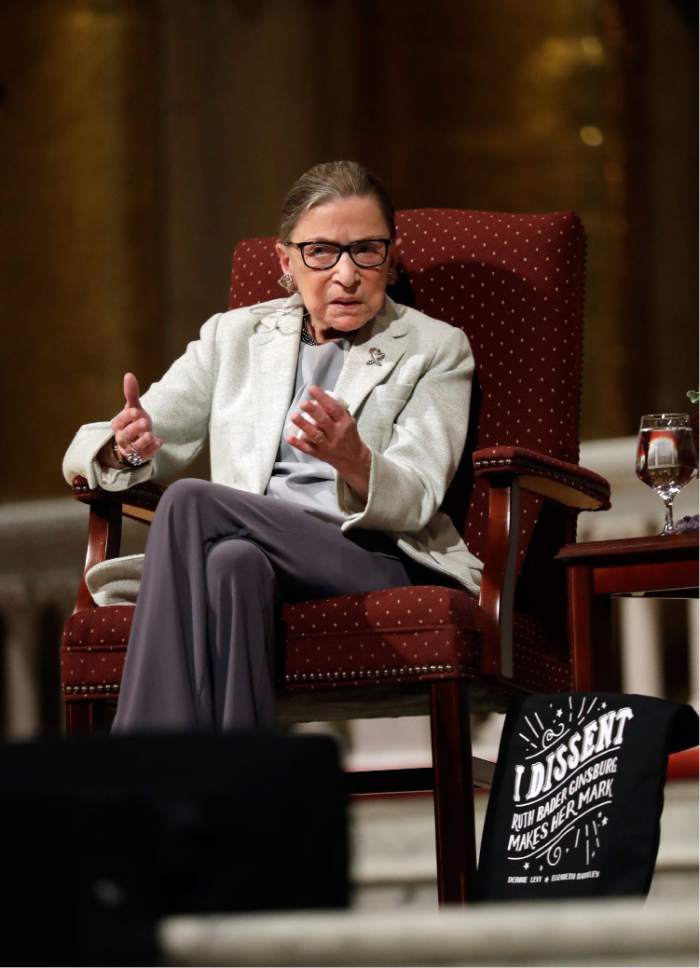
Supreme Court Justice Ruth Bader Ginsburg to speak to Utah lawyers this  summer - The Salt Lake Tribune

A prolific dissent writer

Justice Ginsburg’s lot was to serve on a court with a majority more conservative than she was. As a result, she became much more known for her dissents than her majority opinions. More-moderate justices such as Sandra Day O’Connor, whom Justice Ginsburg greatly admired, and Kennedy often were the ones who wrote when the court was ideologically divided.

Justice Ginsburg wrote a powerful dissent in one of the pivotal cases in her time on the court — Bush v. Gore — which resulted in George W. Bush’s win in the 2000 election. The majority criticized and then shut down a recount by Florida officials, which she would have allowed to continue.

“Ideally, perfection would be the appropriate standard for judging the recount,” she wrote. “But we live in an imperfect world, one in which thousands of votes have not been counted. I cannot agree that the recount adopted by the Florida court, flawed as it may be, would yield a result any less fair or precise than the certification that preceded that recount.”

When Justice John Paul Stevens retired in 2010, Justice Ginsburg became the senior justice among the court’s liberals: her fellow Clinton nominee Stephen G. Breyer and Obama’s choices for the court, Sonia Sotomayor and Elena Kagan.

Under Justice Ginsburg’s direction, the liberals often answered major decisions with which they disagreed with one unified dissent. And they swallowed any differences they had with Kennedy to join him in a string of liberal victories at the court on same-sex marriage, affirmative action and abortion. (Justice Ginsburg later became the first justice to perform a same-sex marriage ceremony.)

When the court in 2016 struck down Texas restrictions on doctors and abortion clinics, Kennedy assigned the majority opinion to Breyer. But Justice Ginsburg issued a rare concurrence to make the point that abortion rights remained — for now — firmly established.

As long as Roe remains good law, Justice Ginsburg wrote, laws that “do little or nothing for health, but rather strew impediments to abortion, cannot survive judicial inspection.”

Justice Ginsburg did most of her work in dissents. She said she most lamented the court’s decisions in Citizens United v. Federal Election Commission (2010), which opened the way for greater corporate and union spending in elections, and Shelby County v. Holder (2013), in which the court threw out a key provision of the civil rights-era Voting Rights Act of 1965.

In a famous passage, she faulted Roberts’s logic that restrictions on states with past desegregation needed to be justified anew.

“Throwing out pre-clearance when it has worked and is continuing to work to stop discriminatory changes is like throwing away your umbrella in a rainstorm because you are not getting wet,” she wrote.

Notorious RBG: The Life and Times of Ruth Bader Ginsburg | Choose Chicago

Justice Ginsburg sometimes drew attention for more than her legal opinions. Tiny and frail-looking, despite the fact that she worked out with a trainer and boasted of doing push-ups, photos of Justice Ginsburg falling asleep at the State of the Union address became the subject of news reports. She explained that it wasn’t fatigue; in fact, she was known as something of a night owl, working late. Instead, she said, Kennedy had brought a good bottle of wine to the dinner that the justices traditionally hold before crossing the street to the Capitol.

Justice Ginsburg was also criticized for speaking too frankly in interviews and speeches, especially about abortion rights and same-sex marriage.

She drew criticism for surprisingly critical remarks about businessman Donald Trump, saying she feared for the court and the country if he were elected president. After several days of controversy, she issued a statement saying it was wrong of her to have commented about politics, but not apologizing for her views.

During her court tenure, Justice Ginsburg had several bouts with cancer, although she never missed a day of the court’s public schedule.

Today, the Notorious RBG turns 87. We honor her legacy and want her around much longer. If you want to protect her and all of our elders, stay at home as much as you can, and when you can’t, maintain strict handwashing and a 6-foot distance. Initial...

She had colon cancer surgery in 1999, which was accompanied by precautionary chemotherapy and radiation treatment, but she never missed a day of oral arguments. And in February 2009, she underwent surgery for early-stage pancreatic cancer but managed to return to the bench when the court returned from recess less than three weeks later.

Instead, cancer took her husband first. Again, she was on the bench the next day.

It was the final day of the court’s term, and she had an opinion to deliver. She thought of having another justice read the summary for her, but her children insisted she go herself, saying it was what their father would have wanted.

Justice Ginsburg’s survivors include two children, Jane C. Ginsburg and James S. Ginsburg; four grandchildren; two step-grandchildren; and a great-granddaughter.

Ruth Bader Ginsburg: Interview on Retirement, Feminists, & Jazzercise | The  New Republic