July 6, 2020

The U.S. Is Lagging Behind Many Rich Countries. These Charts Show Why.

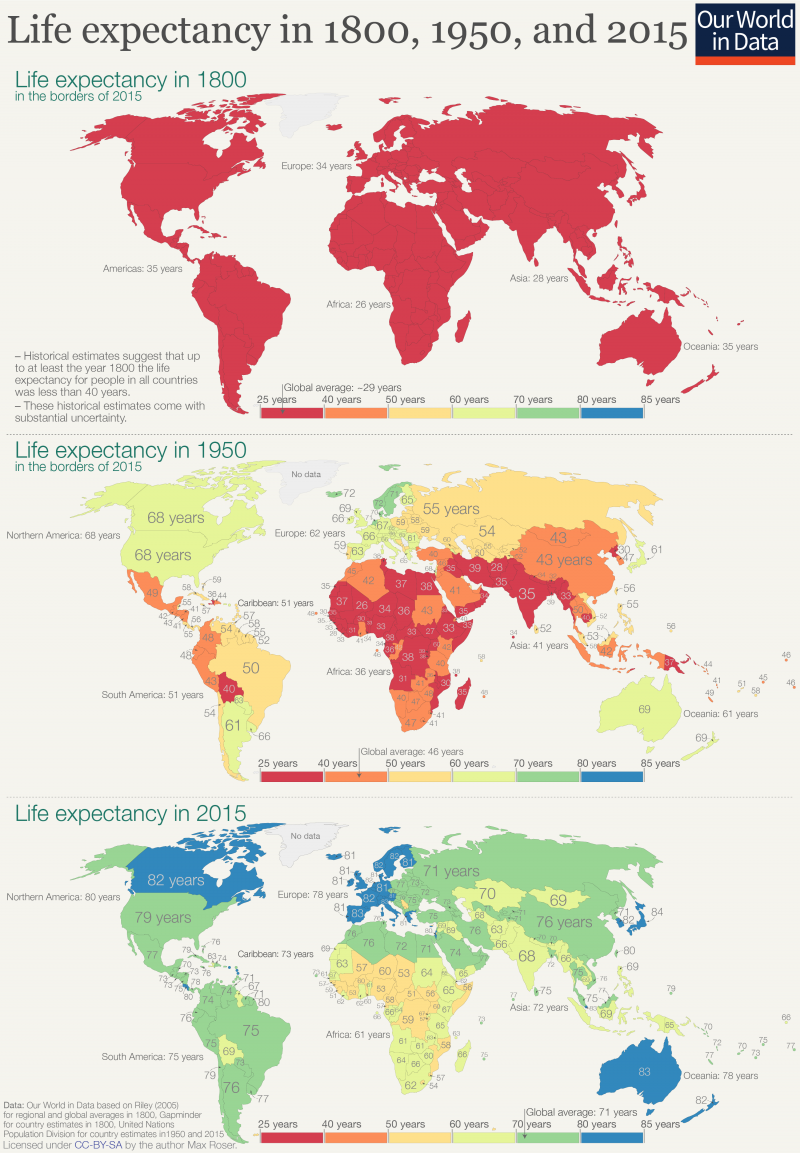
3 world maps of life expectancy e1538651530288
ankCountries and regionsLife expectancy at birth (in years)
OverallFemaleMale
1 Hong Kong84.787.681.8
2 Japan84.587.581.1
3 Singapore83.885.881.5
4 Italy83.685.581.7
5= Spain83.486.180.7
6=  Switzerland83.485.381.1
7 Australia83.385.381.3
8 Iceland82.984.481.3
9= Israel82.884.481.1
10= South Korea82.885.879.7
11 Sweden82.784.480.9
12 France82.585.479.6
13 Malta82.484.180.5
14= Canada82.384.380.3
14= Norway82.384.380.3
16= Greece82.184.579.6
16= Ireland82.183.780.4
16= Luxembourg82.184.280.0
16= Netherlands82.183.880.4
16= New Zealand82.183.980.4
21 Portugal81.984.778.8
22 Andorra81.8  
23 Finland81.784.678.9
25 Belgium81.583.879.1
26 Austria81.483.879.0
27 Germany81.283.678.8
28 Slovenia81.283.978.4
29 United Kingdom81.283.079.5
 European Union81.283.878.6
30 Cyprus80.882.978.7
31 Denmark80.882.877.8
32 Liechtenstein80.5  
33 Costa Rica80.182.777.5
34 Chile80.082.477.6
35 Czech Republic79.281.876.6
36 Barbados79.180.477.7
37 Lebanon78.980.877.1
38 United States78.981.476.3
39 Cuba78.680.676.7
40 Estonia78.682.473.9
41 Poland78.582.474.6
42 Croatia78.381.575.1
43 Panama78.381.675.2
44 Turkey78.381.075.6
45 United Arab Emirates77.879.277.1
46 Uruguay77.881.474.0
47 Oman77.680.175.9
48 Slovakia77.480.873.8
49 Bosnia and Herzegovina77.379.774.8
50 Bahrain77.278.376.3
NY TIMES

The United States is different. In nearly every other high-income country, people have both become richer over the last three decades and been able to enjoy substantially longer lifespans.
But not in the United States. Even as average incomes have risen, much of the economic gains have gone to the affluent — and life expectancy has risen only three years since 1990. There is no other developed country that has suffered such a stark slowdown in lifespans.

Why has this happened? There are multiple causes. But one big one is a lack of political power among the bulk of the population.

Government policy and economic forces have combined to make corporations and the wealthy more powerful, and most workers and their families less powerful. These workers receive a smaller share of society’s resources than they once did and often have less control over their lives. Those lives are generally shorter and more likely to be affected by pollution and chronic health problems.

Here, we show you a series of measures — about power, living standards and more — for a variety of countries. Together, they portray the disturbing new version of American exceptionalism.

We’ll start with union membership.
People in labor unions make substantially more money than similar nonunionized workers, academic research shows. And the share of Americans in unions has plummeted from 35 percent in the mid-1950s to about 10 percent today. The rate is even lower — about 6.2 percent — for private-sector workers.

The decline has happened largely because employers have become more aggressive about keeping out unions and government policy has made it easier for them to do so.
Unionization rates in many other countries are higher:
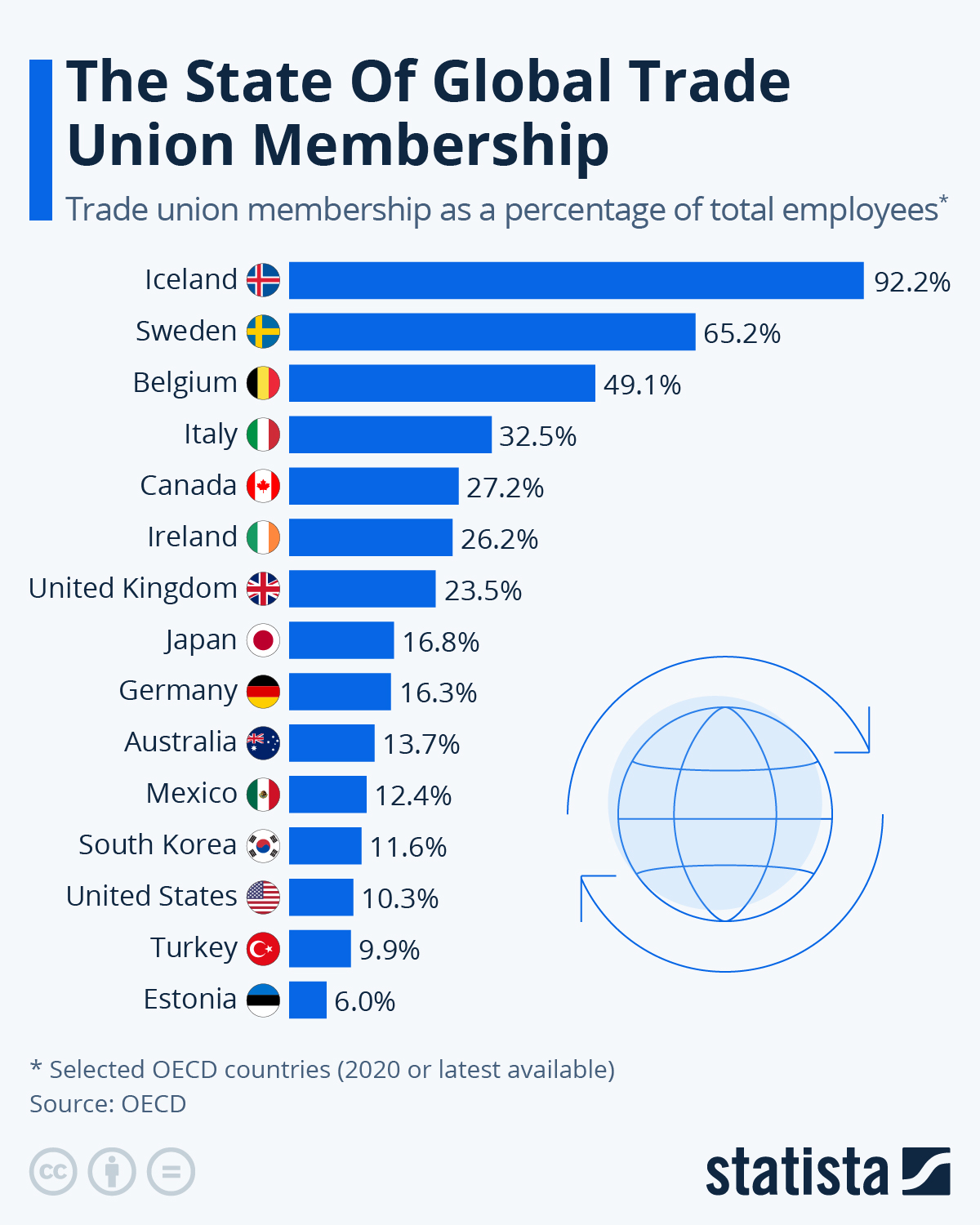
Chart: The State Of Global Trade Union Membership | Statista
Union membership in 2018
 
The decline in unionization is one reason that the share of total national income flowing to corporate profits has risen — and the share going to worker pay has declined. The trend is starker in the U.S. than in Europe.
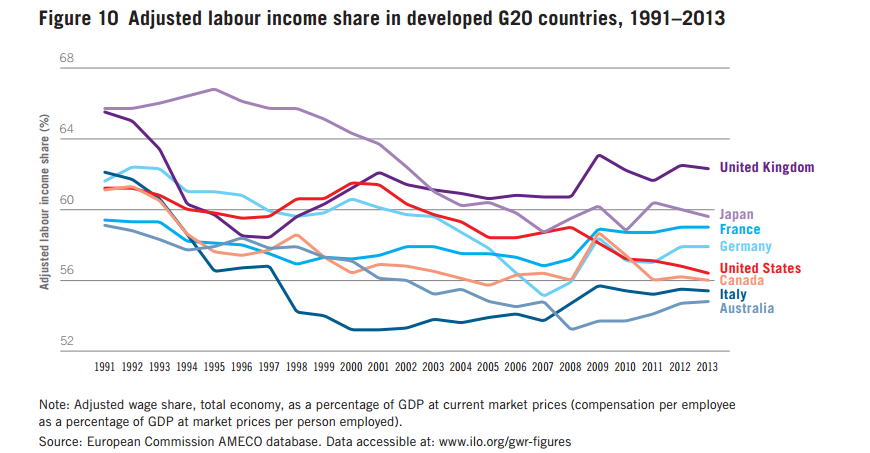
Bad News For Global Wage Trends | Reports from the Economic Front

Higher profits have helped make the United States an outlier on executive pay, too. Although executives’ salaries have risen in most countries, relative to those of workers, in recent decades, the trend is more extreme in the U.S.
 
In 2005, the average CEO in the United States earned 262 times the pay of the average worker, the second-highest level of this ratio in the 40 years for which there are data. In 2005, a CEO earned more in one workday (there are 260 in a year) than an average worker earned in 52 weeks.Jun 21, 2006
 
Government policy plays an important role: The minimum wage is higher in other countries than it is in much of the United States. Some states have set a minimum wage higher than the federal standard, but many states in the South — home to large Black populations — have not.
Annual minimum wage in 2018
 
Image shows a map of the U.S. and each of their individual minimum wages. Title reads: "State minimum wages"
 
In addition to minimum wage, the United States has done less to combat rising corporate concentration. Large U.S. companies are better able to hold down the wages of workers, who don’t always have good employment options, and are also able to charge higher prices because of less competition.

One example: American consumers pay significantly more for cellphone service than people in many other countries.
Cellphone service cost in 2019
The Cost Of Mobile Internet Around The World [Infographic]
 
Arguably the biggest outlier is the American health care system. Prices for drugs, medical procedures and doctors’ visits are all substantially higher in the United States than in other countries. The U.S. also suffers from bureaucratic inefficiency, because of a complex health care system that spans the private sector, state governments and the federal government.
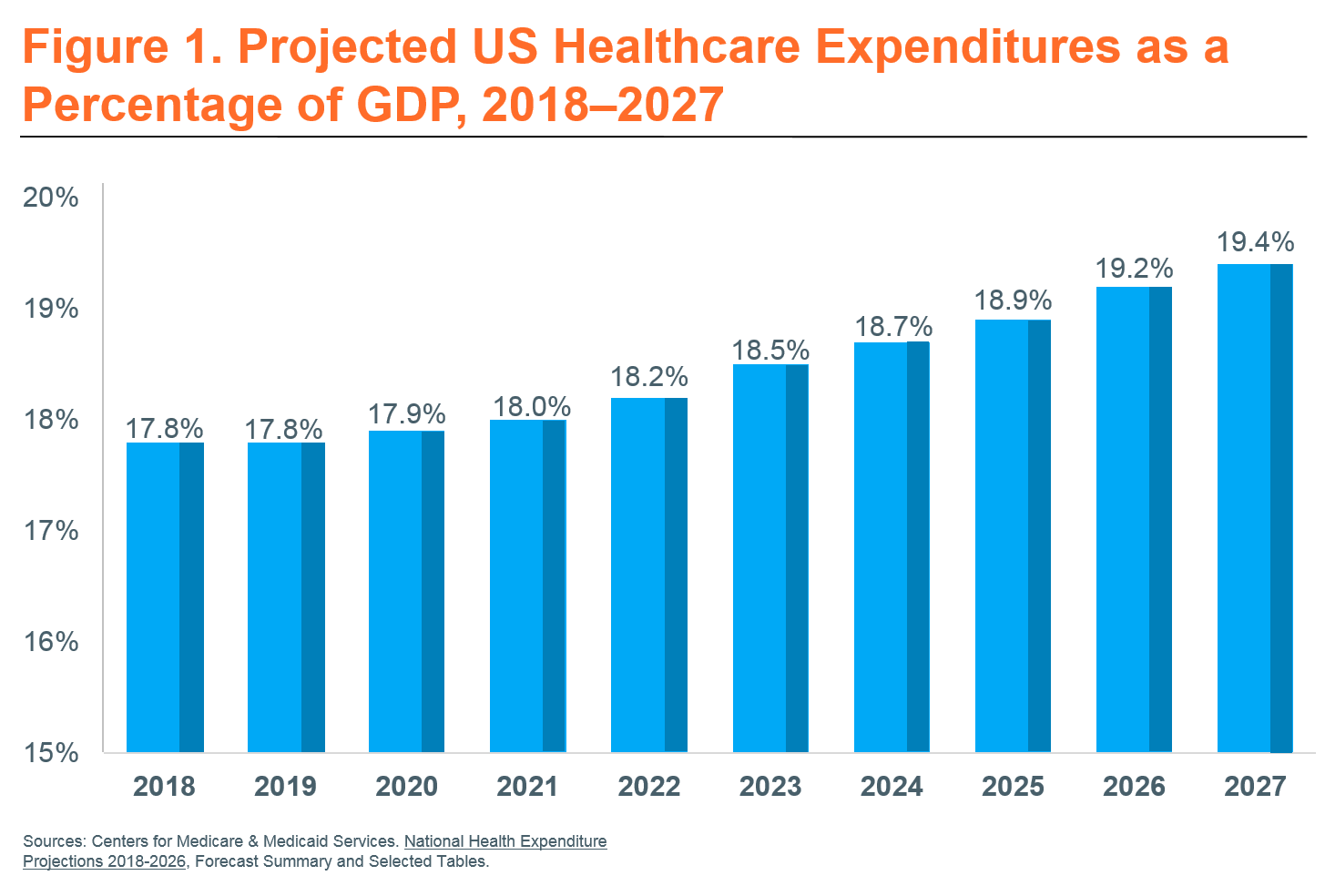
US Healthcare Spending Projected to Grow 5.5% Annually Through ...
Health expenditures in 2019, share of G.D.P., projected thru 2027
 
In all, Americans pay almost twice as much on average for medical care as citizens of other rich countries. And as you may remember from the opening chart in this article, Americans are far from the world’s healthiest people.

Incarceration plays an important role, too. No other wealthy country puts as many people behind bars — and the prison population is disproportionately Black and Latino.
Time in prison casts a long shadow, leaving people with lingering health problems as well as permanently damaging their ability to find decent-paying work. Mass incarceration is a major reason that, even before the pandemic hit, about 30 percent of middle-aged Black men were not working in a typical week. Many of them do not count as unemployed because they are incarcerated or because they have stopped looking for work.
 
And a final example of how government policy exacerbates the unique inequality in the United States: tax policy.

In some other countries, like France, high-income households still pay more than half of their income in taxes on average. In the U.S., tax rates on the affluent are lower — and have fallen sharply in recent decades.
Infographic: Where The System Takes The Biggest Bite From Paychecks | Statista
These trends have combined to increase economic inequality. The middle class and poor receive a smaller share of national income in the U.S. than in much of Europe, while the rich receive a greater share:

Share of national income
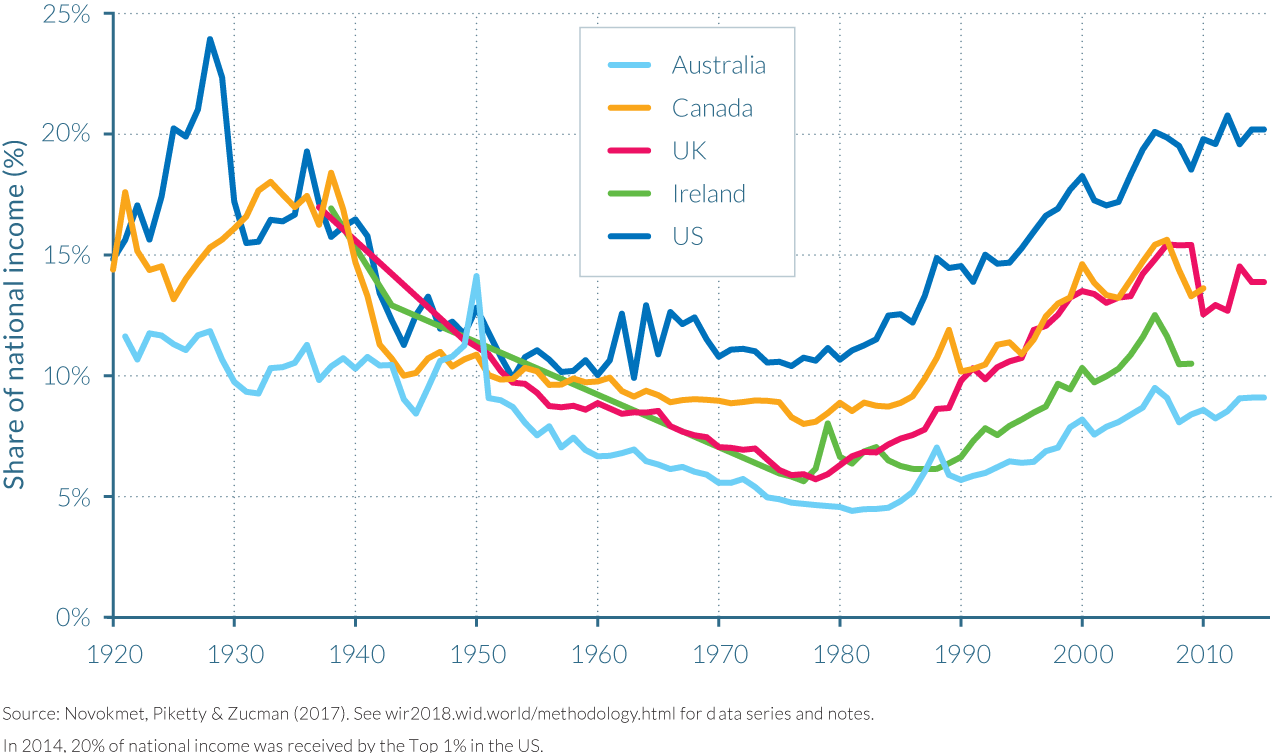
Part II | World Inequality Report 2018

 
Source: World Inequality Database

If anything, these statistics understate American exceptionalism on inequality, because Americans also work longer hours for their pay than workers in many other places:

Annual hours worked in 2018
Which countries work the longest hours? | World Economic Forum
 
The most common way to think about inequality is as an economic story. And it is that. But it is also a story about political power, quality of life and even the amount of time that members of different classes can expect to live.
 

Esco20 is Shocked, Shocked: The Coronavirus Is airborne and is racially unequal!


Revelers enjoy the beach at Coney Island, Saturday, July 4, 2020, (AP Photo/John Minchillo)

The W.H.O. has resisted mounting evidence that viral particles floating indoors are infectious, some scientists say.

NY TIMES

The coronavirus is finding new victims worldwide, in bars and restaurants, offices, markets and casinos, giving rise to frightening clusters of infection that increasingly confirm what many scientists have been saying for months: The virus lingers in the air indoors, infecting those nearby.
If airborne transmission is a significant factor in the pandemic, especially in crowded spaces with poor ventilation, the consequences for containment will be significant. Masks may be needed indoors, even in socially-distant settings. Health care workers may need N95 masks that filter out even the smallest respiratory droplets as they care for coronavirus patients.

Ventilation systems in schools, nursing homes, residences and businesses may need to minimize recirculating air and add powerful new filters. Ultraviolet lights may be needed to kill viral particles floating in tiny droplets indoors.

In an open letter to the W.H.O., 239 scientists in 32 countries have outlined the evidence showing that smaller particles can infect people, and are calling for the agency to revise its recommendations. The researchers plan to publish their letter in a scientific journal next week.

The fullest look yet at the racial inequity of the coronavirus.


Image
Early numbers had shown that Black and Latino people were being harmed by the coronavirus at higher rates, but new federal data — made available after The New York Times sued the Centers for Disease Control and Prevention — reveals a clearer and more complete picture: Black and Latino people have been disproportionately affected by the coronavirus in a widespread manner that spans the country, throughout hundreds of counties in urban, suburban and rural areas, and across all age groups.

Coronavirus cases per 10,000 people

Latino and African-American residents of the United States have been three times as likely to become infected as their white neighbors, according to the new data, which provides detailed characteristics of 640,000 infections detected in nearly 1,000 U.S. counties. And Black and Latino people have been nearly twice as likely to die from the virus as white people, the data shows.
 
The disparities persist across state lines and regions. They exist in rural towns on the Great Plains, in suburban counties, like Fairfax County, Va., and in many of the country’s biggest cities.
“Systemic racism doesn’t just evidence itself in the criminal justice system,” said Quinton Lucas, who is the third Black mayor of Kansas City, Mo., which is in a state where 40 percent of those infected are Black or Latino even though those groups make up just 16 percent of the state’s population. “It’s something that we’re seeing taking lives in not just urban America, but rural America, and all types of parts where, frankly, people deserve an equal opportunity to live — to get health care, to get testing, to get tracing.”

UPDATES

 Trump said Saturday that his administration had “made a lot of progress” on controlling the novel coronavirus pandemic, even as the seven-day average of cases in the United States set a record for the 26th straight day.

Officials and health experts watched nervously to see whether July 4 gatherings would increase the spread while the virus continued to spiral out of control in much of the country, particularly in the South. Several states experienced record numbers of confirmed infections and hospitalizations.

Here are some significant developments:

Florida logged another daily high number of new cases. Hospitalizations in Arizona set a record. Intensive care unit capacity at the world’s largest medical center, in Houston, was exceeded at one point in the day.

Several California municipalities dismissed requests from higher governments to forgo fireworks shows or close beach parking lots to promote social distancing, local news outlets in the state reported.

As the United States reported 48,640 new covid-19 cases on Sunday, Arizona and Nevada reported their highest numbers of coronavirus-related hospitalizations to date. Seven-day case averages in 12 states hit new highs, with the most significant upticks reported in West Virginia, Tennessee and Montana.

As Texas continues to report record-breaking numbers of new cases, the mayors of Austin and Houston are warning that their cities’ health care systems could soon be overwhelmed.

July 5, 2020


Trump got his crowd and his fireworks, and peddled his fiction

The setting for President Trump’s early Fourth of July celebration was magnificent, as the Black Hills of South Dakota tend to be. The scene was also full of painful history, willful ignorance and deliberate fearmongering.
Friday night, in an amphitheater in the shadow of Mount Rushmore, a military band played smooth jazz on snare drums and trumpets as the country sank under the rising number of coronavirus infections. Thousands of unmasked guests, awaiting the arrival of the president, sat shoulder-to-shoulder in black folding chairs tethered together in a kind of coronavirus chain of denial. The VIPs would, of course, be seated separately onstage — not six feet apart but not amid the storm of exhalations, coughs, vociferous cheers and sneezes. And just to add to the upside-down, inside-out madness of the mass gathering, Ivanka Trump, the president’s adviser and daughter, tweeted a reminder to be safe over the holiday weekend by social distancing and wearing a mask. Her nearest and dearest did not listen to the plea.
Mount Rushmore is painfully complex — much like America itself. The faces of four revered but profoundly flawed presidents were carved into the stone by a talented sculptor who sympathized with the Ku Klux Klan. The majestic monument — a testament to human tenacity — scars land considered sacred by Native Americans.
But the president is not a man of complexity and nuance. He is a man who sees things in gloriously righteous white and suspicious, dangerous black. For him, Mount Rushmore is not complicated. It’s telegenic. His was not an open-armed celebration of American independence and the country’s raucous striving to fulfill its promise. The president had orchestrated a rally — a place where he could wade into a warm embrace of approval.
And oh, how he glowed. He wore a dark suit and red tie. An American flag pin was tacked to his lapel. His skin was dewy in the summer heat. His smile was broad. Trump looked so pleased.
He stepped to the microphone and settled into his speech, which warned his Americans that other Americans were a threat to the country. “Our country is witnessing a merciless campaign to erase our history,” Trump warned. “One of their political weapons is cancel culture. … This is the very definition of totalitarianism.”
“This attack on our liberty, our magnificent liberty, must be stopped,” the president said.
He promised to save the monuments, to defend the monuments, to put the full weight of the federal government into protecting giant hunks of stone and bronze. And why not? It’s so much easier to cordon off a statue, to surround it with police officers, than it is to come to terms with the blood and the glory, the cruelty and goodwill that built this country and that haunts it.
He delivered a dark speech ahead of Independence Day in which he sought to exploit the nation’s racial and social divisions and rally supporters around a law-and-order message that has become a cornerstone of his reelection campaign. Trump focused most of his address before a crowd of several thousand in South Dakota on what he described as a grave threat to the nation from liberals and angry mobs — a “left-wing cultural revolution” that aims to rewrite U.S. history and erase its heritage amid the racial justice protests that have roiled cities for weeks.
“The radical ideology attacking our country advances under the banner of social justice. But in truth, it would demolish both justice and society,” Trump said. “It would transform justice into an instrument of division and vengeance and turn our free society into a place of repression, domination and exclusion. They want to silence us, but we will not be silenced.” Trump, who recently signed an executive order aimed at punishing those who destroy monuments on federal property, referred to “violent mayhem” in the streets, even though many of the mass demonstrations have been largely peaceful. He warned that “angry mobs” were unleashing “a wave of violent crime” 
He will defend the Second Amendment and never defund the police. The crowd chanted “USA, USA.” The crowd demanded “four more years.” The president did not discuss the coronavirus, which has killed more than 126,000 Americans. The crowd did not seem to care.
Trump left the microphone with a promise to the crowd that the best is yet to come. Then the sky over the mountain exploded in a rainbow of lights, a shower of fire and spiraling flames. The spectacle was beautiful, as fireworks tend to be. When the show ended, a cloud of smoke remained. The audience was gazing at the heavens. And then the president was gone.


2020: WORST. YEAR. EVER. and there's still 6 months to go.

July 5, 2020: 2020 Worst. Year. Ever!
We rang it in with high hopes and lofty resolutions, then dropped into a downward spiral of death and despair with people trading punches to get the last roll of toilet paper.

Beyond the bewildering pandemic, we’re dealing with unemployment at its highest level since the Great Depression, a divisive presidential election, Donald Trump and his corrupt, autocratic administration; the repeated deaths of unarmed black people at the hands of police and a nationwide reckoning with systemic racism and systemic inequality.
Workers place bodies of coronavirus victims in a cold storage truck outside Brooklyn Hospital Center on Tuesday, March 31.
Overall, the U.S. has lost more than 130,000 people to COVID-19, a quarter of the world’s death toll.
“It feels like a confluence all at once of 1918, 1929 and 1968,” historian Thurston Clarke told The News, referring to the years of the deadly “Spanish Flu” pandemic, the stock market crash that led to the Great Depression and the social unrest following the assassinations of the Rev. Martin Luther King Jr. and Robert F. Kennedy.
 
“We had the terrible assassinations and the war in Vietnam in 1968. But now we’ve got a pandemic that’s already killed two times as many Americans as lost their lives in Vietnam. And we’ve got huge job losses and economic problems we didn’t have then,” he said.
Visitors to the Department of Labor are turned away at the door by personnel due to closures over coronavirus concerns, Wednesday, March 18, in New York.
Visitors to the Department of Labor are turned away at the door by personnel due to closures over coronavirus concerns, Wednesday, March 18, in New York. (John Minchillo/AP) 
I think all of us who study history are feeling whipsawed because there are so many parallels to the past, but it’s so confusing because one day it feels like 1861, the next 1918, then suddenly 1970,” said Ted Widmer, author of the recent book “Lincoln on the Verge” and a professor at CUNY’s Macaulay Honors College.

“So many things are happening at the same time,” he said. “We have so many extremes feeding each other, driving each other forward, while everyone is simultaneously fearful of the global pandemic.”
During the start of the Civil War in 1861, the breaking point was deep division over the enslavement of black people. Today, the flash points are police brutality and systemic racism, enduring echoes of that shameful institution. 
When the graphic video of Ahmaud Arbery’s Feb. 23 killing at the hands of a white ex-cop and his son published online in early May, it touched off a simmering outrage that exploded into the streets following the May 25 death of George Floyd in the custody of four Minneapolis police officers.
Former Minneapolis Police Officer Derek Chauvin during the arrest of George Floyd.
Graphic video of Floyd’s death showed white ex-officer Derek Chauvin kneeling on Floyd’s neck for 8 minutes and 46 seconds in sickening silence as the unarmed black man repeatedly cried, “I can’t breathe” before losing consciousness and never regaining it
.
Three days after Floyd’s death, officials released the harrowing 911 call made by Breonna Taylor’s boyfriend after the 26-year-old EMT was shot at least eight times by police inside her Louisville apartment during a botched drug raid March 13.
On June 12, a white police officer in Atlanta pumped two bullets into the back of Rayshard Brooks in the parking lot of an Atlanta Wendy’s even though he knew the black man was running away with only a spent Taser in his hands, the prosecutor who charged the cop with felony murder said. 
 
 But even amid the stirring calls for social justice, many insist America has already accounted for the sins of its past, and its ongoing failures are few.

Widmer said another defining characteristic that sets 2020 apart from past eras has to do with America’s standing in the world.
“It’s really shocking. The respect other countries hold for us is way, way down by any measure," he said.
“It feels like we’ve lost sight of what Lincoln called our ‘better angels’ — our generosity to people other than ourselves and our willingness to lead in the solutions of global problems,” he said.
 
 “Right now it feels like we’re reeling. We’re far from leading in response to the pandemic. We’re being mocked and pitied. The U.S. is seemingly moving through this as though we are alone. We’re not hearing with any regularity that we’re working with our allies to share expertise and resources,” she said. “We’re so used to hearing we’re the best county in the world. But the idea that Europe is barring Americans as it reopens is a very powerful rejection of that myth.”
She said the U.S. has lost “a lot of steam” in the last six months in terms of lost production, disrupted education, forfeited productivity and breakdowns in our supply chains.  “I think we’re going to be a very tired country on New Year’s Eve. Really, really tired.”