Newspaper & online reporters and analysts explore the cultural and news stories of the week, with photos frequently added by Esco20, and reveal their significance (with a slant towards Esco 20's opinions)
Who is in charge? De Blasio or Mullins? (New York Daily News)
One reason that Bill de Blasio has moved from so-called broken windows or quality of life policing to sloganeering about neighborhood policing and a de facto policy of not-so-benign neglect is that providing real support to people before there’s a call or need for police intervention is arduous and expensive, while talk is still cheap.
Another reason is that he doesn’t have control of his own police department, whose members haven’t been shy about rubbing his nose in that fact even as they’ve become increasingly shy about doing the job asked of them and shootings in recent months have more than doubled from the same stretch just a year earlier. You don’t like what we do? Duck!
If there’s an embodiment of policing as a protection racket in New York City, it’s Ed Mullins, the vulgar, Trumpist head of the sergeants union who’s been at war with the mayor since 2014.
This May, Mullins called the city’s health commissioner, Oxiris Barbot, a “bitch”— and the mayor made her apologize to the police. That was after someone leaked an exchange weeks earlier in which the NYPD’s Chief of Department, Terence Monahan, tried to commandeer Health Department N95 masks when medical workers on the front lines of the fight against the virus were desperately short on them and she told him “I don’t give two rats’ asses about your cops.”
Monahan has heard and said worse, and the NYPD got 250,000 masks, but that didn’t stop Mullins from declaring that “Truth is this bitch has blood on her hands but why should anyone be surprised the NYPD has suffered under DeBlasio since he became Mayor.” (Barbot resigned in August, joining the list of women of color de Blasio has thrown under the bus.)
The grim punchline is that the city is full of cops — who have been charged by the mayor and governor at different points with enforcing mask-wearing compliance — not wearing masks, with the NYPD’s own Twitter account routinely sharing photos of groups of unmasked officers.
De Blasio says “the reality is it’s a very clear standard. We need to protect each other and everyone’s expected to do it.” If only that was New York City’s reality. But in fact, the NYPD has long been deeply suspicious of civilian oversight, let alone leadership.
Just try to imagine teachers or any other group of government workers simply ignoring the rules this way. For the NYPD, which has barricaded most of the 22 blocks with precincts in Manhattan for months now while brushing off questions from elected officials about that “siege mentality,” it’s routine. (De Blasio has routinely dodged questions about this, too.)
A few weeks after attacking Barbot, Mullins posted the police report of the mayor’s daughter after she was arrested at a protest, and without even removing her personal information from it. De Blasio called that doxxing “unconscionable,” but did nothing.
President Trump acknowledged Wednesday that he intentionally played down the deadly nature of the rapidly spreading coronavirus last winter as an attempt to avoid a “frenzy,” part of an escalating damage-control effort by his top advisers to contain the fallout from a forthcoming book by The Washington Post’s Bob Woodward.
Trump’s comments came hours after excerpts from the book and audio of some of the 18 separate interviews he conducted with the author were released, fueling a sense of outrage over the president’s blunt description of knowing that he was not telling the truth about a virus that has killed nearly 190,000 Americans.
Democrats, led by presidential nominee Joe Biden, denounced Trump’s actions as part of a deliberate effort to lie to the public for his own political purposes when other world leaders took decisive action to warn their people and set those nations on a better path to handling the pandemic.
“He knew and purposely played it down. Worse, he lied to the American people. He knowingly and willingly lied about the threat it posed to the country for months,” Biden said in front of the United Auto Workers training facility in Warren, Mich., where he delivered a speech on a “Made in America” plan for the economy.
Biden called Trump’s actions “a life and death betrayal of the American people.”
Trump said publicly that he did nothing wrong.
“So the fact is, I’m a cheerleader for this country. I love our country. And I don’t want people to be frightened,” Trump told reporters at the White House after announcing his potential Supreme Court nominees if he wins reelection. “I don’t want to create panic, as you say. And certainly, I’m not going to drive this country or the world into a frenzy. We want to show confidence. We want to show strength.”
Trump says he knew coronavirus was ‘deadly’ and worse than the flu while intentionally misleading Americans
Despite this comment, Trump would spend another month comparing the coronavirus to the flu, arguing that since we don’t shut down society for the flu, we shouldn’t do it for the coronavirus. He invoked the flu comparison on Feb. 26, 27 and 28 and on March 2, 4, 6, 9 and 10, before ultimately admitting in late March, after adopting stricter safeguards recommended by health officials, that “it’s not the flu; it is vicious.”
That time period also brings an important new revelation from Woodward’s book. After Trump finally embraced those tougher measures March 16, he told Woodward that the nearly two months he had spent downplaying the virus were intentional.
“I wanted to always play it down,” Trump said March 19. He added: “I still like playing it down, because I don’t want to create a panic.”
The comments in Woodward’s book are nearly impossible to square with what Trump was saying at crucial junctures early in the outbreak. If he truly knew this was a far different situation than the flu, why would he keep comparing the two? If he truly knew the scope of the potential disaster ahead, why would he focus almost exclusively on downplaying it?
Avoiding “panic” is one thing, but leaving people with a false sense of security and risking them being underprepared is quite another. Trump certainly erred in that direction — and apparently deliberately so.
I’ve said from early in the outbreak that Trump’s M.O. seemed to be much more focused on avoiding momentary bad headlines about the situation — a trend that has characterized much of his presidency — than on truly combating it. When case numbers began to rise, Trump wrongly assured Americans that they’d soon drop. When the stock market began to drop, Trump seemed to fear that it would irreparably harm his silver bullet in the 2020 campaign: the economy.
As I also noted way back then, though, the danger for Trump — and the country — was much more in the long-term course of the outbreak than brief downturns in the markets. But Trump seemed to have an almost visceral reaction to the idea that the situation was dire or even just bad. That could be either because he believed it would personally reflect upon him, because he worried about strict measures to combat it damaging the economy in the months before his reelection campaign, or both.
The revelations Wednesday suggest that this was indeed a deliberate effort, rather than simply a president who was so utterly out of tune with his own health officials. Trump may not have bought his own hype in the way it appeared, but that doesn’t mean that lots of Americans — and especially Republicans — didn’t do so.
The newly reported comments, though, suggest that something more than optimism was lurking behind Trump’s early handling of the coronavirus outbreak. They suggest that he deliberately sought to give people a false sense of security. Even if you could perhaps argue that it was a well-intentioned effort to avert “panic” — and that’s a big if at this point, given Trump’s apparent fear of an economic downturn — it means that Trump, by his own admission, wasn’t really leveling with the American people about a life-or-death matter.
President Trump’s head popped up during his top-secret intelligence briefing in the Oval Office on Jan. 28 when the discussion turned to the coronavirus outbreak in China.
“This will be the biggest national security threat you face in your presidency,” national security adviser Robert C. O’Brien told Trump, according to a new book by Washington Post associate editor Bob Woodward. “This is going to be the roughest thing you face.”
Matthew Pottinger, the deputy national security adviser, agreed. He told the president that after reaching contacts in China, it was evident that the world faced a health emergency on par with the flu pandemic of 1918, which killed an estimated 50 million people worldwide.
Ten days later, Trump called Woodward and revealed that he thought the situation was far more dire than what he had been saying publicly. “You just breathe the air and that’s how it’s passed,” Trump said in a Feb. 7 call. “And so that’s a very tricky one. That’s a very delicate one. It’s also more deadly than even your strenuous flus. This is deadly stuff,” the president repeated for emphasis.
Trump never did seem willing to fully mobilize the federal government and continually seemed to push problems off on the states,” Woodward writes. “There was no real management theory of the case or how to organize a massive enterprise to deal with one of the most complex emergencies the United States had ever faced.”
Woodward questioned Trump repeatedly about the national reckoning on racial injustice. Woodward asked the president about White privilege, noting that they were both White men of the same generation who had privileged upbringings. Woodward suggested that they had a responsibility to better “understand the anger and pain” felt by Black Americans.
“No,” Trump replied, his voice described by Woodward as mocking and incredulous. “You really drank the Kool-Aid, didn’t you? Just listen to you. Wow. No, I don’t feel that at all.”As Woodward pressed Trump to understand the plight of Black Americans after generations of discrimination, inequality and other atrocities, the president kept answering by pointing to economic numbers such as the pre-pandemic unemployment rate for Blacks and claiming, as he often has publicly, that he has done more for Blacks than any president except perhaps Abraham Lincoln.
In another conversation about race, on July 8, Trump complained about his lack of support among Black voters. “I’ve done a tremendous amount for the Black community,” he told Woodward. “And, honestly, I’m not feeling any love.”
When they spoke about race relations on June 22, when Woodward asked Trump whether he thinks there is “systematic or institutional racism in this country. Well, I think there is everywhere,” Trump said. “I think probably less here than most places. Or less here than many places.”
Asked by Woodward whether racism “is here” in the United States in a way that affects people’s lives, Trump replied: “I think it is. And it’s unfortunate. But I think it is.”
Trump shared with Woodward visceral reactions to several prominent Democrats of color. Upon seeing a shot of Sen. Kamala D. Harris of California, now the Democratic vice-presidential nominee, calmly and silently watching him deliver his State of the Union address, Trump remarked: “Hate! See the hate! See the hate!” Trump used the same phrase after an expressionless Rep. Alexandria Ocasio-Cortez (D-N.Y.) appeared in the frame.
Trump was dismissive about former president Barack Obama and told Woodward that he was inclined to refer to him by his first and middle names, “Barack Hussein,” but wouldn’t in his company, to be “very nice.”
“I don’t think Obama’s smart,” Trump told Woodward. “I think he’s highly overrated. And I don’t think he’s a great speaker.” Trump added that North Korean leader Kim Jong Un thought Obama was “an asshole.”
Trump was taken with Kim’s flattery, Woodward writes, telling the author pridefully that Kim had addressed him as “Excellency.” Trump remarked that he was awestruck meeting Kim for the first time in 2018 in Singapore, thinking to himself, “Holy shit,” and finding Kim to be “far beyond smart.” Trump also boasted to Woodward that Kim “tells me everything,” including a graphic account of Kim having his uncle killed.
In the midst of reflecting upon how close the United States had come in 2017 to war with North Korea, Trump revealed: “I have built a nuclear — a weapons system that nobody’s ever had in this country before. We have stuff that you haven’t even seen or heard about. We have stuff that Putin and Xi have never heard about before. There’s nobody — what we have is incredible.”
Woodward writes that anonymous people later confirmed that the U.S. military had a secret new weapons system, but they would not provide details, and that the people were surprised Trump had disclosed it.
The book documents private grumblings, periods of exasperation and wrestling about whether to quit among the so-called adults of the Trump orbit: Mattis, Coats and then-Secretary of State Rex Tillerson.
Mattis quietly went to Washington National Cathedral to pray about his concern for the nation’s fate under Trump’s command and, according to Woodward, told Coats, “There may come a time when we have to take collective action” since Trump is “dangerous. He’s unfit.”
Then-director of national intelligence Daniel Coats at a White House news briefing on Aug. 2, 2018. (Jabin Botsford/The Washington Post)
In a separate conversation recounted by Woodward, Mattis told Coats, “The president has no moral compass,” to which the director of national intelligence replied: “True. To him, a lie is not a lie. It’s just what he thinks. He doesn’t know the difference between the truth and a lie.”
Jared Kushner, the president’s son-in-law and senior adviser, is quoted by Woodward as saying, “The most dangerous people around the president are overconfident idiots,” which Woodward interprets as a reference to Mattis, Tillerson and former National Economic Council director Gary Cohn.
Kushner was a frequent target of ire among Trump’s Cabinet members, who saw him as untrustworthy and weak in dealing with heads of states. Tillerson found Kushner’s warm dealings with Israeli Prime Minister Benjamin Netanyahu “nauseating to watch. It was stomach churning,” according to Woodward.
Kushner is quoted extensively in the book ruminating about his father-in-law and presidential power. Woodward writes that Kushner advised people that one of the most important guiding texts to understand the Trump presidency was “Alice in Wonderland,” a novel about a young girl who falls through a rabbit hole. He singled out the Cheshire cat, whose strategy was endurance and persistence, not direction.
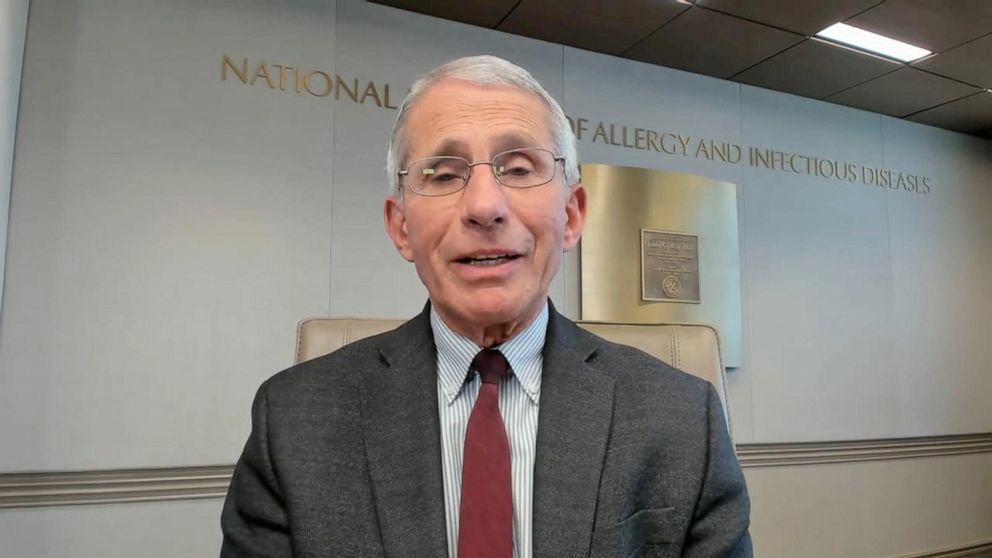
Fauci at one point tells others that the president “is on a separate channel” and unfocused in meetings, with “rudderless” leadership, according to Woodward. “His attention span is like a minus number,” Fauci said, according to Woodward. “His sole purpose is to get reelected.”
In one Oval Office meeting recounted by Woodward, after Trump had made false statements in a news briefing, Fauci said in front of him: “We can’t let the president be out there being vulnerable, saying something that’s going to come back and bite him.” Pence, Kushner, Chief of Staff Mark Meadows and senior policy adviser Stephen Miller tensed up at once, Woodward writes, surprised Fauci would talk in front of Trump that way.
Woodward describes Fauci as particularly disappointed in Kushner for talking like a cheerleader as if everything was great. In June, as the virus was spreading wildly coast to coast and case numbers soared in Arizona, Florida, Texas and other states, Kushner said of Trump, “The goal is to get his head from governing to campaigning.”
The president said he did this to avoid “panic” and a “frenzy," admitting a central revelation in the forthcoming book, “Rage,” by Washington Post associate editor Bob Woodward. “Trump’s comments came hours after excerpts from the book and audio of some of the 18 separate interviews he conducted with the author were released, fueling a sense of outrage over the president’s blunt description of knowing that he was not telling the truth about a virus that has killed nearly 190,000 Americans," Josh Dawsey, Felicia Sonmez and Paul Kane report. "Privately, however, the president realized the book would not be good for him politically. For weeks, he told advisers that Woodward’s book was likely to be negative … But the White House had done little to prepare for it, officials said. Initially, surrogates received bland talking points that included comments from White House press secretary Kayleigh McEnany’s Wednesday briefing. In a phone interview with Fox News’s Sean Hannity on Wednesday night, Trump was dismissive of the book. [He said he's too busy to read it.] …
“Trump encouraged others to speak with Woodwardand would often mention the journalist in conversations with other advisers, suggesting that he might call him again. Some of the conversations between the two men, a White House official said, were precipitated by Trump — who thought Woodward was more receptive to a favorable narrative about his presidency. There was widespread finger-pointing in Trump’s orbit Wednesday about the book and its revelations, but some advisers noted that Trump is the one who drove the decision to cooperate. … In a familiar routine on Capitol Hill, Republicans ducked from the latest Trump controversy, almost uniformly asserting they had yet to read Woodward’s book."
Woodward was criticized for not revealing Trump’s comments earlier. “Woodward said his aim was to provide a fuller context than could occur in a news story: ‘I knew I could tell the second draft of history, and I knew I could tell it before the election,'” writes media columnist Margaret Sullivan. "What’s more, he said, there were at least two problems with what he heard from Trump in February that kept him from putting it in the newspaper at the time: First, he didn’t know what the source of Trump’s information was. … Second, Woodward said, ‘the biggest problem I had, which is always a problem with Trump, is I didn’t know if it was true.’ … Woodward said he believes his highest purpose isn’t to write daily stories but to give his readers the big picture. ... Woodward’s effort, he said, was to deliver in book form ‘the best obtainable version of the truth,’ not to rush individual revelations into publication.”
A top DHS official says he was told to stop providing intelligence analysis on the threat of Russian interference.
“The official, Brian Murphy, who until recently was in charge of intelligence and analysis at DHS, said in a whistleblower complaint that on two occasions he was told to stand down on reporting about the Russian threat and alleged that senior officials told him to modify other intelligence reports, including about white supremacists, to bring them in line with Trump’s public comments, directions he said he refused,” Shane Harris, Nick Miroff and Ellen Nakashima report. “On July 8, Murphy said in the complaint, acting homeland security secretary Chad Wolf told him that an ‘intelligence notification’ regarding Russian disinformation efforts should be ‘held’ because it was unflattering to Trump, who has long derided the Kremlin’s interference as a ‘hoax’ that was concocted by his opponents to delegitimize his victory in 2016. … DHS’s intelligence reports are routinely shared with the FBI, other federal law enforcement agencies, and state and local governments. Murphy objected to Wolf’s instruction, ‘stating that it was improper to hold a vetted intelligence product for reasons [of] political embarrassment,’ according to a copy of his whistleblower complaint. …“The president’s political interests were often of greater concern to senior leaders at the department than reporting the facts based on evidence, Murphy alleges. He claims that Wolf and Ken Cuccinelli, [above] the department’s second-in-command, on various occasions instructed him to massage the language in intelligence reports ‘to ensure they matched up with the public comments by Trump on the subject of ANTIFA and ‘anarchist’ groups,’ according to the complaint. … [Murphy] was removed from his position and assigned in July to an administrative role, where he remains. His new assignment followed reports by The Post that his office had compiled ‘intelligence reports’ about tweets by journalists who were covering protests in Portland, Ore. In his complaint, Murphy called press coverage of his office’s activities ‘significantly flawed.’ … Murphy’s complaint prompted mixed reactions among former senior administration officials, who said he had valid and significant concerns but described him as a flawed messenger. … The House Intelligence Committee has asked Murphy to testify later this month.” (Read Murphy's 24-page complaint here.)
In 2016, Russians sitting in St. Petersburg, pretending online to be Americans, organized unwitting people in the U.S. to create jail cell-like cages for volunteers who played the role of Hillary Clinton in an orange prison jumpsuit. These displays showed up at numerous rallies around the country.
This year, someone spread the news online that “Antifa” activists were coming to the Gettysburg battleground to remove a statue of Civil War rebel leader Robert Lee. In response, a large number of unwitting and heavily armed Americans showed up ready for a fight. In Portland and other cities, pro-Trump groups have spontaneously appeared, armed for combat, carrying rebel and Trump flags and parading in caravans of pick-up trucks. Shootings and killings followed.
What role the Russians are playing this year in fomenting factionalism and violence in the U.S. is not yet publicly known. The Trump administration has tried to prevent counter-intelligence experts from providing details to the public and Congress. What those government specialists have said, however, is that Russia already has and is likely to continue to interfere in the U.S. electoral season in support of Trump. That warning is supported by research from non-government experts.
But Russia’s goal is not just the re-election of Trump. That is a means to an end. What Vladimir Putin seeks is to rip the social and political fabric of America, to create chaos, to sow public distrust in the government, and to set us at each others' throats. As Putin himself once said about what he thought the West was doing to Russia, “There are certain people who want us to be focused on internal problems, and they pull the strings here so we don’t raise our heads internationally.”
An America on the verge of a new civil war will not be an impediment to Putin’s revanchist desires for gaining back control of neighboring countries and spreading Russian power in the Middle East and elsewhere.
We should be concerned that Russia will go beyond instigating jail cell pantomimes to actively agitating violence in the U.S. Fueled by social media, armed groups are already on the streets of our country. What Putin has done in Russia may tell us how far he is willing to go here. In at least two incidents in his political career when Putin needed a bounce in support, suspicious terrorist incidents occurred, killing Russians and allowing Putin to gain political support for his harsh responses and his promises of law and order.
As reported in “Putin’s People” by Catherine Belton, in 1999, in three incidents over nine days in September, 243 people were killed by bombings of apartment blocks. What looked like a fourth bombing was prevented, but those caught in the fourth incident were Russian intelligence officers. Russians who investigated whether Putin was behind the bombings were poisoned and murdered.
Putin, however, gained great popularity, portraying himself as the defended of Russia from such terrorism. In 2002, a group of “terrorists” took hostages at a suburban Moscow theater. Putin ordered the theater gassed, resulting in the death of 115 hostages. Independent investigators and journalists later found evidence that the incident might have been staged by Russian intelligence using fake bombs and prisoners playing parts, encouraged by promises to be whisked out of the country after the incident. Instead, they were shot dead on the site. Putin’s popularity again soared for his courageous (though botched) response to terrorism.
Alexi Navalny
In 2020, faced with massive protests against his allied autocrat in Belarus and large scale demonstrations in the Russian Far Eastern city of Khabarovsk, Putin again seems to have opted for a lethal response from his intelligence services. Fearing that the opposition leader Alexi Navalny would succeed in rallying a large protest vote in upcoming regional elections, Putin seems to have ordered him killed by use of a nerve gas (Novichok) made and possessed only by Russian security services. It is the same gas that the British government says was used by Russian intelligence agents in an attempted assassination of a Putin opponent living in England.
We should brace ourselves for violence and lethal force being employed for political purposes in the U.S. in the weeks before the election and in the weeks after, when the results are likely to be contested. Incidents may occur and be blamed on “Antifa.” Armed militias may engage peaceful protestors with increased violence. Those pulling the trigger may be unwitting American dupes, but orchestrating it will be the man in the Kremlin. Joe Biden and Kamala Harris should warn the American people about what may be coming.
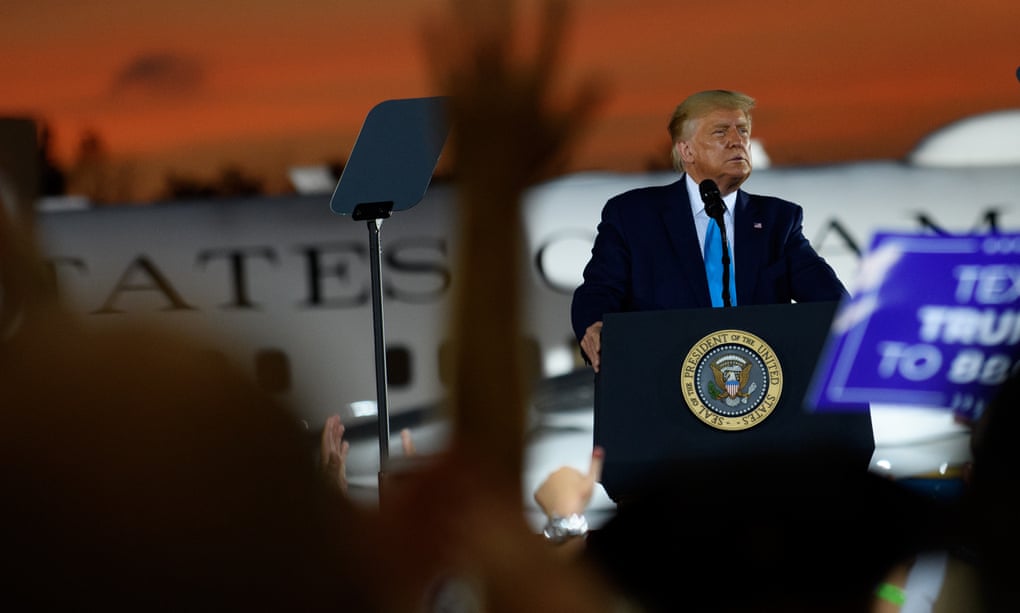
It was just like old times. Donald Trump stood at a presidential lectern, encouraging a rambunctious crowd of supporters – few of whom wore face masks or physically distanced – to turn and boo the “fake news” media. Behind him Air Force One bathed in a glorious sunset, a huge US flag dangled from a crane and two giant signs declared, “Make America great again!”
Thursday’s outdoor campaign rally at an airport hangar in Latrobe, Pennsylvania, carried echoes of 2016 when Trump whipped up excitement in unglamorous corners of battleground states to overthrow conventional wisdom and edge out Hillary Clinton. Once again, Trump is drawing bigger and noisier crowds than his rival Joe Biden.
But in 2020 the political crystal ball is cloudier than ever.
It was President George W Bush’s defense secretary, Donald Rumsfeld, who once ruminated on “known knowns”, “known unknowns” and “unknown unknowns – the ones we don’t know we don’t know”. The 2020 presidential election is now a smorgasbord of all three.
Can the opinion polls be trusted, or are they missing “hidden” Trump voters? Could Biden, like Clinton, win the popular vote but lose the electoral college? Will people vote by mail, despite the president’s efforts to undermine the postal service, or feel safe queuing to vote on election day in the middle of a global pandemic? Will the result be known on election night or take days or even weeks? Could the result – like 2000 – by decided in the courts?
“You couldn’t script this any worse, short of hurricanes and earthquakes taking place at the same time across the country,” said Tara Setmayer, a political analyst and former Republican communications director on Capitol Hill. “It is a cacophony of chaos being mixed together all at once as we approach election day.”
The miasma of uncertainty was apparent over the past week when a batch of polls and burst of campaigning gave conflicting signals. Some observers were adamant they showed Biden holding on to a solid lead of seven or eight percentage points, higher than Clinton’s at the same stage, and praised him for displaying both empathy and steeliness in a series of speeches. “5 reasons Biden’s odds of victory look better than ever,” ran a headline in New York magazine on Thursday.
Others, however, detected a shift in momentum and polls tightening, especially in swing states. “Of course Trump can win,” ran a headline in the Washington Post. Film-maker Michael Moore wrote: “I’m warning you almost 10 weeks in advance. The enthusiasm level for the 60 million in Trump’s base is OFF THE CHARTS! For Joe, not so much.” There was panic that Biden has been thrown on to the back foot by Trump’s demand for “law and order”.Supporters of Donald Trump cheer as he arrives to speak during a campaign rally at Arnold Palmer regional airport in Latrobe. Photograph: Evan Vucci/AP
The sense of lost bearings is compounded by less traditional metrics, ranging from social media activity – Russian meddling and all – to anecdotal counts of campaign signs in voters’ front gardens to some pandemic-induced tactical wild cards. The Politico website reported last month: “Trump’s campaign knocks on a million doors a week. Biden’s knocks on zero.”
Overshadowing it all are the cascading crises of public health, economic recession, racial injustice and a president waging asymmetric warfare in his willingness to say or do anything to retain power.
Monika McDermott, a political science professor at Fordham University in New York, said: “It’s just a perfect storm of dysfunction. That’s what we’re looking toward right now. It’s a road we’ve never travelled before.”
Trump’s stunning upset win in 2016 led to a widespread belief that the polling industry is fundamentally broken. In fact the national polls were generally accurate in predicting that Clinton would win the popular vote by nearly 3m ballots. But they failed to spot how Trump would thread the needle of winning Michigan, Pennsylvania and Wisconsin by a combined total of fewer than 80,000 votes.
Axios recently warned that the public should have “even less confidence” this time around, arguing that the flaws in state polling persist because there are not enough big sample surveys that take into account typical Trump voter demographics, such as people who did not attend university.
Axios also noted that the pandemic is expected to lead to a record number of mail-in ballots but the postal service lack experience and states could struggle to process them. People’s ability to vote in-person on 3 November is another known unknown, for example due to shortages of poll workers.
McDermott added: “The reports of the death of polling were much exaggerated and too soon: the national polls nailed Hillary Clinton’s vote. It was much more accurate on a national level than it had been in either of the previous two presidential elections. For that, the polling industry deserves huge kudos because it was a relatively unknown situation with Donald Trump’s candidacy.
“But I think the problem was that we don’t have enough polling in the states to know what’s going to happen with the electoral college so we can’t run the kind of reliable averages or things like that that we do for the national vote.”
Horse race narratives in the media are also shaped by perception.
Peaceful protests in Kenosha, Wisconsin, and elsewhere tend to pass unremarked but scenes of burning buildings and looting draw cameras and received wall-to-wall exposure on the conservative Fox News network. Trump seized on the images with a racially divisive message to accuse Democratic state governors and mayors of appeasing “domestic terrorists” and warn that a Biden victory would bring similar carnage to every city and suburb.
The former vice-president was forced to respond, and travelled to Kenosha two days after Trump, fueling commentary that he was on the defensive and losing control of a narrative that he wanted to focus on Trump’s mishandling of the virus. Alarm bells have also been rung by everything from Fox News’s high ratings to the popularity of conservative pundits on social media.
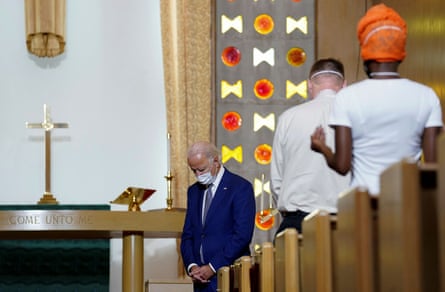
Joe Biden bows his head in prayer during a community meeting at Grace Lutheran church in Kenosha, Wisconsin. Photograph: Kevin Lamarque/Reuters
Kevin Roose of the New York Times wrote: “Listen, liberals. If you don’t think Donald Trump can get re-elected in November, you need to spend more time on Facebook.”
Roose detailed how his analysis of partisan content on the platform found that conservative politicians, pundits and topics dominate. “Pro-Trump political influencers have spent years building a well-oiled media machine that swarms around every major news story, creating a torrent of viral commentary that reliably drowns out both the mainstream media and the liberal opposition,” he added.
To illustrate the point, a visit by Nancy Pelosi, the Democratic House speaker, to a hair salon in San Francisco, where she was seen indoors without a face mask in violation of the city’s health guidelines, got little mainstream media coverage but was the number one story on Facebook. It was also amplified by Fox News, adding to worries that, in this polarised society of self-affirming bubbles, no one can see the full picture.
Some longtime observers believe that Trump’s strength may be underestimated, an effect magnified by the arbitrary distortions of the electoral college. Larry Sabato, the founder and director of the University of Virginia’s Center for Politics, said: “Everybody laughs about this because I’m a stats guy and you’re not supposed to do anything that’s not based on the data, but my scientific method leads me to add a point or two to Trump because there is actually a small hidden Trump vote.
“There is. We all know it. We’ve seen it in our offices and in our families. They’re always the silent ones. They don’t tell you they’re for Biden or for Clinton. They just don’t say. They’re ‘undecided’ or ‘I just hate the way it’s so negative’. Those kind of comments are a dead giveaway.”
Sabato added: “So it’s a point or two and then you have to add another couple of points for the electoral college. Trump lost the popular vote by two points in 2016, but he could lose it by three or four and probably win this time around. No Democrat will ever be able to do it but for a Republican it’s easy.”The pandemic is expected to lead to a record number of mail-in ballots but the postal service lack experience and states could struggle to process them. Photograph: Logan Cyrus/AFP/Getty Images
“So you’re adding three, three and a half points to where he is in the polls. It’s close. Biden’s still ahead. Biden should win but it’s close enough so that this would not take some kind of massive dramatic turnaround for Trump to win, assuming things go well for him.”
To top it all, Biden is the oldest major party nominee in history, running mate Kamala Harris is the first woman of colour on a major party ticket and Trump himself is perhaps the least predictable candidate in history.
Setmayer, the host of the Honestly Speaking podcast, said: “Conventional wisdom has been thrown out the window since Donald Trump came down the escalator [to launch his campaign at Trump Tower] in 2015 and his tenure as president has only reinforced the fact that we don’t know anything about how things will play out.”
She added: “One of the strategies that Trump employs is chaos, and he thrives in that environment, that’s the way he’s governed and that’s the way he’s campaigning.”
Democrats are often accused of “quadrennial bedwetting” ahead of elections which is, at least, a safeguard against complacency. The known unknowns include three presidential debates that could change the trajectory of the race. Trump may yet spring an “October surprise” by announcing a Covid-19 vaccine. And in 2020 of all years, there are bound to be unknown unknowns.
John Zogby, a pollster and author, acknowledged that “Trump is on the ropes” but added: “It’s competitive. It looks especially competitive in the battleground states. So I would say at this point, 60-40 Biden. Which means I would bet you $50 – but I wouldn’t bet you $500.”
At 121 degrees, Los Angeles County hit its highest temperature ever recorded this weekend, as the state swelters in a heat wave that has helped intensify the most devastating wildfire season California has experienced in years.
The record temperature was measured in Woodland Hills, northwest of downtown Los Angeles.
The "kiln-like" heat was exacerbated by a high-pressure system and a weak sea breeze, according to the National Weather Service.
NWS Meteorologist Dave Bruno toldThe New York Times that these factors "allowed basically the entire region to roast." Several other locations in the state also faced scorching temperatures.
The heat contributed to the death of a 41-year-old hiker, who died Saturday from a heat-related seizure after hiking at Tapia Park in Malibu Creek State Park for several hours, L.A. County Sheriff's officials told CNN. After her death, officials decided to close all hiking trails in the Santa Monica Mountains through Labor Day.
"Do not hike this holiday weekend, especially with dogs," Malibu Search and Rescue said.
Late Monday, the U.S. Forest Service announced it would close eight national forests in Southern California because of the conditions.
California firefighters are currently battling dozens of active blazes that have so far consumed more than 1.8 million acres, damaged over 3,800 structures, and killed seven people. Many of the fires were caused by lightning strikes, but the El Dorado Fire in San Bernardino County was caused by "a smoke generating pyrotechnic device used during a gender reveal party," the California Department of Forestry and Fire Protection said.
That fire, which began Saturday morning, spread north and quickly consumed more than 7,000 acres. More than 500 people, 60 fire engines and six helicopters were fighting the blaze, which was only 5 percent contained by Sunday night.
2020 has now seen the most acres burned in California than any other year during the modern era, according to Daniel Swain, a climate scientist at UCLA.
But some small relief could be coming. Weakening high pressure and a stronger sea breeze will lead to "some decent cooling across the coast today," NWS Los Angeles tweeted Monday. "A little less cooling inland but it won't be nearly as oppressive as yesterday! Just one more day of heat before we get a break! We got this!"
Police remained tight-lipped here on Monday about a fatal shooting that occurred over the weekend after confrontations between supporters of President Trump and Black Lives Matter counterprotesters, with some local officials fearing the violent incident might beget more mayhem.
The Portland Police Bureau identified the slain man as 39-year-old Aaron J. Danielson, of Portland, and said he had died of a gunshot wound to the chest. Friends of Danielson, who also went by "Jay," said he was a supporter of the far-right group Patriot Prayer. The group alleges that Danielson might have been targeted because he was wearing a hat that bore its insignia.
The incident came after a caravan of Trump supporters — among them, the Patriot Prayer group — made their way through Portland, sparking skirmishes with those who objected to their presence. It again put on edge a city that has seen three months of nightly demonstrations, some of them violent, and sparked political consequences across the country.
Trump had on Sunday retweeted a video showing his supporters driving into Portland, adding the message, “GREAT PATRIOTS!” On Monday, he said the Departments of Justice and Homeland Security would create “a joint operations center to investigate the violent left-wing civil unrest.” Noting that 100 people in Portland have already been arrested on federal charges, the president said the “violence and destruction that we’ve seen in recent weeks and months has occurred in cities exclusively controlled and dominated by the Joe Biden party.”
Law enforcement officials, including Trump’s own attorney general and Justice Department, have attributed the violence at some nationwide demonstrations to a wide array of political actors, including those on the right. Patriot Prayer has a history of organizing rallies in the Pacific Northwest that spark conflict. The stated aim of Patriot Prayer, organized in 2016 to bring pro-Trump rallies to liberal bastions, is to “liberate the conservatives on the West Coast.”
Even though Saturday’s shooting was captured on video, the precise details of what happened — and why — remain unclear.
In one video posted online, men can be heard shouting, followed in rapid succession by the sound of something spraying and then two gunshots.
Justin Dunlap, a lighting technician from nearby Vancouver, Wash., who recorded the widely circulated video and broadcast it live on Facebook, previously told The Washington Post he heard yelling and saw mace being sprayed. Then gunshots rang out.
Dunlap, 44, said that when the gunshots were fired, “the guy who had sprayed the bear mace turned and took three or four steps and then went face down. While he was doing that, the two that he had bear-maced ran back in my general direction and kind of went around the corner.”
In a taped interview posted online, Chandler Pappas, who said he was with Danielson during the shooting, said whoever fired the shots “recognized our Patriot Prayer hats,” and just before gunfire rang out, he heard someone say, “We’ve got a couple of ‘em right here. Pull it out. Pull it out.”
“It didn’t even register that somebody was pointing a gun at us until the shots went off,” Pappas said. “Jay’s dead because he believed something different than them.”
Pappas told The Washington Post that Danielson was “killed in cold blood” but did not provide other details.
Joey Gibson, the founder of Patriot Prayer, said that the incident occurred after the Trump caravan had broken upand that Pappas had told him a similar account to what he said in the online interview.
Authorities have not released a detailed account of the incident.
A night of relative peace unfolded the day after Saturday’s mayhem, though officials still said they were worried about possible retaliation.
“For those of you saying . . . that you plan to come to Portland to seek retribution, I’m calling on you to stay away,” Portland Mayor Ted Wheeler said Sunday. “You of course have a constitutional right to be here, but we’re asking you to stay away and work with us to help us de-escalate the situation.”
The protesters who had gathered at Laurelhurst Park for the city’s nightly protest numbered around 100 on Sunday. It was smaller than past marches in this city, but by nightfall, police said, around 150 had amassed to gather in front of the Penumbra Kelly city building, which houses some police services.
Fran Bittakis, founder of Snack Bloc, a mutual aid group that provides water, snacks, medical supplies and protective equipment to demonstrators, said that in the wake of Saturday’s events, further escalation felt inevitable. She was among those who had gathered at the park.
“People should be scared,” she said. “Nobody wanted anyone to get killed. I think the thing is that now that it is someone on that side of things, it’s a very retaliatory [fear] — that’s what we are all feeling that can happen.”
That fear has also encouraged the protesters to become more vigilant about facing down the threats.
“We don’t have vests, we don’t have the gear that they have, we haven’t been training in military tactics and theory,” she said. But the fear ramps up every weekend of outside groups coming into town to stir things up, and that concern had grown further after Saturday’s violence.
The Portland shooting came on the heels of a violent incident during unrest in Kenosha, Wis., over the police shooting of 29-year-old Jacob Blake. Amid demonstrations there, a 17-year-old wielding an AR-15-style rifle shot and killed two men and injured a third, authorities allege.
Local officials and residents were preparing for Trump’s planned visit to the city on Tuesday, and some said they wished the president would delay his trip, citing the city’s need to heal after the recent chaos. Trump on Monday suggested that the 17-year-old facing murder charges in Kenosha was forced to defend himself.
“You saw the same tape I saw, and he was trying to get away from them I guess, it looks like, and he fell, and then they very violently attacked him. And it’s something we’re looking at right now and it’s under investigation,” the president said. “I guess he was in very big trouble — he probably would have been killed — but it’s under investigation.”
After the shooting, Oregon Gov. Kate Brown (D) issued a statement denouncing “the right-wing group Patriot Prayer and self-proclaimed militia members” who she said “drove into downtown Portland . . . armed and looking for a fight.”
Brown also released what her office said was a plan to bolster the law enforcement response in Portland. Under the plan, the Oregon State Police would dispatch personnel so the Portland police can focus on arresting and charging “those engaging in violent acts,” Brown’s office said in the statement.
The local district attorney will prosecute offenses such as arson and physical violence, her office said, while the sheriff’s office would make sure there is jail space to hold people “booked for violent behavior.” Brown said other local and federal officials would also help.
On Sunday, activists chanted and yelled taunts at police as they blared loud music and gathered in the street. Police declared an unlawful assembly about 10:40 p.m. Officers bull-rushed activists — pinning down several of them — fired pepper balls and made arrests. It was the first of several such responses by police Sunday, who were aided by an additional phalanx of Oregon State Police after Saturday’s clashes. The Portland Police Bureau said it ultimately arrested 29 people after declaring an unlawful assembly in the area.
The arrests seemingly came at random and targeted anyone who was seen violating the unlawful assembly order by remaining in the street. Demonstrators were mostly held for alleged disorderly conduct and interfering with police officers. But the added police from the state level led to some coordination issues and confusion.
Gabriel Trumbly, 29, a paralegal who runs a photography business and has been documenting the protests, was abruptly shoved to the ground, handcuffed and held before being released less than an hour later. Trumbly, wearing gear clearly marked “PRESS,” was told he had been interfering. His release came after Portland police at the site asked state police why he had been arrested.
“I was standing for a minute and a sergeant came over was like, ‘Where’s the press guy? You’re getting out of here. Sorry about this,’ ” Trumbly recalled.
Trumbly said he saw a line of about 25 people inside waiting to be processed. It was calmer than the scenes outside.
“They definitely slammed my head to the ground, but the helmet probably helped me on that one,” he said.
The city should launch an independent investigation of a possible work slowdown by NYPD officers, say a pair of pols from Brooklyn and the Bronx.
“Violence, especially gun violence, is heading in the wrong direction. So are NYPD response times,” Councilman Ritchie Torres (D-Bronx) told the Daily News on Sunday. “If you think those are purely coincidental, then I have the Brooklyn Bridge to sell you.”
He and Brooklyn Borough President Eric Adams recently wrote Department of Investigation Commissioner Margaret Garnett urging her to probe “whether there is in fact a work [slowdown] and to what extent crime has risen as a result.”
The duo cited spiking crime numbers and a published report suggesting there is a slowdown.
Councilman Ritchie Torres (D-Bronx) recently wrote Margaret Garnett, commissioner of the Department of Investigations. (Angus Mordant/Angus Mordant)
Shooting incidents underwent a shocking 83% change from Jan. 1 to Aug. 23 compared to the same time frame last year, according to NYPD data. Murders had a 34.6% change.
Meanwhile, the NYPD is taking longer to respond to crimes than last summer, according to a NY1 report cited in Torres and Adams’ letter. Last month, the average response time was nine minutes and 41 seconds, up from eight minutes and 29 seconds a year earlier, the outlet reported.
“We have heard in recent months from a number of alarmed officers who are still on the force,” Adams said in a statement. “We urge the NYPD to cooperate fully so we can restore public trust and continue the vital work of keeping our city safe.”
Brooklyn Borough President Eric Adams recently wrote Margaret Garnett, commissioner of the Department of Investigations. "We are hereby requesting the New York City Department of Investigation (DOI) to investigate whether there is in fact a work slowdown and to what extent has crime has risen as a result." (Theodore Parisienne/New York Daily News)
Mayor de Blasio and NYPD brass have denied there’s a slowdown, with Police Commissioner Dermot Shea saying earlier this month, “When I hear that, it makes my blood boil. It’s absolutely not true.”
De Blasio’s office and the Department of Investigation, which has probed police handling of recent protests, did not immediately answer requests for comment.
“There’s certainly a perception among members of the public as well as elected officials that the growth in violence is driven by a slowdown,” said Torres, who chairs the Council’s Committee on Oversight and Investigations. “What we need is neither under-policing nor over-policing; what we need is balance.”